
 +86-(0)512-82283871
Content
- 1 Product Overview: A Travel-Smart Power Chair Built for Everyday Use
- 2 Core Specifications
- 3 Automatic Folding: Why It Matters
- 4 Joystick Control and User-Friendly Operation
- 5 Comfort-Oriented Design: Foot Platform, Suspension, and Seat Experience
- 6 Performance and Power: Dual Motor Capability
- 7 Safety Features for Confident Daily Mobility
- 8 Advantages Over Conventional Electric Wheelchairs
- 9 Travel-Smart Design for Cars, Homes, and Public Spaces
- 10 Battery Options and Range Planning
- 11 Manufacturing Strength Behind the Product
- 12 Advanced Production Processes and Quality Control
- 13 Design Philosophy: Independence, Dignity, and Practical Convenience
- 14 Market Position and Competitive Value
- 15 Use Scenarios
- 16 Buyer Considerations
- 17 Q&A Section
- 17.1 Question 1: What is the main advantage of this automatic folding electric wheelchair?
- 17.2 Question 2: Is the joystick controller suitable for left-handed and right-handed users?
- 17.3 Question 3: What is the driving range?
- 17.4 Question 4: What battery options are available?
- 17.5 Question 5: How fast can the wheelchair travel?
- 17.6 Question 6: Does the wheelchair have suspension?
- 17.7 Question 7: What type of brake system is used?
- 17.8 Question 8: Is it suitable for travel by car?
- 17.9 Question 9: What is the weight capacity?
- 17.10 Question 10: Who manufactures the product?
- 18 Conclusion: A Balanced Solution for Modern Personal Mobility
- 19 References
- 20 Product: iFold PLUS Automatic folding electric wheelchair with joystick controller hot sale
Modern personal mobility is no longer defined only by the ability to move from one place to another. For many older adults, people with limited mobility, caregivers, travelers, and active families, the ideal mobility solution must combine independence, compact storage, simple operation, reliable safety, and travel-ready convenience. The automatic folding electric wheelchair described in this article is designed around those exact priorities. It is a compact, joystick-controlled, travel-smart power wheelchair that folds automatically, supports daily movement, and helps users manage indoor spaces, outdoor paths, transportation, and storage with less effort.
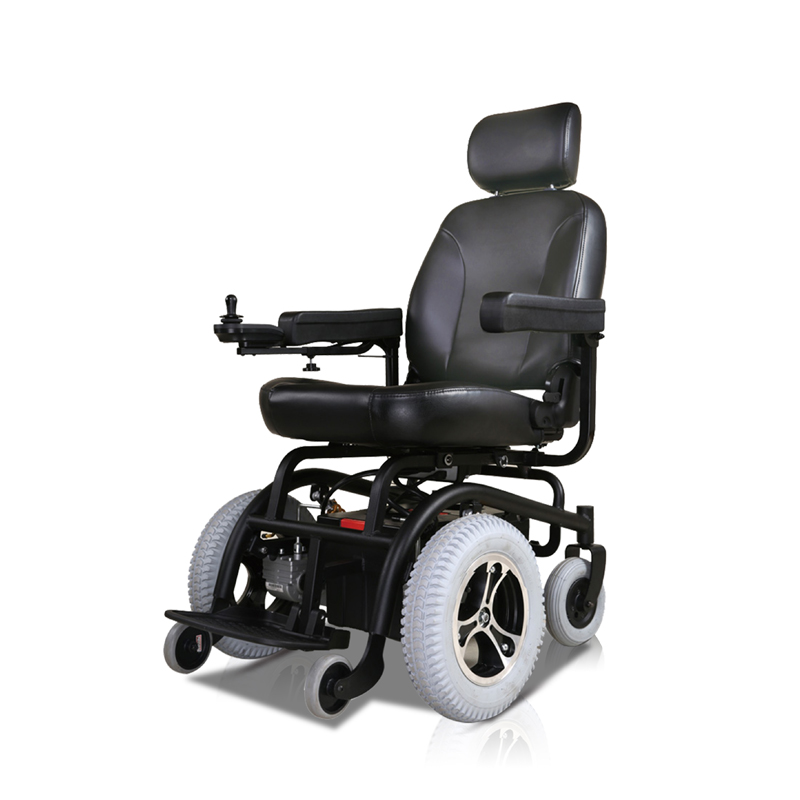
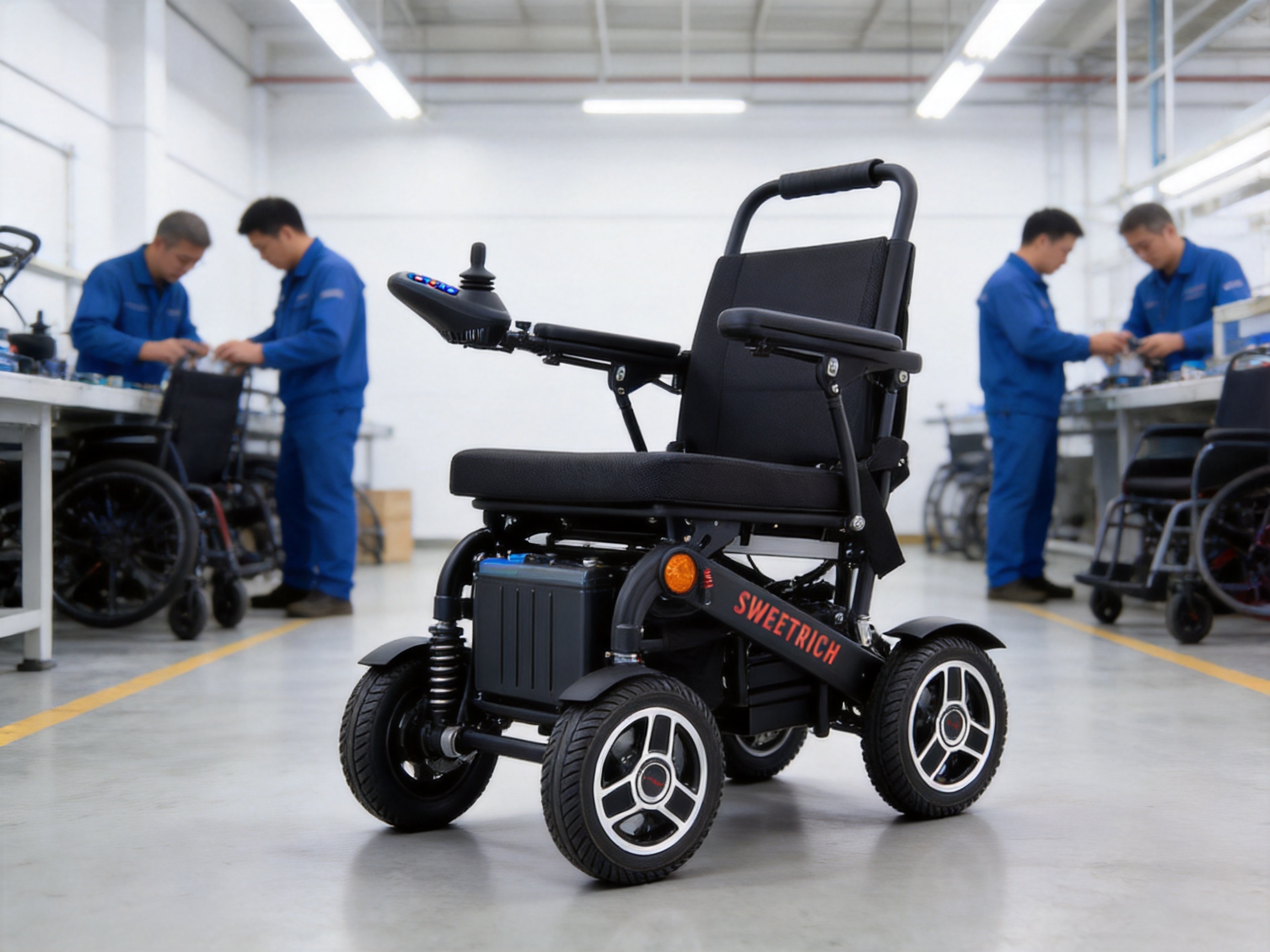
This product belongs to the travel smart wheelchair category and is built as a non-medical mobility device for the U.S. market where applicable. Its design is centered on practical daily assistance rather than complicated operation. Key features include automatic folding, a large foot platform, front and rear suspension, electromagnetic braking, dual high-efficiency motors, under-seat storage, optional battery capacities, and a joystick controller that can be configured for use on either side. These details make it especially suitable for users who value comfort, easy handling, and portability in one integrated solution.
Compared with many conventional electric wheelchairs, this model stands out because it directly addresses a common challenge: how to combine powered mobility with true portability. Standard power wheelchairs may offer stability and strength, but they are often heavy, bulky, and difficult to load into vehicles or store in small homes. Lightweight manual wheelchairs may fold, but they require physical effort from the user or caregiver. This automatic folding electric wheelchair offers a balanced alternative by providing electric drive performance, compact folding convenience, and user-friendly operation.
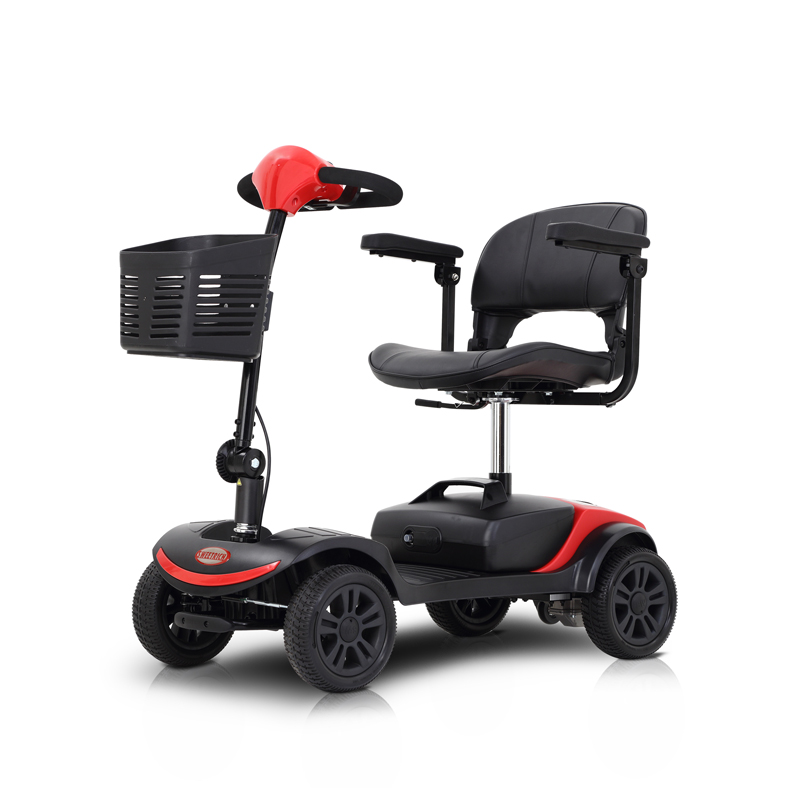
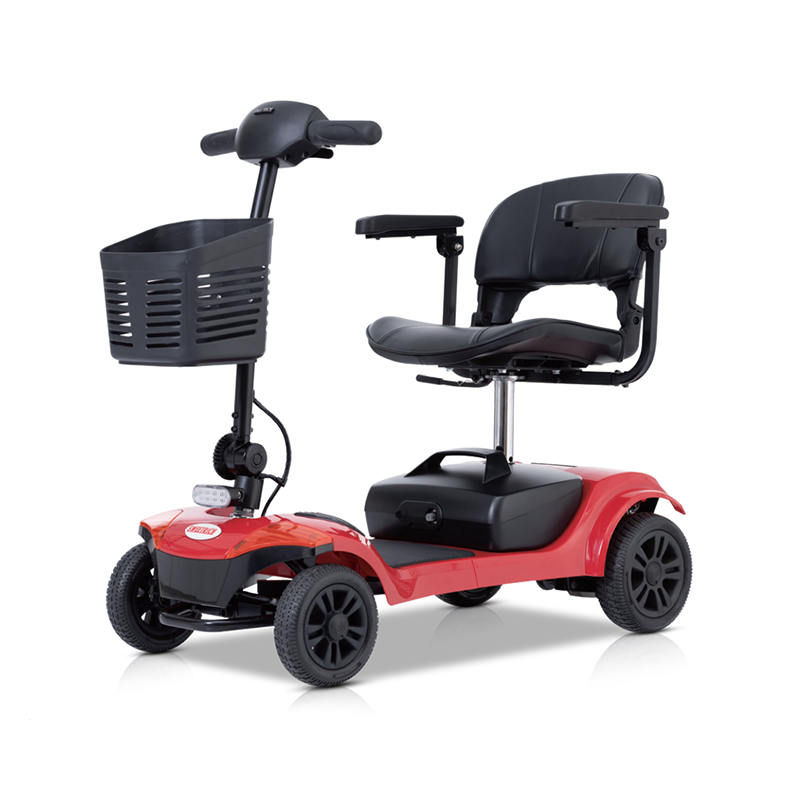
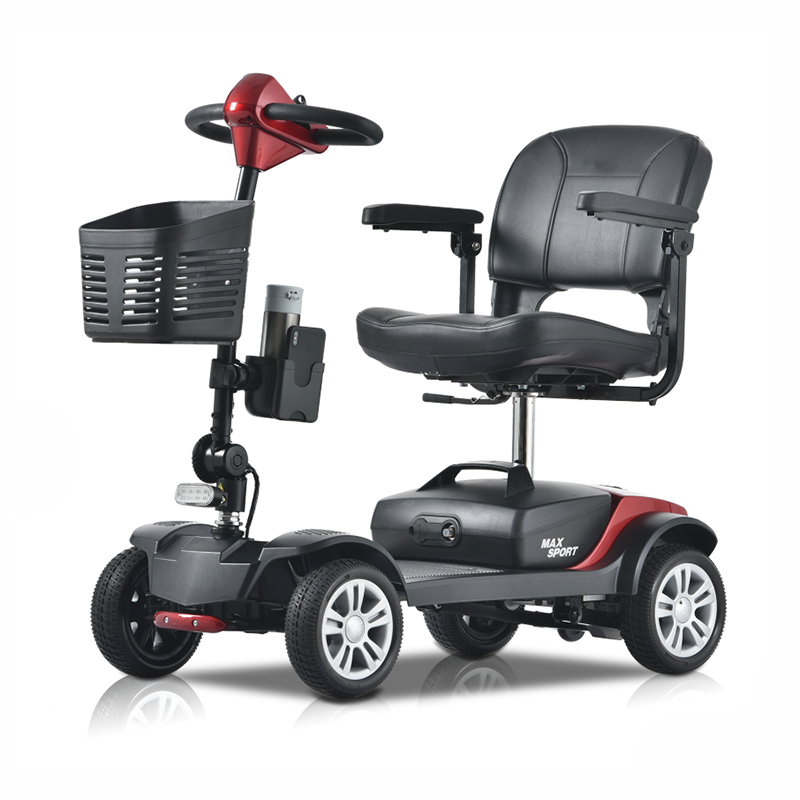
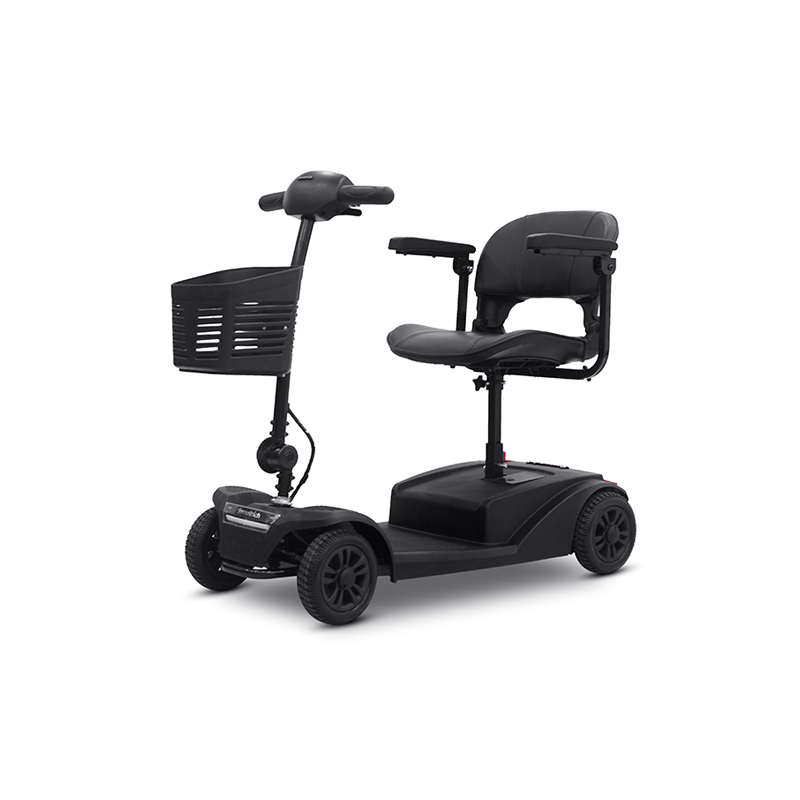
iFold PLUS Automatic folding electric wheelchair with joystick controller hot sale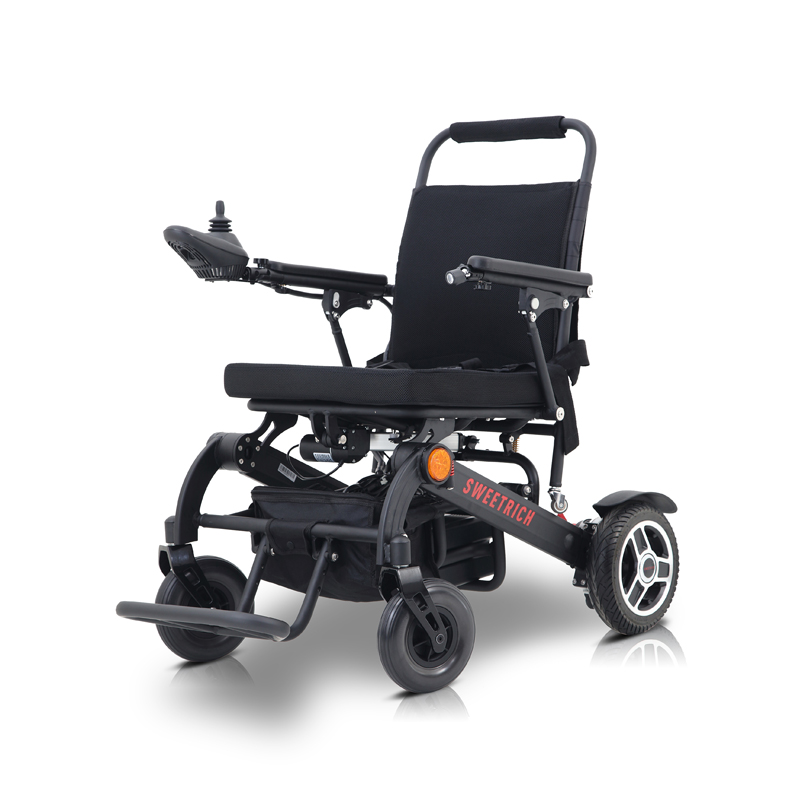
Product Overview: A Travel-Smart Power Chair Built for Everyday Use
The automatic folding electric wheelchair is designed for people who want a dependable mobility solution that can adapt to multiple daily scenarios. It can be used for neighborhood travel, shopping, family visits, leisure activities, and movement through large indoor spaces such as community centers, apartment buildings, hotels, and transport terminals. Its compact folding structure allows users and caregivers to reduce storage volume quickly, while its electric drive system helps reduce the physical strain associated with manual pushing.
One of the most important features is automatic folding. A folding mechanism is valuable only when it is easy to activate and dependable in repeated use. The automatic folding design helps reduce the need for bending, lifting, or manually locking multiple frame sections. For many users, this makes the wheelchair more manageable at the beginning and end of a journey. For caregivers, it reduces handling time and improves convenience when moving the chair into a car trunk, hallway, storage area, or travel accommodation.
The wheelchair is equipped with a joystick controller that can be installed for left-side or right-side use. This is a practical advantage because users have different dominant hands, strength levels, and comfort preferences. A controller that supports both-side configuration allows the product to better fit individual needs without requiring an entirely different model. In the mobility industry, small ergonomic details often determine whether a product is comfortable over the long term. A flexible joystick setup shows that the design is based on real-world user scenarios.
Another notable advantage is the large foot platform. Foot placement affects comfort, posture, and confidence while riding. A narrow or awkward footrest can make users feel restricted, especially during longer outings. The large foot platform gives users more stable support and a more comfortable seated position. Combined with the chair’s suspension system, it helps create a smoother and more secure experience over ordinary surfaces.
The product also includes an under-seat storage bag, a feature that can easily be overlooked but is highly useful in daily life. Users often need to carry small personal items such as keys, documents, medication packs, shopping items, mobile phones, chargers, or water bottles. The under-seat bag improves convenience without increasing the overall footprint of the chair. It supports the travel-smart concept by making the wheelchair not only a mobility device but also a practical daily companion.
Core Specifications
The following table summarizes the main specifications of the automatic folding electric wheelchair. Some performance figures may vary depending on battery configuration, market requirements, user weight, terrain, tire condition, and operating environment.
Specification |
Details |
Overall Dimensions |
1090 mm length x 605 mm width x 998 mm height |
Maximum Forward Speed |
6 km/h listed configuration; selected feature configurations may support speeds up to approximately 8.5 km/h or 5.2 mph depending on market setup |
Maximum Driving Gradient |
10 degrees |
Maximum Driving Range |
30 plus or minus 5 km depending on battery and conditions |
Weight Capacity |
120 kg or 265 lbs |
Suspension |
Front and rear suspension |
Tire Size |
8 inch front tires and 10 inch rear tires |
Brake System |
Electromagnetic brake |
Battery Options |
Lithium 24 V, 10.2 Ah or 20 Ah; optional higher-capacity battery configurations may be available up to 30 Ah |
Charger |
DC 24 V 2 A, AC 115 to 230 V |
Charging Time |
Approximately 5 hours depending on battery condition and capacity |
Motor |
24 V, 250 W x 2 pieces |
Motor Controller |
24 V, 50 A |
Weight Without Battery |
24 kg |
Automatic Folding: Why It Matters
Folding is one of the most important functions in a travel-oriented electric wheelchair. In a traditional wheelchair, folding may require the user or caregiver to manually release locks, push frames together, remove components, or perform several steps in the correct sequence. If the chair is heavy, the process can be inconvenient. If the folding procedure is complicated, it may discourage users from taking the chair on outings. Automatic folding simplifies this experience.
With automatic folding, the chair is designed to reduce the physical effort required to transform it from riding mode to storage mode. This can be especially helpful in car travel, public facility access, elevators, apartments, and family homes where space is limited. A compact folded shape also makes the product easier to move after folding. The provided feature set specifically highlights that the chair is easy to move after folded, which is a crucial distinction. A chair that folds but remains awkward to handle does not fully solve the portability problem.
The automatic folding function also gives the product a clear advantage over many competing electric wheelchairs that rely on manual folding or partial disassembly. Some portable power chairs require battery removal, seat removal, or frame separation before loading. While these designs may reduce single-piece weight, they add time and complexity. This model’s integrated folding concept is better aligned with users who want quick preparation and fewer handling steps.
In daily life, convenience influences independence. If a user knows that the chair can be folded without complicated procedures, they may be more willing to participate in social activities, travel with family, visit outdoor spaces, or run errands. The value of automatic folding is therefore not limited to storage. It can support a more active lifestyle by lowering the practical barriers that often prevent users from leaving home.
Joystick Control and User-Friendly Operation
The joystick controller is one of the most user-facing parts of any electric wheelchair. It must be intuitive, responsive, and positioned comfortably. The controller on this model is available for use on both sides, which means it can be arranged according to the user’s preference or physical ability. For users with stronger control in one hand, this flexibility is essential. For distributors and care providers, it also means the same product can serve a wider range of users.
A joystick-controlled wheelchair offers a direct and natural driving experience. The user can control forward movement, turning, and stopping from a seated position without manual propulsion. This is especially helpful in indoor environments where tight turning and precise movements may be needed. A well-positioned joystick can reduce fatigue because the user does not need to push wheels or rely entirely on caregiver assistance.
Compared with scooter-style tiller controls, joystick control can also improve maneuverability in compact spaces. Mobility scooters are excellent for many users, but their longer turning radius and handlebar-style steering may make them less convenient in narrow hallways or crowded indoor areas. A joystick-controlled wheelchair is often better suited for mixed indoor and outdoor use because it allows more compact directional control.
For safety and comfort, electric control must work together with braking and motor response. The wheelchair uses an electromagnetic brake system, which supports reliable stopping performance. This is particularly valuable on slopes, ramps, and transitions between surfaces. A braking system that responds consistently helps the user feel confident while operating the chair.
Comfort-Oriented Design: Foot Platform, Suspension, and Seat Experience
Comfort is not a luxury in mobility equipment; it is a foundation of practical usability. A chair that is uncomfortable may be used less often, even if it has strong technical specifications. This product incorporates comfort-focused elements such as a large foot platform, front and rear suspension, and balanced tire sizing. Together, these features help create a more pleasant ride for daily mobility.
The large foot platform supports a stable seated posture. When the feet are properly supported, the user can feel more secure during starting, stopping, and turning. A generous foot platform also makes entry and exit feel less cramped. This is important for older adults and users who may have stiffness, reduced flexibility, or difficulty adjusting their foot position quickly.
Front and rear suspension improves ride comfort by helping absorb surface irregularities. In real-world use, users may encounter sidewalk joints, door thresholds, paved paths, shopping center surfaces, and minor uneven ground. Suspension helps reduce the vibration and jolts that can occur when moving across these surfaces. While the chair is not intended for extreme terrain, the suspension contributes to smoother travel in ordinary environments.
The tire arrangement uses 8 inch front tires and 10 inch rear tires. Larger rear tires can help with stability and rolling performance, while front tires support steering and maneuverability. This combination reflects a balance between compact design and ride quality. In many travel smart products, manufacturers must carefully manage size, weight, and wheel dimensions. If the wheels are too small, comfort may suffer. If they are too large, the chair may become harder to fold and store. This model’s tire sizing supports both portability and practical use.
Performance and Power: Dual Motor Capability
The wheelchair is powered by two 24 V, 250 W motors. A dual-motor configuration is common in high-quality electric wheelchairs because it allows independent control of left and right drive wheels. This supports turning, maneuverability, and stability. For a user, the benefit is simple: the chair can respond effectively to joystick input and provide dependable movement in varied daily environments.
The motor controller is rated at 24 V and 50 A, supporting coordinated power delivery between the battery, motors, and user controls. In an electric wheelchair, the controller is a key component that influences acceleration, turning response, braking coordination, and overall driving smoothness. A high-performance control system helps create predictable behavior, which is essential for user confidence.
The listed maximum forward speed is 6 km/h, which is appropriate for controlled mobility in many everyday environments. Product feature information also indicates that some configurations may support speeds up to 8.5 km/h or 5.2 mph. This difference can reflect model configuration, market rules, battery setup, or controller programming. In practice, many users value smooth and safe control more than high top speed. A travel smart wheelchair should prioritize confidence, stability, and manageable operation.
The maximum driving gradient is listed as 10 degrees. This indicates capability for typical ramps and mild inclines, though users should always follow operating guidance, consider surface condition, and avoid unsafe slopes. The combination of dual motors and electromagnetic braking helps the chair manage everyday gradient situations with greater assurance than purely manual wheelchairs or lower-powered compact devices.
Battery capacity affects range, convenience, and travel planning. The wheelchair supports lithium battery options such as 24 V 10.2 Ah and 20 Ah, with optional higher-capacity configurations mentioned up to 30 Ah for extended distance. The maximum driving range is listed as 30 plus or minus 5 km, depending on conditions. For many users, this range is sufficient for daily outings, shopping trips, family visits, and community travel. Lithium batteries are also valued because they provide practical energy density and are commonly used in portable electric mobility equipment.
Safety Features for Confident Daily Mobility
Safety in an electric wheelchair is created by multiple design elements working together. It is not limited to one brake or one component. This model includes an electromagnetic braking system, controlled speed settings, suspension, stable frame geometry, dependable drive motors, and lighting availability. Each contributes to a more secure user experience.
The electromagnetic brake is especially important. It helps the chair stop when needed and supports holding control when the user releases the joystick. This is a major advantage over manual wheelchairs that depend entirely on hand brakes or caregiver control. For users who may have limited grip strength, reduced coordination, or slower reaction times, automatic braking behavior can increase confidence.
The front light option is another practical safety feature. Visibility matters when traveling in dim indoor areas, parking structures, early evening environments, or shaded walkways. A front light can help the user see the path ahead and also help others notice the wheelchair. In mobility products, visibility features are often simple but valuable additions.
The chair’s weight capacity of 120 kg or 265 lbs supports a broad user range. Proper weight capacity is important because it affects durability, motor performance, braking behavior, and structural reliability. Users should always operate within the stated weight limit to maintain safety and performance.
The maximum driving range and battery configuration also relate to safety. A user who can plan trips with predictable range is less likely to experience unexpected power loss away from home. The availability of different battery capacities allows buyers to select a configuration that matches their travel habits. Short-distance users may prefer a lighter battery option, while longer-distance users may choose higher capacity.
Advantages Over Conventional Electric Wheelchairs
Many conventional electric wheelchairs are built for strength and seating support but are not optimized for portability. They may be heavy, rigid, and difficult to transport. This automatic folding electric wheelchair offers an advantage by combining electric mobility with a travel-friendly frame. Its 24 kg weight without battery is relatively manageable compared with many full-size powered chairs, especially when combined with the automatic folding design.
Another advantage is storage efficiency. Full-size power chairs can occupy significant floor space in a home, apartment, care facility, or vehicle. A foldable design helps reduce this burden. For users living in urban apartments or homes with limited storage areas, compact folding can be a decisive factor.
Compared with manual wheelchairs, this product reduces the need for upper-body strength. Manual propulsion can cause fatigue in the shoulders, arms, wrists, and hands. Some users rely on caregivers for pushing, which can limit independence. An electric wheelchair gives users greater control over their own movement while reducing physical strain.
Compared with many mobility scooters, this product offers a more compact seating and steering arrangement. Scooters are useful for longer outdoor travel, but they are often longer and require more turning space. The joystick-controlled wheelchair format can be easier to maneuver indoors, in tight aisles, and through doorways. The 605 mm width supports practical access in many indoor settings, though users should always verify local doorway and space dimensions.
Compared with low-cost folding power chairs, this model’s advantages include automatic folding, front and rear suspension, dual motors, electromagnetic braking, optional lighting, and flexible battery choices. Budget products may appear similar at first glance, but they often compromise on control smoothness, braking quality, folding convenience, ride comfort, or after-sales reliability. The value of a mobility product should be judged not only by purchase price but by long-term dependability, comfort, service support, and user confidence.
Travel-Smart Design for Cars, Homes, and Public Spaces
The travel smart concept means the wheelchair is designed around movement beyond a single location. Users may need a chair at home, in a vehicle, during holidays, at shopping centers, or while visiting friends. A product that can move smoothly through these scenarios provides more value than a chair limited to one environment.
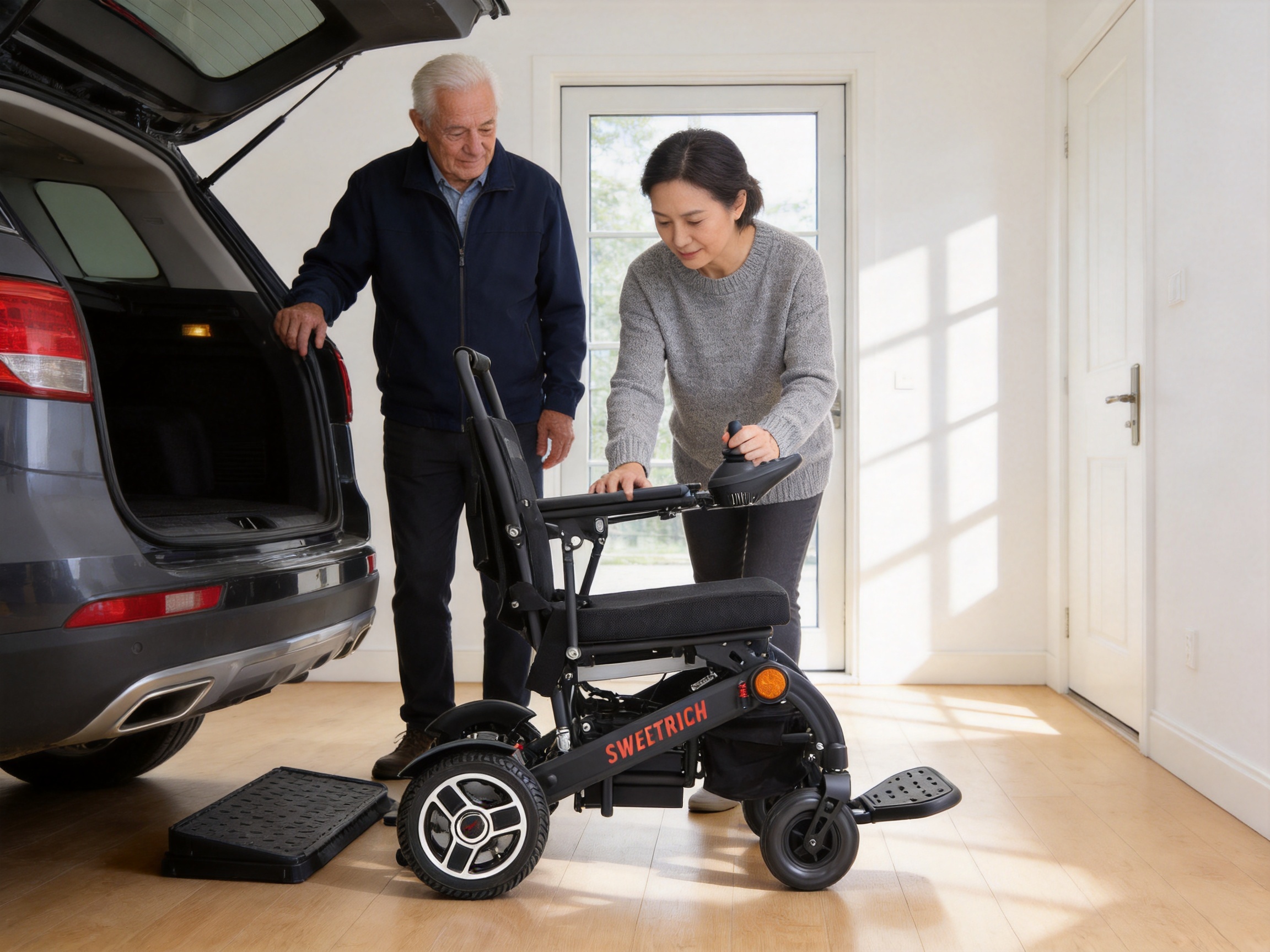
The automatic folding function is especially useful for car transport. While users should confirm vehicle trunk size and handling requirements, a folding chair is generally easier to load than a rigid electric wheelchair. Caregivers may appreciate the reduced setup time when moving between stops. For example, a family outing may involve folding and unfolding the chair several times in one day. The easier this process becomes, the more practical the trip feels.
In the home, the folded wheelchair can be stored in a corner, hallway area, garage, or entry space more conveniently than a full-size electric chair. This supports families who do not have dedicated mobility equipment storage. It also helps maintain a more open living environment.
In public spaces, the chair’s joystick control and compact dimensions support maneuverability. Users can navigate elevators, shops, waiting rooms, and community areas with greater ease than with larger mobility scooters. The front and rear suspension further improves comfort when transitioning between indoor and outdoor surfaces.

Battery Options and Range Planning
Battery choice is one of the most important decisions when selecting an electric wheelchair. A smaller battery can reduce overall carrying weight and may be suitable for short daily trips. A larger battery provides extended range but may add weight and cost. This model supports lithium battery options, including 24 V 10.2 Ah and 20 Ah configurations, with optional capacity up to 30 Ah for users who need greater travel distance.
The listed maximum driving range is 30 plus or minus 5 km. Actual range depends on many factors, including user weight, speed, road surface, gradient, temperature, tire condition, stop-and-start frequency, and battery age. Users who often travel on inclines or rough surfaces may experience lower range than those traveling on flat indoor floors. Responsible range planning helps prevent inconvenience during outings.
The charger is specified as DC 24 V 2 A with AC 115 to 230 V input. This broad input range is useful for different markets and electrical environments. Charging time is listed at approximately 5 hours, although charging duration can vary depending on remaining battery level and battery capacity. A practical charging routine, such as charging after daily use, can keep the chair ready for planned activities.
Lithium battery technology is well suited for portable mobility products because it offers a favorable balance of energy capacity and weight. Compared with older lead-acid batteries, lithium batteries are generally lighter and easier to integrate into travel-friendly designs. This supports the product’s goal of reducing handling difficulty.
Manufacturing Strength Behind the Product
A mobility product is only as reliable as the company and manufacturing process behind it. Sweetrich Mobility, officially Suzhou Sweetrich Vehicle Industry Technology Co., Ltd., is a high-tech company located in Suzhou Industrial Zone, Jiangsu, China. Established in 2011, the company has accumulated more than ten years of experience in the research, development, and production of mobility scooters and power wheelchairs. This background is important because mobility products require consistent engineering, quality control, material selection, and production discipline.
The company operates on a site covering approximately 60 acres and has a 30,000-square-meter factory. A manufacturing base of this scale supports organized production, component storage, assembly lines, inspection areas, engineering development, and shipping preparation. For international buyers and distributors, factory scale can be an indicator of production stability and supply capability.
The company focuses on improving the well-being and convenience of elderly and disabled people by helping them live more independently and with greater dignity. This mission aligns closely with the design goals of the automatic folding electric wheelchair. The product is not merely a mechanical device; it is part of a broader effort to support daily independence, family participation, and personal mobility.
Sweetrich owns intellectual property rights for its electric scooters and power wheelchairs. This indicates an emphasis on internal design capability rather than simple assembly. Intellectual property ownership can reflect investment in product development, structure design, control systems, and user-centered improvements. In a competitive mobility market, R&D capability helps a manufacturer respond to user feedback and market requirements more effectively.
The company exports products to America, Europe, Japan, Australia, the Middle East, Russia, and other markets. Serving diverse international markets requires awareness of different user expectations, transportation environments, safety preferences, and distributor requirements. Export experience also supports better packaging, documentation, communication, and after-sales coordination.
Advanced Production Processes and Quality Control
Manufacturing a reliable automatic folding electric wheelchair requires coordinated processes across frame fabrication, motor integration, battery system assembly, controller programming, wiring, seating installation, final inspection, and packaging. Each step affects the final user experience. A weak weld, loose connector, poor controller calibration, or inconsistent folding mechanism can reduce product quality. Therefore, advanced production management is essential.
Frame production begins with structural design and material preparation. The frame must balance strength, weight, and folding geometry. If it is too heavy, portability suffers. If it is too light without adequate reinforcement, durability may be compromised. The automatic folding mechanism adds another layer of engineering complexity because moving parts must align precisely and operate repeatedly without excessive looseness or resistance.
Motor installation requires accuracy because the two drive motors must work in coordination. If alignment is poor, the chair may pull to one side or produce uneven tire wear. The controller must deliver balanced power to both motors and respond smoothly to joystick commands. Quality assembly helps ensure that the user experiences predictable driving behavior.
Electrical wiring must be routed and secured carefully. In folding products, wiring design is particularly important because cables may move as the frame folds and unfolds. Proper cable protection helps prevent pinching, wear, or accidental disconnection. A manufacturer with experience in folding electric mobility products understands the importance of protecting electrical systems through repeated folding cycles.
Battery integration is another critical process. Lithium batteries must be securely housed, electrically compatible, and easy enough to manage for charging and maintenance. Battery connectors should be reliable, and charging components must match the system specifications. Because battery performance affects range and safety, inspection procedures are essential.
Final product testing may include drive testing, brake testing, controller response verification, folding and unfolding checks, charger connection inspection, frame stability assessment, and visual quality review. A well-managed factory can standardize these checks to improve consistency. The company’s emphasis on strict production management and scientific product design supports the reliability expected from mobility equipment.
Design Philosophy: Independence, Dignity, and Practical Convenience
Good mobility equipment should support independence without making the user feel burdened by complex technology. This wheelchair reflects a practical design philosophy: make movement easier, make storage simpler, make control intuitive, and make daily travel more comfortable. The automatic folding function, joystick control, large foot platform, storage bag, and suspension are all user-centered features.
Independence is not only about moving alone. It is also about reducing the number of obstacles between the user and ordinary activities. If a chair is difficult to fold, users may avoid car trips. If it has poor range, users may worry about returning home. If it is uncomfortable, users may shorten outings. If it is too large, users may avoid indoor public spaces. This product addresses these barriers with a balanced combination of portability, power, and comfort.
Dignity is also an important consideration. A modern, compact electric wheelchair can help users feel more confident in public. It supports active participation instead of passive assistance. The user can direct movement through the joystick, keep personal belongings in the under-seat bag, and move through daily environments with greater autonomy.
Practical convenience extends to caregivers and family members as well. A chair that folds automatically and moves easily after folding can reduce caregiver workload. This can make transportation less stressful and encourage more frequent outings. When both user and caregiver benefit, the product becomes more valuable as part of daily life.
Market Position and Competitive Value
The mobility market includes many product categories: manual wheelchairs, transport chairs, heavy-duty power chairs, folding power chairs, mobility scooters, and travel scooters. This automatic folding electric wheelchair occupies a valuable position between compact portability and powered independence. It is especially attractive for users who want electric operation but cannot manage a bulky, full-size powered chair.
Its competitive value comes from the integration of features rather than a single specification. Automatic folding is valuable, but it becomes more powerful when combined with dual motors, electromagnetic brakes, suspension, optional battery capacity, and joystick flexibility. A competing product may offer one or two of these features, but a well-balanced combination creates a stronger user experience.
The product also benefits from the manufacturer’s long-term focus on mobility scooters and power wheelchairs. Companies with broad mobility product experience often understand the differences between scooter users, wheelchair users, caregivers, distributors, and international buyers. This knowledge can influence design details such as controller placement, foldability, frame durability, and service support.
For distributors, the product’s clear positioning in the travel smart wheelchair category can support sales to users seeking compact electric mobility. For end users, the main value is simple: easier travel, less effort, and more confidence in daily activities.
Use Scenarios
Home and Apartment Living
In homes and apartments, space can be limited. A foldable electric wheelchair helps reduce storage demands and can be positioned more conveniently when not in use. The compact width supports movement through many indoor areas, while joystick control helps with turning and positioning.
Shopping and Community Activities
Shopping centers, markets, and community facilities often require users to travel moderate distances. Manual wheelchairs may cause fatigue, and large scooters may be difficult to maneuver in narrow aisles. This model provides powered movement in a compact format, making it suitable for these environments.
Family Travel
Family travel often requires loading and unloading mobility equipment. Automatic folding reduces the complexity of this process. The chair can support visits to relatives, parks, hotels, and social events where portability matters.
Outdoor Daily Movement
The chair is suitable for ordinary outdoor surfaces such as paved paths, sidewalks, and community roads, provided conditions are safe and within the chair’s capability. The suspension, tires, and dual motors support comfort and control on typical daily surfaces.
Buyer Considerations
Before purchasing, users should consider their daily travel distance, storage space, vehicle size, body weight, preferred joystick side, and typical terrain. The product’s 120 kg weight capacity should be respected. Users who travel longer distances may prefer higher battery capacity, while those who prioritize lighter handling may choose a smaller battery configuration.
It is also important to understand that performance specifications are influenced by real-world conditions. Range may decrease on slopes, rough surfaces, or during frequent acceleration. Speed settings may vary by market. Charging routines should be maintained to keep the battery in good condition. Users should read the operating instructions and follow safety recommendations.
Because the product is described as a non-medical device for the U.S. market where applicable, buyers should not treat it as a substitute for professional medical advice or prescribed clinical equipment. Individuals with specific medical seating, posture, pressure relief, or rehabilitation needs should consult qualified professionals before selecting any mobility product.
Q&A Section
Question 1: What is the main advantage of this automatic folding electric wheelchair?
The main advantage is its combination of powered mobility and automatic folding convenience. It gives users joystick-controlled electric movement while allowing the chair to fold for easier storage and transport. This makes it more practical for travel than many conventional power wheelchairs.
Question 2: Is the joystick controller suitable for left-handed and right-handed users?
Yes. The joystick controller is available for use on both sides, which allows the chair to be configured according to the user’s preferred or stronger hand. This improves comfort and accessibility for a wider range of users.
Question 3: What is the driving range?
The listed maximum driving range is 30 plus or minus 5 km, depending on battery capacity, user weight, terrain, temperature, speed, and other conditions. Optional battery configurations may provide different range performance.
Question 4: What battery options are available?
The wheelchair supports lithium battery configurations such as 24 V 10.2 Ah and 20 Ah, with optional higher-capacity configurations mentioned up to 30 Ah. Buyers should select battery capacity based on travel habits and handling preferences.
Question 5: How fast can the wheelchair travel?
The listed maximum forward speed is 6 km/h for the stated configuration. Product feature information also mentions speeds up to approximately 8.5 km/h or 5.2 mph depending on configuration and market settings. Users should operate at safe speeds appropriate for the environment.
Question 6: Does the wheelchair have suspension?
Yes. It has front and rear suspension, which helps improve comfort when traveling over ordinary uneven surfaces such as sidewalk joints, door thresholds, and paved paths.
Question 7: What type of brake system is used?
The wheelchair uses an electromagnetic brake system. This supports controlled stopping and helps improve confidence during everyday operation.
Question 8: Is it suitable for travel by car?
The automatic folding design makes it more convenient for car travel than many rigid electric wheelchairs. However, users should confirm the folded size, vehicle trunk dimensions, and lifting ability before transport.
Question 9: What is the weight capacity?
The weight capacity is 120 kg or 265 lbs. Users should remain within this limit to maintain safe and reliable performance.
Question 10: Who manufactures the product?
The product is manufactured by Sweetrich Mobility, a mobility equipment company based in Suzhou, China, with experience in mobility scooters and power wheelchairs, a 30,000-square-meter factory, and export experience in multiple international markets.
Conclusion: A Balanced Solution for Modern Personal Mobility
The automatic folding electric wheelchair offers a strong combination of convenience, comfort, and controlled performance. Its automatic folding structure makes it easier to store and transport. Its joystick controller supports intuitive operation and can be configured for either side. Its dual motors, electromagnetic braking system, front and rear suspension, and lithium battery options contribute to practical daily usability.
The product’s value is strengthened by the manufacturing background of Sweetrich Mobility. With more than ten years of experience, a large factory, intellectual property ownership, and international market presence, the company has the production foundation needed to support reliable mobility products. The design reflects the company’s focus on helping elderly and disabled people live with greater independence and dignity.
For users seeking a travel-smart electric wheelchair that is easier to handle than many conventional powered chairs and more independent than a manual wheelchair, this model offers a compelling solution. It is designed not just to move, but to simplify everyday journeys, support confidence, and make mobility more convenient at home, in the community, and on the road.
References
1. Product specification materials for automatic folding electric wheelchair, including dimensions, motor configuration, battery options, braking system, suspension, and weight capacity.
2. Company profile materials of Suzhou Sweetrich Vehicle Industry Technology Co., Ltd., including manufacturing scale, establishment history, product focus, and export market information.
3. General mobility equipment design principles relating to powered wheelchair usability, folding mechanisms, joystick control, range planning, and user safety.
4. Industry knowledge on lithium battery use in portable electric mobility devices, including energy density, charging behavior, and range factors.
5. General ergonomic considerations for personal mobility equipment, including foot support, controller placement, ride comfort, and caregiver handling convenience.