
 +86-(0)512-82283871

Content
- 1 Product Overview
- 2 Key Specifications at a Glance
- 3 Compact Dimensions for Travel-Oriented Mobility
- 4 Four-Wheel Stability and Everyday Control
- 5 Performance Designed for Practical Travel
- 6 Lithium Battery and Charging System
- 7 Motor, Controller, and Braking Integration
- 8 Advantages Compared with Larger or Less Specialized Alternatives
- 9 Manufacturing Strengths and Product Development Capability
- 10 Quality-Oriented Production Considerations
- 11 User Experience and Practical Applications
- 12 Safety, Maintenance, and Responsible Ownership
- 13 Purchasing Considerations for Dealers and End Users
- 14 Q&A
- 14.1 What type of product is the SW 1000F?
- 14.2 What is its maximum speed?
- 14.3 How far can it travel on one charge?
- 14.4 What is the scooter’s weight capacity?
- 14.5 Is the scooter suitable for hills?
- 14.6 Does it have suspension?
- 14.7 What battery does it use?
- 14.8 How long does charging take?
- 14.9 How heavy is the scooter to transport?
- 14.10 What type of braking system does it use?
- 14.11 Why choose a four-wheel travel scooter instead of a three-wheel model?
- 14.12 Is it suitable for rough outdoor terrain?
- 14.13 Who manufactures the product?
- 14.14 What manufacturing strengths does the company report?
- 14.15 Is the scooter ready to ship?
- 15 Conclusion
- 16 References
- 17 Product: SW 1000F Ready to ship mobility scooter 9 inch 4 wheels scooters
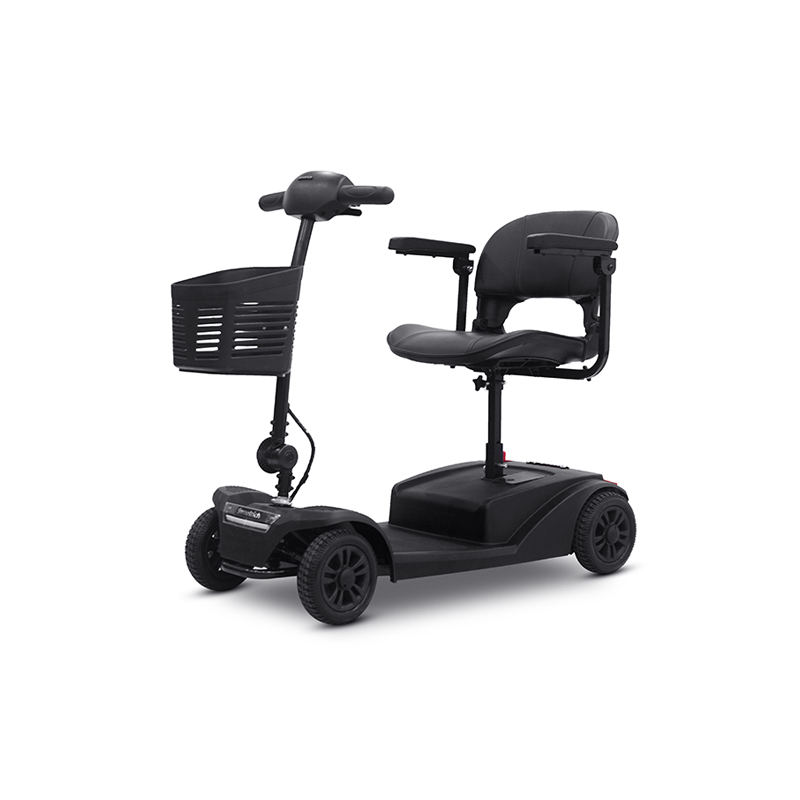
For people who want practical personal transportation without the size and complexity of a full-size mobility vehicle, a compact four-wheel scooter can offer an attractive balance of portability, stability, comfort, and operating efficiency. The SW 1000F is designed for travel-oriented use, with a compact footprint, a lithium battery system, electromagnetic braking, and a maximum speed of 5 mph. Its 9-inch-class wheel configuration, manageable overall dimensions, and 300-pound weight capacity make it suitable for many everyday activities, including shopping, visiting family, moving around large indoor spaces, and traveling through suitable outdoor environments.
This product is presented as a non-medical device for the United States market. It should not be treated as a medical treatment or as a substitute for professional mobility advice. Users should review their individual needs, local regulations, terrain conditions, and safety requirements before operating any powered mobility product.
Product Overview
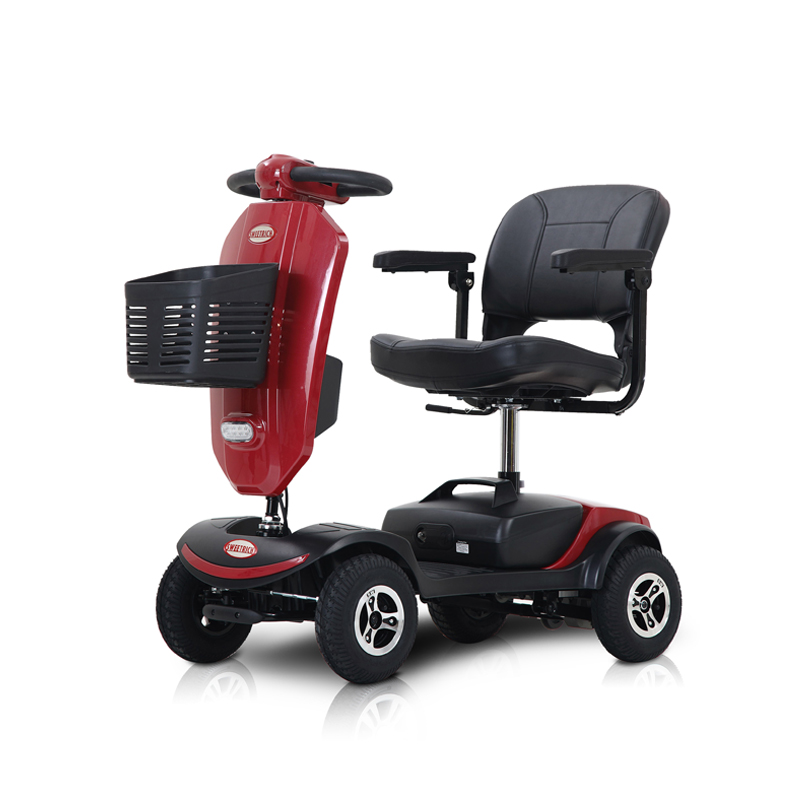
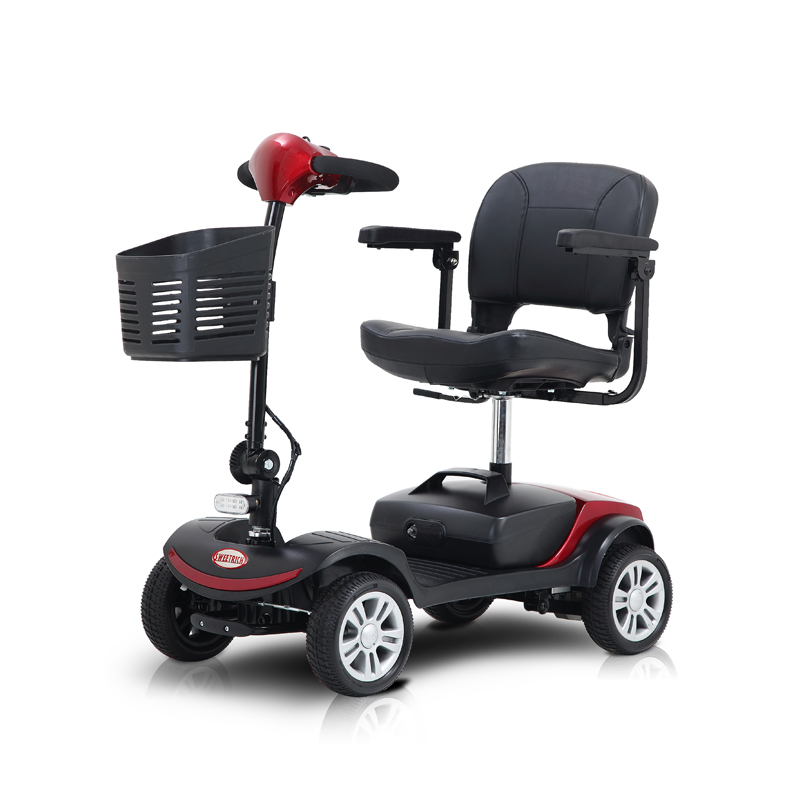
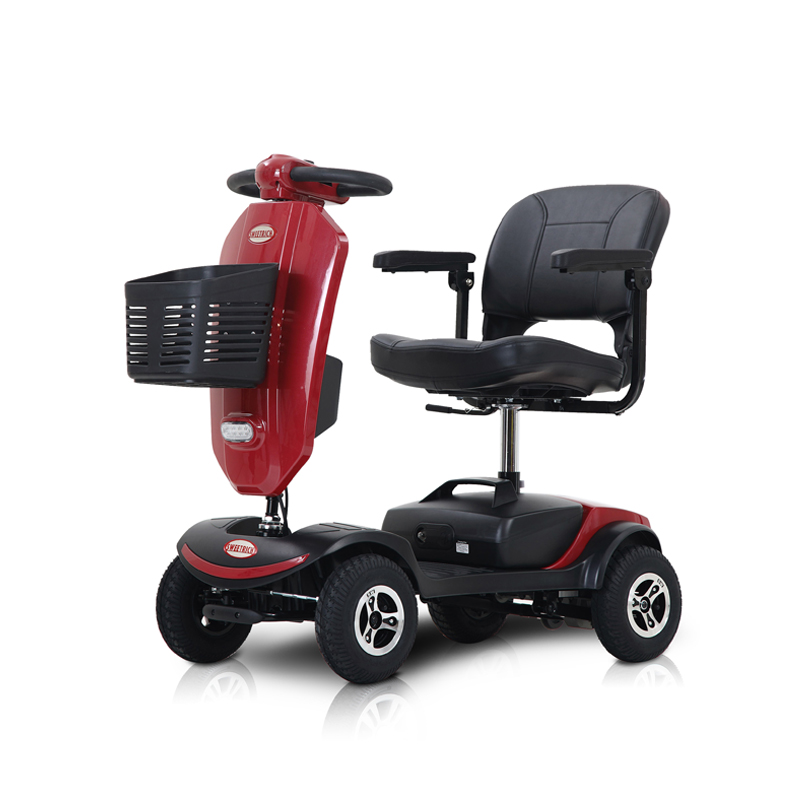
The SW 1000F is a four-wheel travel scooter measuring 1000 × 525 × 920 millimeters. In approximate imperial terms, this is about 39.4 inches long, 20.7 inches wide, and 36.2 inches high. This compact arrangement is one of its most important design advantages. A narrow body can make it easier to maneuver through appropriate doorways, corridors, retail aisles, and other spaces where a larger mobility scooter may be inconvenient.
The four-wheel layout is intended to provide a stable platform for everyday travel. Compared with a three-wheel design, a four-wheel structure can give many riders a greater sense of balance, particularly during straight-line travel and low-speed maneuvering. The design also distributes the rider and battery load across four contact points, helping create a predictable driving feel on suitable level surfaces.
Power comes from a 24-volt, 20-amp-hour lithium battery. Lithium battery technology is valued in travel products because it can provide useful energy capacity with a comparatively efficient weight profile. The stated maximum driving range is 15 to 25 kilometers, or approximately 9.5 to 15.5 miles. Actual range will vary according to rider weight, temperature, tire pressure, terrain, speed, battery age, stop-and-go driving, and other operating conditions.
The scooter uses a 24-volt, 270-watt motor manufactured in Taiwan and a 24-volt, 50-amp PG motor controller. This powertrain is matched to a maximum forward speed of 8 kilometers per hour, or 5 miles per hour, and a maximum driving gradient of 10 degrees. The combination is aimed at controlled personal transportation rather than high-speed recreation or demanding off-road use.
A key convenience feature is the electromagnetic braking system. When the controls are released under normal operating conditions, the braking system is designed to help bring the scooter to a controlled stop. Braking performance can still be affected by slope, surface conditions, load, tire condition, and mechanical or electrical maintenance. Riders should always follow safe operating practices and avoid relying on the brake system alone to prevent movement on steep slopes.
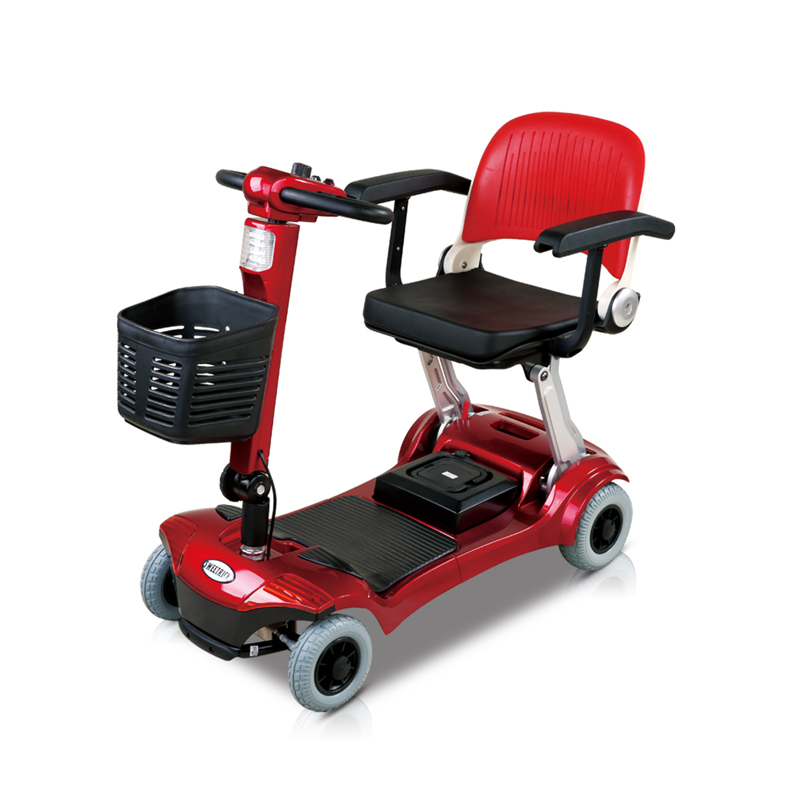
SW 1000F Ready to ship mobility scooter 9 inch 4 wheels scooters
Key Specifications at a Glance
| Specification | Stated Information | Practical Significance |
|---|---|---|
| Product type | Four-wheel travel mobility scooter | Designed for compact everyday transportation and travel-oriented use |
| Overall dimensions | 1000 × 525 × 920 mm | Compact footprint for suitable indoor and outdoor environments |
| Maximum forward speed | 8 km/h or 5 mph | Controlled speed for personal mobility applications |
| Maximum driving gradient | 10 degrees | Suitable only for slopes within the product’s stated operating capability |
| Maximum driving range | 15–25 km or 9.5–15.5 miles | Supports local trips, errands, and selected travel activities |
| Weight capacity | 136 kg or 300 lb | Provides a substantial rated load limit for many adult users |
| Front tires | 7 × 2.5 inches | Supports steering and contact with suitable driving surfaces |
| Rear tires | 8 × 3 inches | Provides the powered rear contact area for forward movement |
| Brake system | Electromagnetic brake | Supports controlled stopping and parking behavior |
| Battery | Lithium, 24 V/20 Ah | Rechargeable energy source with a travel-oriented configuration |
| Charger | DC 24 V/2 A, AC 100–240 V | Broad input-voltage compatibility for suitable charging environments |
| Charging time | 8–10 hours | Best suited to overnight or extended scheduled charging |
| Motor | 24 V/270 W, Taiwan | Provides propulsion for normal travel conditions |
| Motor controller | 24 V/50 A, PG | Coordinates motor output and operating response |
| Heaviest part | 36.3 kg or 80 lb | Important consideration for loading, unloading, and transportation |
Compact Dimensions for Travel-Oriented Mobility
The SW 1000F’s compact size is a major part of its value proposition. Many larger scooters provide additional seating space, suspension, speed, and range, but their increased dimensions can create challenges in homes, shops, vehicles, and public buildings. A scooter measuring approximately 20.7 inches wide can be easier to position in locations where floor space is limited.
Compact dimensions may also simplify route planning. Riders can often approach narrow passages more confidently when the scooter’s width is known and manageable. In indoor environments, a smaller turning envelope can help when navigating around furniture, counters, displays, and door frames. The operator must still verify the dimensions of each route because doorway width, threshold height, turning space, and surface quality vary significantly.
The product’s height of approximately 36.2 inches contributes to a relatively low-profile appearance. This can help when the scooter is being stored in an appropriate location or positioned near a table, counter, or vehicle-loading area. Storage should always take place in a dry, secure environment, with the battery handled and charged according to the applicable instructions.
The stated heaviest-part weight is 36.3 kilograms, or 80 pounds. This is a meaningful consideration for anyone planning to lift the scooter into a vehicle. Although the product may be compact in its overall dimensions, compact does not mean weightless. A suitable ramp, lift, loading aid, or second person may be necessary. Users should never attempt an unsafe lift or place themselves at risk to transport the scooter.
Compared with many full-size scooters, the SW 1000F is positioned around convenience and accessibility rather than maximum equipment capacity. Its design is particularly relevant for buyers who value a smaller footprint and local travel capability. The trade-off is that users seeking extensive suspension, very long range, high ground clearance, or heavy-duty outdoor performance may require a different product category.
Four-Wheel Stability and Everyday Control
The four-wheel architecture is a practical choice for riders who prioritize a stable and reassuring platform. Two front wheels and two rear wheels create a broad support arrangement and can make the vehicle feel planted during normal straight-line movement. This characteristic is useful for indoor travel, shopping environments, building corridors, and paved outdoor routes.
Stability is influenced by more than the number of wheels. Speed, rider posture, slope, tire condition, load distribution, and steering technique all affect handling. Riders should keep both hands positioned appropriately for control, avoid sudden steering movements, and reduce speed when turning or traveling across uneven surfaces. The scooter should be used only on surfaces and slopes appropriate for its design.
The 7-inch front tires and 8-inch rear tires provide a balanced wheel arrangement for a compact travel scooter. The rear tires support the drive system, while the front tires assist steering and directional control. The listed tire sizes are appropriate reference points when checking replacement components, but replacements should always match the product’s specifications and be installed correctly.
No suspension system is listed for this model. That information is important because suspension influences how a scooter absorbs bumps and uneven surfaces. The absence of a listed suspension system reinforces the product’s intended focus on relatively smooth, maintained surfaces rather than rough terrain. Users should select routes with care and avoid potholes, loose gravel, steep edges, deep cracks, and other obstacles that could affect safety or comfort.
Performance Designed for Practical Travel
The maximum forward speed of 5 mph is appropriate for controlled personal transportation. It allows the rider to travel efficiently without positioning the scooter as a high-speed vehicle. A moderate maximum speed can also help support careful operation in pedestrian environments, although riders must always follow local rules and yield appropriately.
The rated driving gradient is 10 degrees. This figure should not be interpreted as a guarantee that every 10-degree slope will be safe under every condition. Surface material, moisture, rider weight, battery charge, tire grip, direction of travel, and stopping distance all matter. Slopes should be approached slowly and directly when appropriate, and users should avoid diagonal crossings or sudden stops on inclines unless the operating instructions specifically permit them.
The driving range of 9.5 to 15.5 miles offers flexibility for many local activities. A rider might use the scooter for short neighborhood trips, visits to commercial areas, movement across a large facility, or transportation between nearby destinations. Range is a maximum-oriented estimate rather than a fixed promise. Planning should include a reserve because a low battery can reduce the rider’s options and may create a difficult return journey.
Weather and temperature can affect battery performance. Cold conditions may reduce available range, while repeated acceleration, steep slopes, heavy loads, and rough surfaces can increase energy consumption. Maintaining suitable tire pressure and avoiding unnecessary high-load operation can help support more consistent performance. The scooter should not be exposed to water beyond the environmental conditions for which it is designed.
The 300-pound weight capacity gives the product a useful load rating for a broad range of adult users. The rating includes the rider and any carried items. Exceeding the stated capacity can affect stability, braking, motor performance, range, and component durability. Personal belongings should be secured so they do not interfere with steering, controls, wheels, or the rider’s balance.
Lithium Battery and Charging System
The 24-volt, 20-amp-hour lithium battery is one of the product’s central travel features. Lithium systems are widely used in portable electric transportation because they can support a useful energy-to-weight balance. For a compact scooter, this can contribute to a practical combination of range and manageable design.
The supplied charger is specified as DC 24 V/2 A with AC 100–240 V input. Broad AC input compatibility can be useful for owners who travel between regions with different standard mains voltages, provided the charger and local electrical arrangement are used correctly. The charging environment should be dry, ventilated, and free from combustible materials. Users should use the intended charger rather than an incompatible substitute.
The stated charging time is 8 to 10 hours. This makes overnight charging a convenient routine for many users. Charging schedules should allow enough time for a complete cycle before the next planned trip. Riders should not assume that a short charging period will restore the full stated range, especially when the battery has been heavily depleted.
Battery care has a direct effect on service life and reliability. Users should follow the operating and charging instructions supplied with the scooter. The battery should be protected from extreme heat, freezing conditions, physical damage, and unauthorized modification. If unusual heat, odor, swelling, leakage, or charging behavior is observed, charging should stop and qualified service personnel should be contacted.
For travel planning, it is useful to distinguish between the scooter’s maximum range and the rider’s practical daily range. A route that appears to fit within the published distance may become unsuitable when hills, frequent stops, cold weather, or additional load are included. Leaving a safety reserve is a simple and effective way to reduce range-related inconvenience.
Motor, Controller, and Braking Integration
The 270-watt motor provides the propulsion required for the scooter’s stated operating profile. Rather than focusing on high output, the system is matched to a moderate travel speed and a compact four-wheel chassis. This approach can support efficient everyday use while keeping the product aligned with the needs of local transportation.
The PG 24-volt, 50-amp motor controller serves as the electronic coordination point between the rider’s inputs and the motor system. A properly matched controller helps regulate acceleration and motor response. For the user, the result should be predictable control during starts, stops, and normal changes in speed, subject to the condition of the scooter and the surface being used.
The electromagnetic brake complements the motor and controller system. Electrical braking technology can provide convenient automatic stopping behavior when the control input is released. It can also help keep the scooter from rolling freely when stationary, although riders should select safe parking locations and use any additional parking procedures described in the operating instructions.
Braking distance is never identical in all conditions. A wet surface, loose material, downhill travel, heavy load, worn tires, or delayed rider response can increase stopping distance. Safe use requires looking ahead, maintaining a reasonable speed, and allowing enough space to stop. The brake system should be inspected if the scooter behaves unusually, produces abnormal noise, or fails to stop as expected.
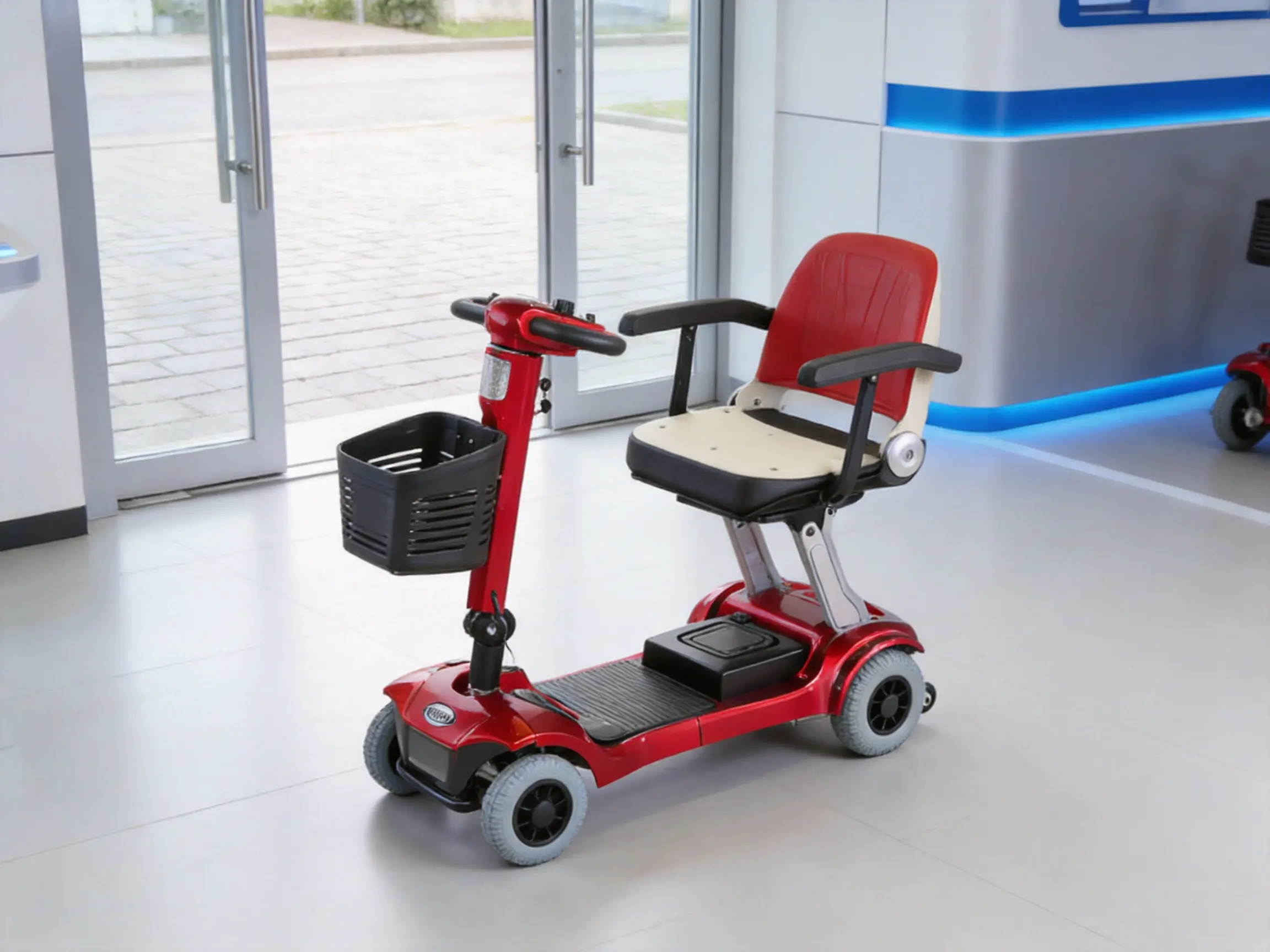
Advantages Compared with Larger or Less Specialized Alternatives
Efficient Footprint
One advantage of the SW 1000F is its emphasis on compactness. A larger scooter may offer more seating, suspension, and battery capacity, but it can be harder to position indoors or transport. The SW 1000F gives buyers an alternative for whom a smaller overall footprint is more valuable than heavy-duty equipment.
Balanced Four-Wheel Layout
Some lightweight travel products use three wheels to achieve a tight turning circle. A four-wheel model can appeal to riders who prefer a more stable-feeling base. The SW 1000F combines four-wheel contact with a compact body, creating a practical middle ground between ultra-light maneuverability and the larger dimensions of a full-size scooter.
Useful Rated Capacity
A 300-pound weight capacity is significant for a compact travel-oriented product. It provides more flexibility than many very small personal transporters with lower load ratings. The stated capacity should still be respected, but it allows the product to serve a wider range of adult users and everyday carrying needs.
Travel-Compatible Electrical Design
The lithium battery, 24-volt electrical architecture, and AC 100–240-volt charger input support a travel-conscious design. These features do not eliminate the need to check transportation policies or charging requirements, but they can make the scooter more practical for owners who move between homes, facilities, or regions.
Ready-to-Ship Availability
The product title identifies the scooter as ready to ship. Availability can be valuable for distributors, dealers, and customers who need a current model without waiting for a lengthy custom-production cycle. Actual stock, lead time, packaging, delivery method, and destination requirements should be confirmed before purchase.
Simple Operating Focus
The SW 1000F does not attempt to combine every possible feature into one large platform. Instead, it concentrates on the essential functions required for local mobility: a four-wheel base, moderate speed, useful range, electromagnetic braking, and a rechargeable lithium battery. This focused design may appeal to users who prefer a straightforward product rather than a more complex premium vehicle.
Manufacturing Strengths and Product Development Capability
Suzhou Sweetrich Vehicle Industry Technology Co., Ltd. is identified as the manufacturer behind the product. The company was established in 2011 and operates from Suzhou Industrial Zone in Jiangsu, China. According to the supplied company information, its site covers approximately 60 acres and includes a 30,000-square-meter factory. This provides a substantial foundation for research, development, production, quality management, and export coordination.
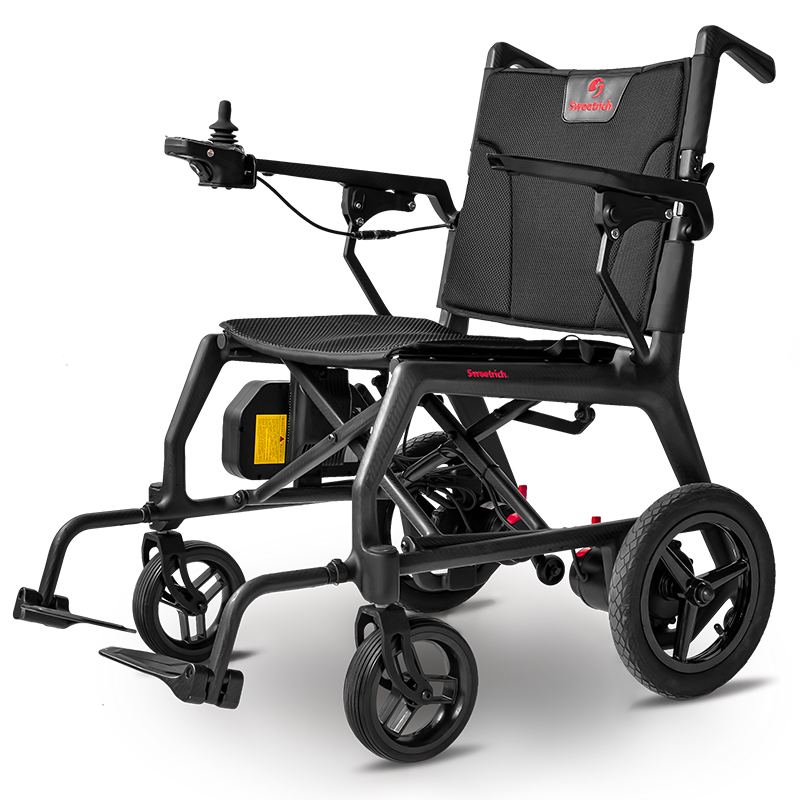
The company specializes in mobility scooters and power wheelchairs. Concentrating on these product categories can support the development of relevant engineering knowledge, component sourcing relationships, assembly skills, and customer service experience. A manufacturer that works continuously in one field can refine its understanding of frame design, drivetrain integration, controls, battery systems, seating requirements, and user expectations.
The company describes itself as a high-tech enterprise with more than ten years of experience in research, development, and manufacturing. It also states that it owns intellectual property rights for its electric scooters and power wheelchairs. Intellectual property ownership can indicate investment in original product development and engineering solutions, although buyers should evaluate each product according to its documented specifications and applicable compliance requirements.
Product design is described as incorporating user comfort, advanced control technology, and driving systems intended to support smooth and safe operation. In the SW 1000F, these priorities can be seen through the integration of the motor, PG controller, electromagnetic brake, four-wheel arrangement, and compact travel dimensions. Effective product development requires these systems to work together rather than being selected as unrelated components.
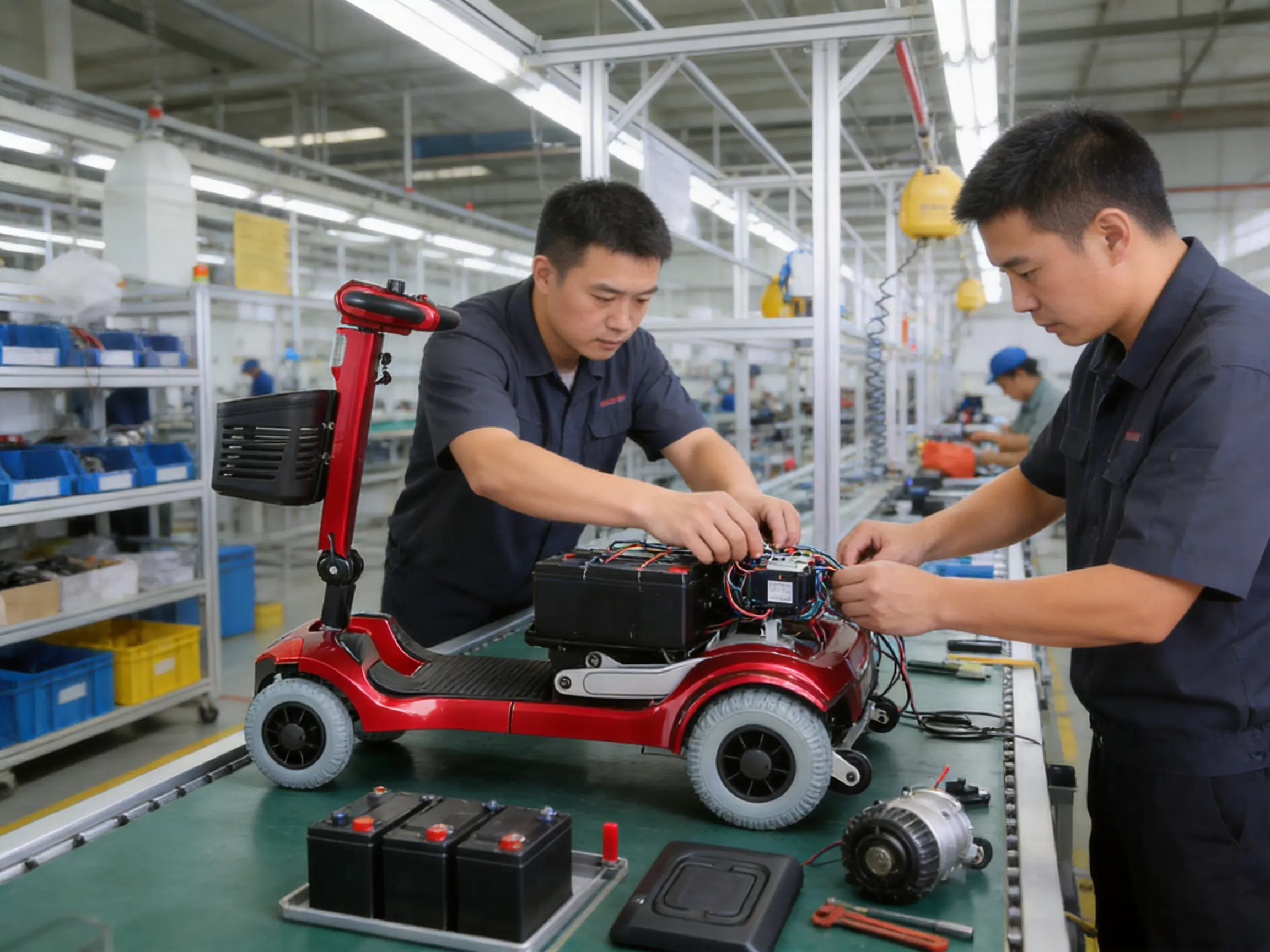
The manufacturer also emphasizes strict production management and scientific product design. In practical terms, a disciplined production system can help create repeatable assembly procedures, reduce variation between units, and establish clearer inspection points. For a powered mobility product, consistency matters because small deviations in wiring, fastener installation, brake adjustment, wheel alignment, or control calibration may influence performance.
Manufacturing quality is not limited to the final visual appearance. It includes the accuracy of assembly, the security of electrical connections, the alignment of moving parts, the protection of wiring, the fit of battery components, and the reliability of controls. A mature production organization should pay attention to these details throughout the manufacturing process rather than relying only on a final inspection.
The company reports that its products are exported to America, Europe, Japan, Australia, the Middle East, Russia, and other markets. International distribution requires experience with different customer expectations, packaging conditions, documentation needs, service arrangements, and market requirements. Export experience can therefore be an advantage for distributors seeking a supplier familiar with cross-border business.
At the same time, market-specific requirements must be verified for each shipment. The product is described as a non-medical device for the United States market, and purchasers should request the relevant product documentation, labeling information, testing records, warranty terms, and transportation guidance before placing an order. Importers and distributors remain responsible for confirming the requirements applicable to their particular market and use case.
Quality-Oriented Production Considerations
A reliable mobility scooter depends on coordinated control of mechanical and electrical manufacturing. The frame must support the intended load, the wheels must be aligned, and the steering assembly must move predictably. The drivetrain must be installed securely, while the battery and controller require careful electrical connections and appropriate protection.
Production planning should begin with incoming component control. Motors, controllers, batteries, chargers, tires, brakes, fasteners, and structural parts should be checked against defined specifications. Consistent component identification helps prevent incorrect substitutions and improves traceability during assembly and after-sales service.
Assembly processes should be organized around repeatable work instructions. Technicians need clear guidance for routing wires, securing connectors, installing wheels, fitting brake components, tightening structural fasteners, and checking control functions. Repeatability is particularly important when a product is manufactured in volume for customers in different regions.
Functional testing should evaluate the complete scooter rather than isolated parts only. Relevant checks may include forward and reverse controls where applicable, acceleration response, brake engagement, steering behavior, charger operation, battery connection, wheel rotation, and basic load-related inspection. The specific test program should be determined by the manufacturer’s technical procedures and the requirements of the destination market.
Packaging is another important part of manufacturing strength. A scooter can be correctly assembled but damaged during storage or transportation if the packaging does not protect vulnerable components. Appropriate internal supports, exterior protection, moisture control, and clear handling instructions help preserve product condition through the distribution chain.
After-sales capability is also part of a manufacturer’s overall strength. Dealers and users may need replacement chargers, batteries, tires, controllers, brake components, or other service parts over the product’s life. A manufacturer with established export experience and a focused mobility product portfolio may be better positioned to support product continuity, subject to the exact warranty and parts policies agreed with the buyer.
User Experience and Practical Applications
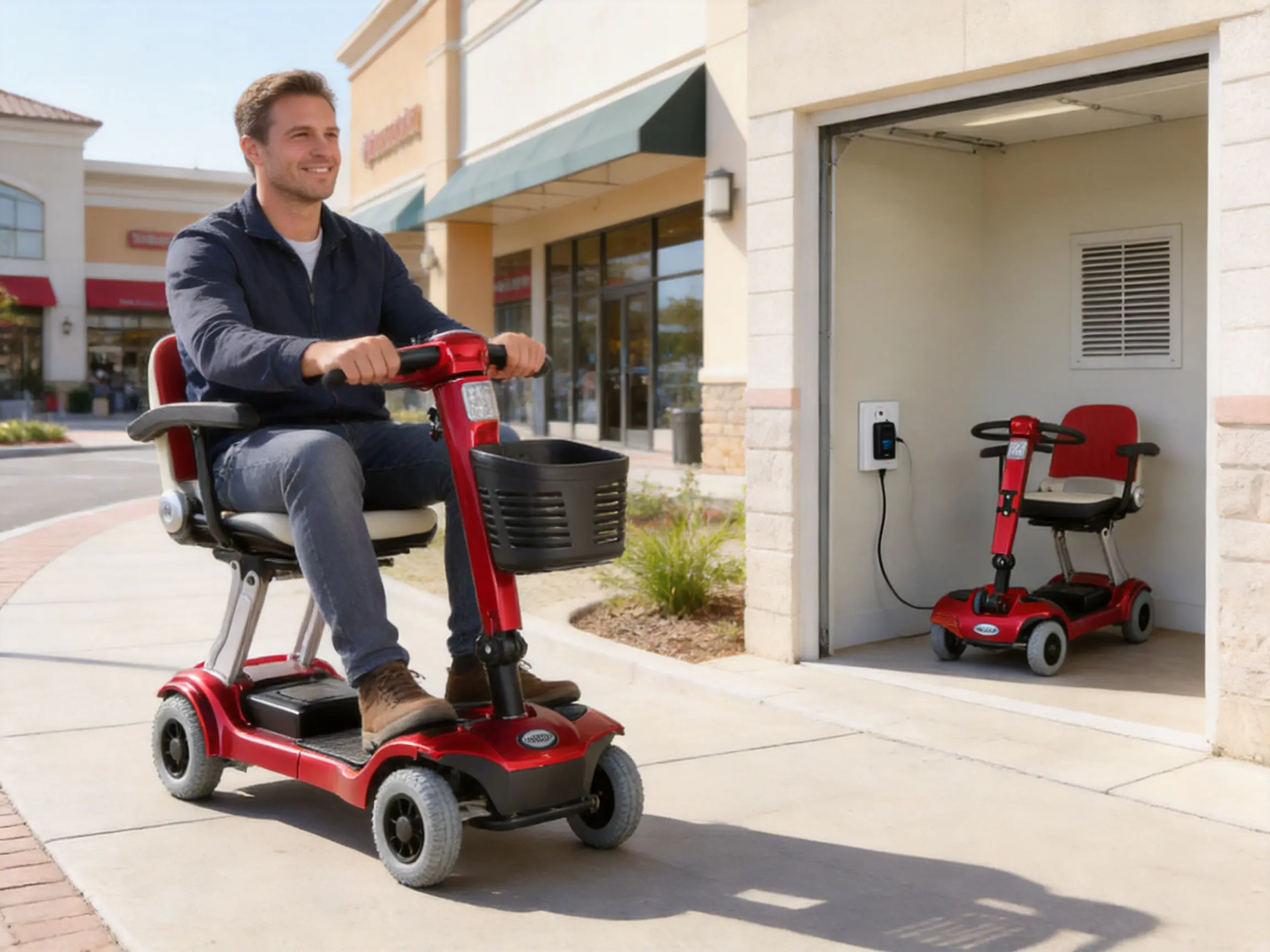
The SW 1000F can be considered for a range of everyday applications. At home, its compact width may make it useful in suitable living spaces, garages, covered storage areas, and private pathways. In commercial environments, it may support movement through shopping centers, stores, community buildings, and other accessible facilities, provided the route is appropriate.
For local outdoor travel, the scooter may be used on smooth sidewalks, paved paths, and maintained access routes. Users should verify that powered mobility devices are allowed on the intended route and should remain attentive to pedestrians, bicycles, vehicles, curbs, ramps, and changes in surface material.
The scooter may also be useful for travel involving a car or other transport vehicle, but the 80-pound heaviest-part specification must be considered carefully. Owners should use suitable loading equipment and secure the scooter properly. Transportation procedures can differ according to the vehicle, battery configuration, destination, and carrier rules.
Comfort is influenced by seating, posture, speed, surface condition, and trip duration. Because no suspension is listed, smooth surfaces are especially important for a comfortable ride. Users should adjust their route and speed to the terrain rather than assuming that the scooter is intended for rough ground.
The best use case is generally one in which the rider values compactness, moderate range, controlled speed, four-wheel stability, and straightforward operation. Buyers who need to travel very long distances without recharging, cross rough outdoor terrain, carry heavy cargo, or climb demanding slopes should compare the SW 1000F with a larger model designed for those purposes.
Safety, Maintenance, and Responsible Ownership
Before every trip, users should perform a brief visual inspection. Check the tire condition, steering response, battery level, control operation, seating position, and obvious signs of damage. Confirm that personal items are secure and that no clothing, straps, or bags can contact the wheels or moving components.
Speed should be reduced in crowded areas, narrow passages, turns, ramps, and unfamiliar environments. Riders should keep a safe distance from pedestrians and avoid sudden direction changes. When approaching a slope, the rider should consider whether the surface and angle are within the product’s stated capability and whether there is sufficient space to stop safely.
Routine care should include keeping the scooter clean and dry, checking fasteners, observing tire condition, and following the recommended battery maintenance schedule. Electrical components should not be opened or modified by unqualified individuals. Any repair involving the battery, controller, motor, charger, or electromagnetic brake should be handled by an appropriately trained technician.
Storage conditions matter. The scooter should be stored where it is protected from excessive moisture, extreme temperatures, unauthorized use, and impact. The battery should be maintained in accordance with the manufacturer’s instructions, especially when the scooter will not be used for an extended period.
The 10-degree gradient specification should be treated as an upper operating reference, not a target for routine travel. Even if a slope appears technically manageable, the rider must consider traction, visibility, turning space, stopping distance, and the possibility of a loss of control. When conditions are uncertain, the safest choice is to select a flatter route.
Purchasing Considerations for Dealers and End Users
Dealers should confirm stock status, production date, packaging configuration, warranty coverage, replacement-part availability, and technical documentation. They should also determine whether the product’s non-medical classification is suitable for their intended sales channel and local market.
End users should assess the scooter against their actual daily routine. Important questions include the distance of regular trips, the type of terrain, available storage space, charging access, vehicle transport requirements, rider weight, and the width of frequently used doorways or pathways.
The stated dimensions and heaviest-part weight should be compared with the user’s home and vehicle. A product can be compact on the floor while still requiring careful lifting or mechanical assistance. Planning for transportation before purchase helps prevent problems later.
Buyers should also request clear information about delivery, assembly, setup, inspection, operating instructions, and service support. A mobility scooter is a functional transportation device, and proper setup is important for safe use. The dealer or supplier should explain controls, charging, braking behavior, battery care, and basic maintenance before the customer begins regular operation.
Q&A
What type of product is the SW 1000F?
It is a compact four-wheel travel mobility scooter intended for everyday personal transportation. It is identified as a non-medical device for the United States market.
What is its maximum speed?
The stated maximum forward speed is 8 kilometers per hour, or 5 miles per hour. Actual operating speed should be adjusted to the environment, surface conditions, traffic, and rider ability.
How far can it travel on one charge?
The stated maximum driving range is 15 to 25 kilometers, or approximately 9.5 to 15.5 miles. Actual range depends on rider weight, terrain, temperature, battery condition, speed, tire pressure, and driving style.
What is the scooter’s weight capacity?
The rated weight capacity is 136 kilograms, or 300 pounds. This rating includes the rider and any items carried on the scooter.
Is the scooter suitable for hills?
The listed maximum driving gradient is 10 degrees. The scooter should only be used on slopes that are appropriate for the rider, surface, load, weather, and route conditions. A maximum specification should not be treated as a recommendation for routine operation.
Does it have suspension?
No suspension is listed in the supplied specifications. The scooter is therefore best suited to smooth, maintained surfaces rather than rough terrain.
What battery does it use?
It uses a lithium battery rated at 24 volts and 20 amp-hours. The supplied charger is specified as DC 24 V/2 A with AC 100–240 V input.
How long does charging take?
The stated charging time is 8 to 10 hours. Charging should be performed in a suitable dry and ventilated location using the intended charger.
How heavy is the scooter to transport?
The heaviest part is listed as 36.3 kilograms, or 80 pounds. Owners should plan loading and unloading carefully and use a ramp, lift, or assistance where necessary.
What type of braking system does it use?
The scooter uses an electromagnetic brake system. Riders should still maintain safe speed and stopping distance because braking performance is affected by slope, surface, load, tire condition, and maintenance.
Why choose a four-wheel travel scooter instead of a three-wheel model?
A four-wheel layout can provide a more stable-feeling base during straight-line travel and low-speed operation. A three-wheel design may offer a tighter turning circle, so the best choice depends on the rider’s priorities and the spaces where the scooter will be used.
Is it suitable for rough outdoor terrain?
The product’s compact dimensions, lack of listed suspension, and travel-oriented specifications suggest that it is better suited to smooth indoor and paved outdoor surfaces. It should not be treated as a heavy-duty off-road scooter.
Who manufactures the product?
The product is manufactured by Suzhou Sweetrich Vehicle Industry Technology Co., Ltd., a company established in 2011 and focused on mobility scooters and power wheelchairs.
What manufacturing strengths does the company report?
The company reports a 60-acre site, a 30,000-square-meter factory, more than ten years of research and manufacturing experience, intellectual property related to its electric mobility products, strict production management, and international export experience.
Is the scooter ready to ship?
The product title identifies it as ready to ship. Buyers should confirm current inventory, destination, packaging, delivery schedule, and applicable shipping requirements with the supplier before ordering.
Conclusion
The SW 1000F is a compact four-wheel mobility scooter built around practical local transportation. Its key strengths include a narrow footprint, a 300-pound weight capacity, a lithium battery, a 9.5-to-15.5-mile stated range, a 5-mph maximum speed, electromagnetic braking, and a travel-oriented electrical system. These features make it a reasonable option for users who prioritize manageable dimensions and everyday convenience over heavy-duty terrain capability.
The product also benefits from the manufacturing background of Suzhou Sweetrich Vehicle Industry Technology Co., Ltd., including focused experience in mobility products, a substantial factory operation, stated intellectual property ownership, international export activity, and an emphasis on structured production management. These factors provide a foundation for product development and manufacturing consistency.
As with any powered mobility product, proper selection and responsible operation are essential. Buyers should match the scooter to their weight, route, terrain, storage, charging, and transport requirements. When used within its stated specifications and maintained according to the applicable instructions, the SW 1000F can provide a practical and efficient mobility solution for suitable everyday travel.
References
1. Supplied product specification sheet for the SW 1000F four-wheel travel mobility scooter.
2. Supplied manufacturer profile for Suzhou Sweetrich Vehicle Industry Technology Co., Ltd.
3. General principles of powered mobility scooter operation, battery care, braking safety, and routine maintenance.
4. General product-design considerations for compact electric mobility vehicles, including load capacity, wheel arrangement, range, charging, and terrain suitability.
5. General purchasing and service considerations for international mobility-scooter distribution and non-medical personal transportation products.