
 +86-(0)512-82283871

Content
- 1 Product Positioning and Intended Use
- 2 Four-Wheel Stability in a Compact Platform
- 3 Folding-Oriented Portability and Transport Value
- 4 Motor, Controller, and Driving Performance
- 5 Battery Options, Charging, and Practical Range
- 6 Braking, Suspension, and Rider Comfort
- 7 Weight Capacity and User Matching
- 8 Advantages Compared with Basic Compact Alternatives
- 9 Manufacturing Strengths and Production Background
- 10 International Market Experience and Wholesale Support
- 11 Maintenance and Long-Term Ownership
- 12 Safety Considerations for Users and Retailers
- 13 Wholesale Value Proposition
- 14 Technical Specification Table
- 15 Frequently Asked Questions
- 15.1 What type of user is the S1 PLUS designed for?
- 15.2 Is the S1 PLUS a medical device?
- 15.3 How fast can the scooter travel?
- 15.4 What is the expected driving range?
- 15.5 Can the scooter climb hills?
- 15.6 How much weight can it carry?
- 15.7 Is the scooter easy to lift?
- 15.8 What battery does the S1 PLUS use?
- 15.9 How long does charging take?
- 15.10 Does the scooter have suspension?
- 15.11 Why use a four-wheel design?
- 15.12 What should wholesalers confirm before ordering?
- 16 Conclusion
- 17 References
- 18 Product: S1 PLUS All Weather Wholesale Four Wheels Electric Folding Mobility Scooter in Walmart
Choosing a mobility scooter for travel, daily errands, and outdoor use requires more than comparing motor power or advertised speed. A useful scooter must balance portability, stability, range, comfort, braking performance, battery capacity, and ease of operation. It must also be supported by dependable engineering and a manufacturer capable of delivering consistent quality at wholesale scale.
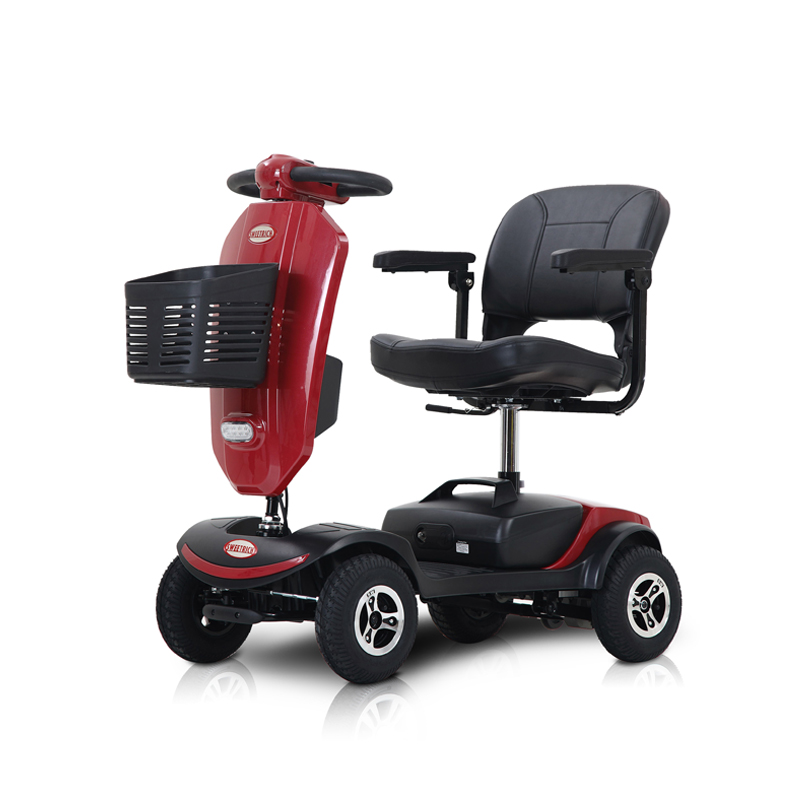
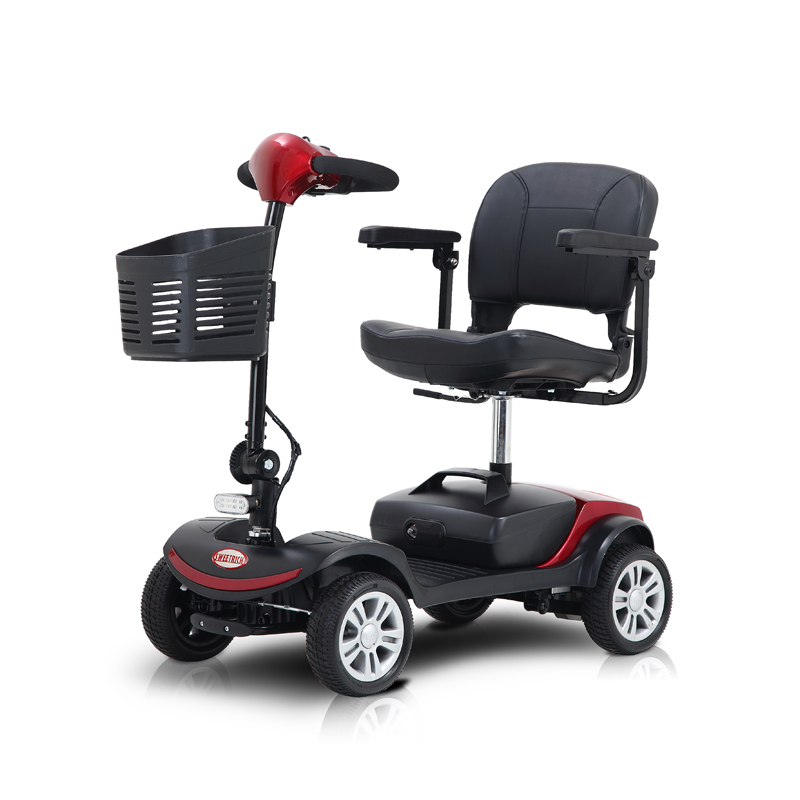
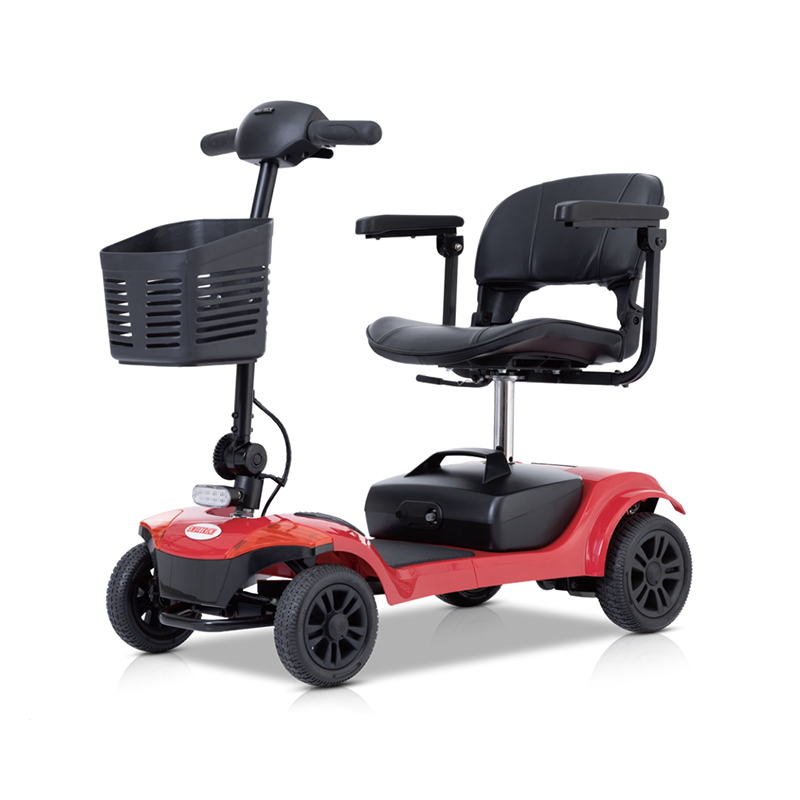
The S1 PLUS All Weather Wholesale Four Wheels Electric Folding Mobility Scooter is designed around this balance. It combines a four-wheel platform, folding-oriented portability, rear suspension, electromagnetic braking, and a practical travel range in a compact package. With a maximum speed of 8 km/h, a stated maximum driving gradient of 12 degrees, and a weight capacity of 136 kg, the scooter is intended for users who need convenient personal mobility without moving to a larger, heavier full-size mobility vehicle.
For distributors, retailers, and mobility-product suppliers, the S1 PLUS also offers a product profile that is easy to explain to customers. Its key specifications are straightforward, its operating concept is familiar, and its compact dimensions support the travel-scooter category. At the same time, its four-wheel design, rear suspension, and electromagnetic brake system provide features that can distinguish it from very small three-wheel or minimal-feature alternatives.
This article examines the S1 PLUS in detail, including its design advantages, operating characteristics, travel practicality, technical specifications, manufacturing background, wholesale value, maintenance considerations, and questions commonly raised by prospective buyers.
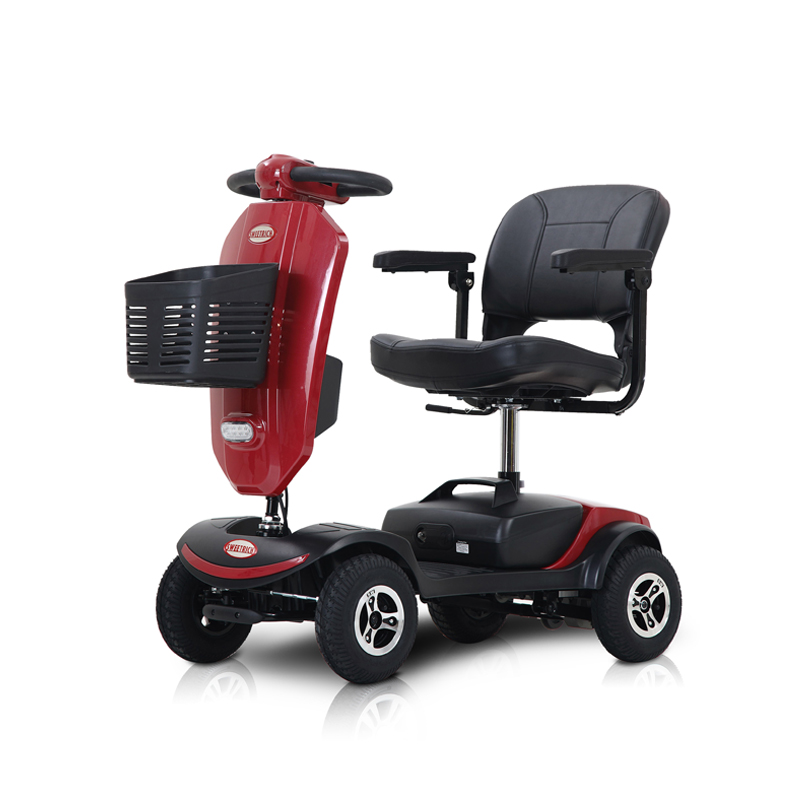
S1 PLUS All Weather Wholesale Four Wheels Electric Folding Mobility Scooter in Walmart
Product Positioning and Intended Use
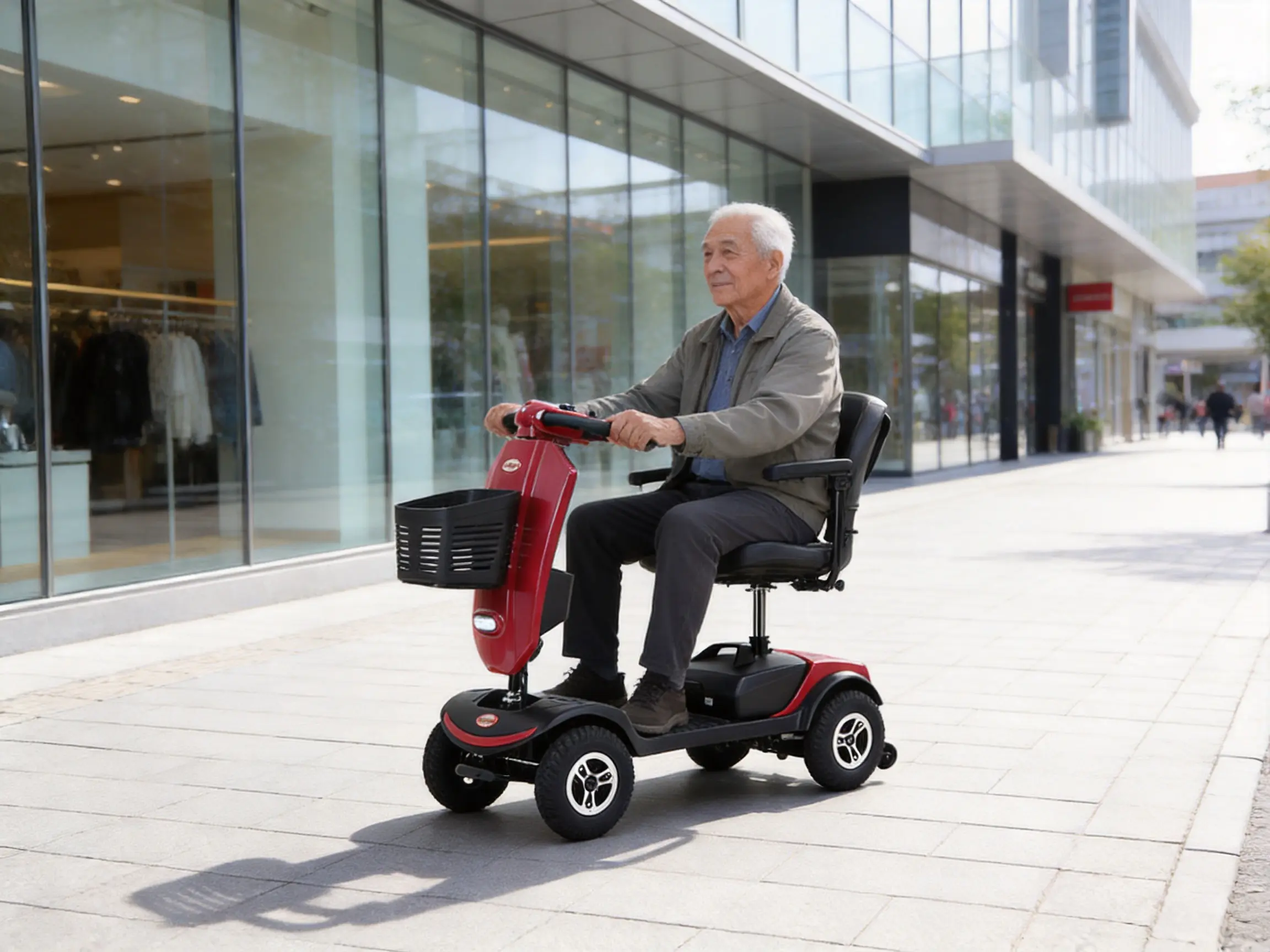
The S1 PLUS belongs to the travel smart scooter category. It is intended for users who value mobility, transportability, and convenient everyday operation. Typical applications may include moving through residential areas, shopping environments, resorts, paved paths, building complexes, and other suitable surfaces where local regulations permit the use of a mobility scooter.
The product information identifies the device as a non-medical device for the United States market. This distinction is important. A mobility scooter can support personal transportation and independence, but it should not automatically be presented as a medical treatment, rehabilitation device, or substitute for professional medical advice. Users should select a product according to their physical needs, environment, and local requirements.
The S1 PLUS is particularly appropriate for customers who may find a full-size mobility scooter too difficult to transport but want more stability than a lightweight manual or three-wheel travel model can offer. Its four-wheel configuration creates a broad and balanced footprint. This can be valuable for users who prefer a planted feeling when turning, starting, stopping, or traveling over ordinary outdoor surfaces.
For wholesalers, this positioning gives the model a clear place within a product range. It can serve customers seeking a portable scooter for vacations, shopping trips, family visits, local transportation, or occasional outdoor use. It may also appeal to users who want a compact secondary scooter while retaining a larger model for longer journeys or more demanding terrain.
Understanding the Travel Scooter Category
Travel scooters are generally designed around convenience rather than extreme performance. They typically emphasize a manageable footprint, moderate speed, relatively simple controls, and easier transport compared with larger mobility vehicles. The S1 PLUS follows this general philosophy while adding features that support stability and routine comfort.
Its maximum forward speed is 8 km/h, equivalent to approximately 5 miles per hour. This is a practical speed for controlled personal mobility in suitable environments. It allows the user to make steady progress while leaving time to observe surroundings, manage turns, and respond to pedestrians or obstacles.
The stated maximum driving range is 15 to 25 km, or approximately 9.5 to 15.5 miles. Actual range depends on battery configuration, user weight, surface conditions, temperature, gradient, tire pressure, driving style, and battery condition. For this reason, distributors should present the published range as a specification range rather than a guarantee of identical performance in every situation.
Four-Wheel Stability in a Compact Platform
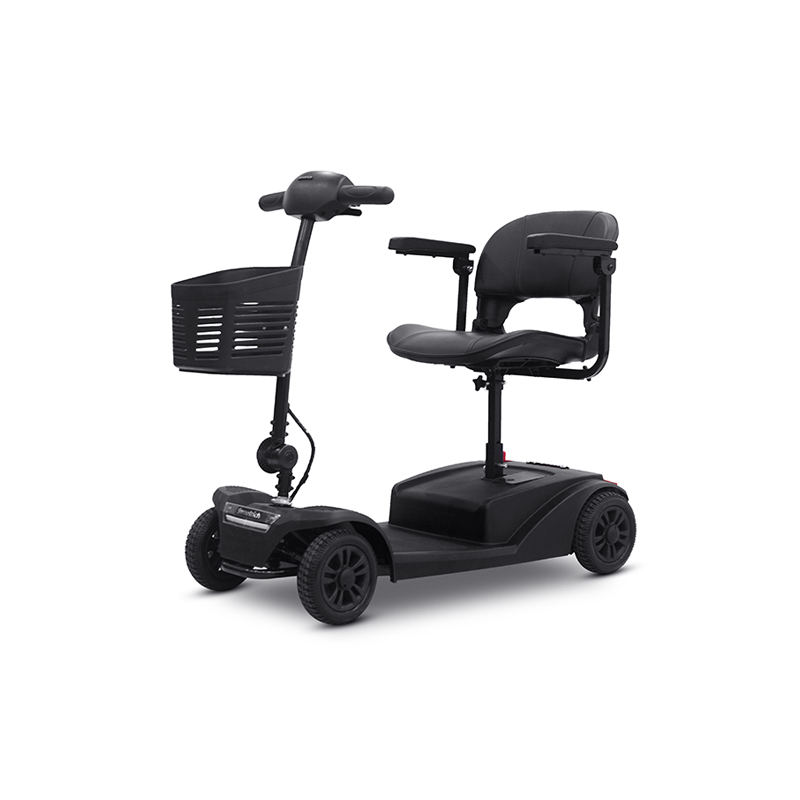
One of the central advantages of the S1 PLUS is its four-wheel structure. A four-wheel scooter can provide a reassuring sense of balance for users who prioritize stability. Compared with some narrow three-wheel alternatives, a four-wheel layout can be more suitable for customers who prefer predictable handling and a stable stance during low-speed maneuvering.
The scooter uses 9-inch by 3-inch tires at the front and rear. This uniform tire specification simplifies product communication and can help distributors organize replacement-tire information. The tire dimensions also support the scooter’s compact travel profile while providing more contact area than the very small wheels often found on ultra-light indoor mobility products.
Four-wheel construction does not eliminate the need for careful driving. Users should still approach slopes, uneven pavement, ramps, curbs, wet surfaces, and sharp turns cautiously. A mobility scooter should be operated within its rated capacity and environmental limits. Even a stable design can become unsafe if driven too quickly, overloaded, or used on terrain outside its intended application.
Balance Between Maneuverability and Security
A three-wheel scooter may offer a tighter turning circle in some environments, while a four-wheel scooter may provide a more stable feeling. The best choice depends on the user’s surroundings and preferences. The S1 PLUS is aimed at customers who want a compact product without giving up the confidence associated with four points of contact.
Its dimensions are approximately 1,110 millimeters long, 525 millimeters wide, and 920 millimeters high. This creates a relatively narrow overall width for a four-wheel design. A width of 525 millimeters can be useful in residential corridors, store aisles, elevators, and other constrained areas, although customers should always measure their intended routes before purchase.
For wholesalers, the combination of compact width and four-wheel stability is an important selling point. It gives retailers a clear explanation: the scooter is designed to remain manageable in everyday spaces while providing a broader base than many compact alternatives.
Folding-Oriented Portability and Transport Value
Portability is one of the most important factors in the travel-scooter market. A scooter can have excellent driving performance, but if it is difficult to store or transport, users may leave it at home. The S1 PLUS is identified as an electric folding mobility scooter, making its folding-oriented design central to its product appeal.
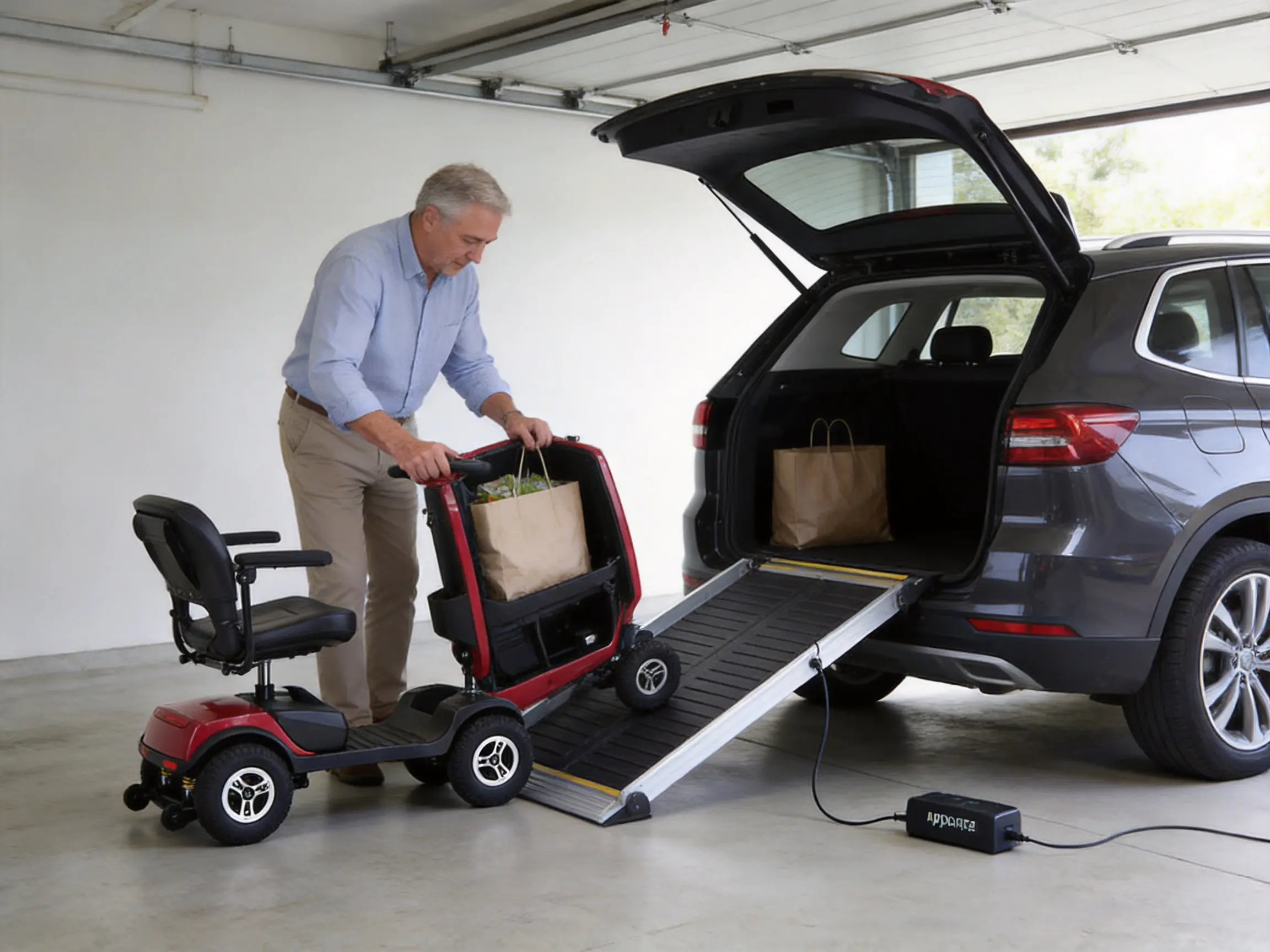
Folding capability can help users prepare the scooter for vehicle transport, storage, and seasonal use. It may also make the product more practical for households with limited storage space. Instead of requiring a permanent parking area, a foldable scooter may be stored in a designated room, garage, closet area, or vehicle compartment, provided the folded dimensions and lifting requirements are suitable.
Portability should be evaluated realistically. The listed heaviest part is 28.5 kg, or approximately 63 pounds. This is lighter than many full-size mobility scooters but may still be too heavy for one person to lift safely. Some users may need assistance, a loading ramp, or a vehicle hoist. Retailers should explain this point clearly so customers can plan transport based on their actual strength and vehicle configuration.
The product’s portability therefore comes from a combination of compact dimensions, folding design, and travel-oriented construction. It should not be described as weightless or effortless to carry. Its practical advantage is that it is more transport-friendly than many larger scooters, while retaining useful features such as four wheels, suspension, and a relatively substantial weight capacity.
Storage and Vehicle Planning
Before purchase, customers should consider the available storage location, doorway width, vehicle opening, lifting height, and any required assistance. Retailers can improve customer satisfaction by discussing these points during the sales process rather than treating folding capability as the only measure of portability.
When transported in a vehicle, the scooter should be secured according to the vehicle and carrier instructions. It should not be allowed to slide, tip, or obstruct the driver’s view. Batteries should be handled according to the applicable transport rules and the manufacturer’s instructions, especially when air travel or commercial transportation is involved.
For wholesale customers, packaging and logistics planning are also relevant. A compact folding design can help distributors manage warehouse space and provide a product that is convenient to demonstrate. However, exact carton dimensions, shipping weight, folded dimensions, and loading procedures should be confirmed with the manufacturer before listing the product for sale.
Motor, Controller, and Driving Performance
The S1 PLUS uses a 24-volt, 300-watt motor. This motor rating is appropriate for a compact mobility scooter designed for moderate-speed transportation. It is not intended to compete with heavy-duty outdoor scooters equipped with much larger motors, but it offers a practical balance between propulsion, electrical consumption, and compact form factor.
The motor controller is listed as 24 volts and 50 amps, with dynamic control. A well-matched controller is essential because it regulates the relationship between the battery, throttle input, and motor. Smooth control can make low-speed operation more comfortable, particularly when starting from rest, maneuvering through a narrow space, or approaching a doorway.
The scooter’s maximum speed is 8 km/h. A controlled speed is useful for travel environments where pedestrians, doorways, shopping areas, and shared paths are present. Users should reduce speed when turning, driving near people, moving over unfamiliar ground, or operating in low visibility.
The stated maximum driving gradient is 12 degrees. This figure should be treated as a maximum test or design reference, not as an instruction to climb every slope at that angle. Gradient performance can be affected by the user’s weight, battery charge, surface traction, temperature, tire condition, direction of travel, and whether the slope is wet or uneven. Straight-line climbing is generally safer than diagonal crossing, and users should avoid slopes that exceed their confidence or local safety guidance.
Why the Electrical System Matters
A mobility scooter’s electrical system affects more than speed. It influences starting behavior, stopping control, battery consumption, range, and overall reliability. The 24-volt architecture used by the S1 PLUS is a common and practical platform for a compact scooter. It supports the 300-watt motor while allowing a battery system sized for travel use.
The controller, charger, battery, wiring, connectors, and motor must operate as a coordinated system. A reputable manufacturing process should include inspection and testing of these connected components rather than evaluating each part in isolation. This system-level approach is particularly important for wholesale buyers, because consistent electrical performance reduces avoidable returns and service issues.
Retailers should also explain that performance changes as the battery discharges. A scooter may climb or accelerate differently at a low state of charge than it does immediately after charging. Users should plan their trips conservatively and avoid allowing the battery to become completely depleted away from home.
Battery Options, Charging, and Practical Range
The S1 PLUS is specified with lead-acid batteries in a 12-volt, 12-amp-hour configuration or a 20-amp-hour configuration using two batteries. The information also identifies the 20-amp-hour option as optional. This gives distributors an opportunity to offer different configurations according to market demand, but the exact battery package should be confirmed in the purchase specification.
Lead-acid batteries remain familiar in mobility products because they are widely understood, comparatively serviceable, and compatible with established charging systems. They can provide dependable performance when charged correctly and maintained according to instructions. They are also heavier than many lithium battery systems, which affects the total transport weight of the scooter.
The charger is specified as DC 24 volts and 2 amps, with an AC input of 100 to 240 volts. This input range can support use across different electrical markets when the correct plug, approval requirements, and regional configuration are supplied. Wholesalers should confirm the charger’s market-specific compliance and plug type before distribution.
The listed charging time is approximately six hours. Users should charge the scooter in a suitable dry and ventilated location, use the supplied or approved charger, and follow the charging sequence in the user documentation. Batteries should not be covered during charging, and charging should stop if unusual heat, odor, noise, or damage is observed.
Range Expectations
The published driving range of 15 to 25 km is useful for comparing the S1 PLUS with other travel scooters, but range is always application-dependent. A heavier user, frequent hill climbing, low temperatures, soft ground, repeated starts and stops, underinflated tires, or an aging battery can reduce the distance available from one charge.
Distributors can improve customer understanding by presenting range as an operating estimate. For example, a customer planning short shopping trips may have ample capacity, while a user expecting long outdoor journeys should consider a larger scooter or additional charging arrangements. The S1 PLUS is best matched with planned local and travel use rather than unsupported long-distance expectations.
Battery life is influenced by charging habits. Regularly allowing the battery to remain deeply discharged can shorten its useful service life. Conversely, charging according to the recommended cycle and storing the scooter in appropriate conditions can help maintain performance. Exact battery replacement intervals depend on use, maintenance, climate, and battery quality.
Braking, Suspension, and Rider Comfort
The S1 PLUS uses an electromagnetic brake system. Electromagnetic braking is valuable in a mobility scooter because it can help bring the vehicle to a controlled stop when the throttle is released, subject to the system’s design and operating instructions. It also supports a simple user experience because the rider does not need to manage a conventional hand-operated mechanical brake in the same manner as a bicycle.
Braking performance still depends on speed, slope, load, tire traction, and surface conditions. Users should leave adequate stopping distance and avoid abrupt maneuvers. The scooter should be inspected if braking feels delayed, inconsistent, noisy, or different from normal operation.
Rear suspension is another important feature. Suspension can help reduce the transfer of small surface irregularities to the rider and scooter frame. It may improve comfort when crossing ordinary pavement joints, modest unevenness, or slightly rough surfaces. Suspension is not a license to drive over severe obstacles, deep potholes, stairs, or terrain outside the scooter’s design range.
Comfort also depends on seating position, tiller adjustment, posture, tire condition, and route selection. Distributors should encourage customers to test the riding position where possible. A scooter that fits the user physically is more likely to be used safely and consistently.
Everyday Handling
The compact dimensions of the S1 PLUS support routine maneuvering. At 525 millimeters wide, the scooter can be suitable for many narrow indoor and semi-outdoor environments. However, turning clearance should be checked in advance, especially in bathrooms, elevators, apartment corridors, and vehicle loading areas.
Users should approach thresholds and transitions at a controlled angle and speed. They should avoid carrying unsecured items on the tiller or seat, because loose objects can interfere with steering or shift the center of gravity. Shopping bags should be placed only in approved storage areas, if provided.
Weight Capacity and User Matching
The rated weight capacity is 136 kg, or 300 pounds. This figure represents the total permitted user load under the manufacturer’s stated conditions. Retailers should clarify whether accessories, luggage, shopping items, and other carried objects count toward the total load. In practical terms, customers should remain below the maximum rating rather than treating it as a target.
Operating near the maximum capacity may affect acceleration, hill performance, braking distance, and range. A user who regularly carries equipment or purchases should allow additional capacity. Proper matching improves both safety and customer satisfaction.
Weight capacity should also be considered alongside seat dimensions, legroom, tiller position, and transfer ability. A customer may meet the weight requirement but still need a different scooter if the seating position is uncomfortable or difficult to access. A responsible sales process evaluates the complete user-product relationship.
The listed heaviest part of 28.5 kg provides a useful transport reference, but the actual lifting experience depends on how the scooter folds, where the weight is concentrated, and whether the user has assistance. Demonstrations should be performed carefully, using safe lifting practices.
Advantages Compared with Basic Compact Alternatives
The S1 PLUS competes in a broad field that includes three-wheel travel scooters, very small indoor models, heavy full-size scooters, and other folding products. Its advantage is not that it maximizes every specification. Instead, it offers a balanced combination of features that can be attractive to customers seeking a practical middle ground.
First, the four-wheel layout may provide a more stable feeling than a narrow three-wheel configuration. This can be important for older users or customers who feel more comfortable with a broader support base.
Second, the 9-inch tire size and rear suspension offer a more substantial riding platform than extremely small indoor scooters. While the product remains a travel-oriented vehicle, these features can contribute to greater comfort on ordinary outdoor surfaces.
Third, the 136 kg weight capacity gives the scooter a useful customer range. It is not limited to only very light users, although actual performance must still be matched to the total load.
Fourth, the electromagnetic brake system provides an integrated approach to stopping and parked control. Customers who find traditional manual brake levers difficult may appreciate the simplicity of a scooter designed around electrical control and automatic braking behavior.
Fifth, the 24-volt, 300-watt motor provides appropriate propulsion for a compact scooter without requiring the size and mass associated with heavy-duty outdoor models. This supports the product’s travel-oriented identity.
Finally, the folding and compact format may make the product more convenient for storage and transport than a conventional full-size scooter. Customers who need a scooter for occasional travel may value this convenience more than an extremely high top speed or long-distance battery system.
A Balanced Alternative Rather Than an Extreme Model
Some scooters are designed primarily for indoor use and may have limited outdoor capability. Others are designed for extended outdoor journeys and may be difficult to transport. The S1 PLUS occupies a practical middle position. It offers compactness and folding-oriented portability while retaining four-wheel stability, rear suspension, and a useful weight capacity.
This balanced specification can make the model easier for distributors to position across several customer groups. It may appeal to seniors, travelers, users with limited walking endurance, and households that need a secondary mobility vehicle. Nevertheless, product suitability should always be determined by the customer’s environment, physical ability, and intended distance.
Manufacturing Strengths and Production Background
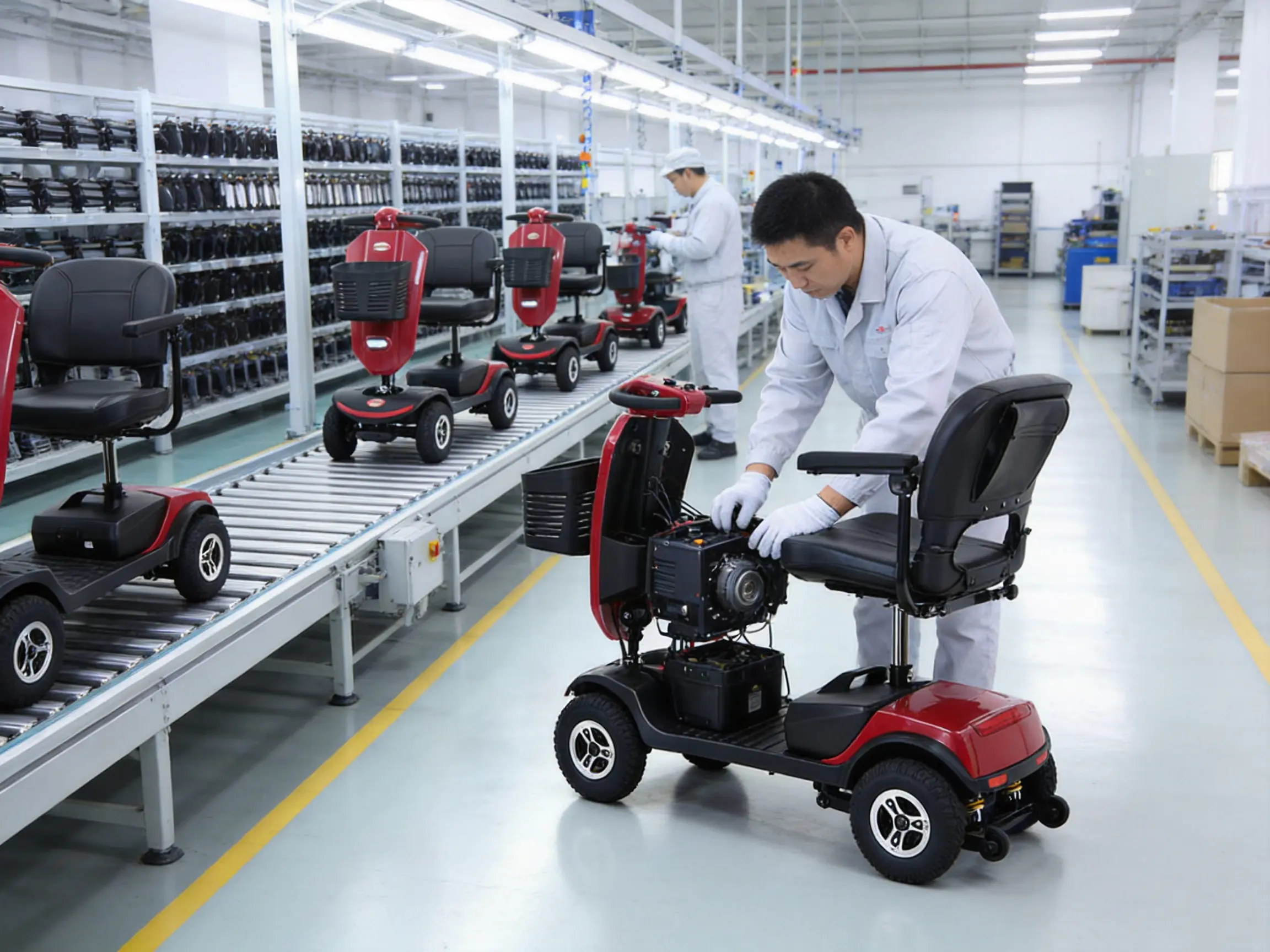
The S1 PLUS is produced by Suzhou Sweetrich Vehicle Industry Technology Co., Ltd., a company established in 2011 and located in Suzhou Industrial Zone, Jiangsu, China. The company reports a 60-acre site and a 30,000-square-meter factory. This scale provides a substantial foundation for research, development, assembly, testing, inventory coordination, and wholesale production.
A manufacturer’s physical facilities do not automatically guarantee product quality, but they can support a more structured production system. Dedicated space allows different activities to be organized, including component handling, assembly, inspection, finished-product storage, and after-sales support. For wholesale customers, this matters because reliable supply and consistent specifications are essential to maintaining a product line.
The company has accumulated more than ten years of experience in mobility scooters and power wheelchairs. This experience is relevant because mobility products require an understanding of human factors, low-speed vehicle control, battery systems, braking, seating, frame construction, and user safety. Long-term participation in the sector can help a manufacturer refine designs based on market feedback and service experience.
Research and Development Orientation
Sweetrich states that it owns intellectual property rights related to its electric scooters and power wheelchairs. Product development supported by internal intellectual property can help a manufacturer control important design decisions rather than simply relying on generic external platforms. It may also support ongoing improvements in control technology, driving systems, folding structures, and user comfort.
The S1 PLUS reflects a design approach centered on practical mobility. The combination of compact dimensions, four wheels, rear suspension, electromagnetic braking, moderate motor power, and travel-oriented battery options indicates an effort to integrate several user needs into one product. A successful mobility scooter is not defined by a single component; its value comes from how the frame, controls, motor, battery, wheels, brake, and seating work together.
Research and development should also include consideration of different user abilities. Many mobility scooter customers may have reduced strength, limited balance, or difficulty with complex controls. A straightforward operating system and predictable response can therefore be as important as raw performance.
Production Management and Quality Focus
The company describes its production management as strict and its product design process as scientific. Although specific inspection procedures, certifications, and test reports should be requested for each market and model, the stated emphasis on production control is relevant to wholesale buyers.
Consistent production involves more than assembling visible components. It includes incoming inspection of parts, dimensional control, wiring verification, battery and charger checks, brake testing, functional operation, and final appearance inspection. A structured process can help identify defects before products leave the factory and can reduce variation between batches.
For a folding mobility scooter, quality control should pay particular attention to frame joints, folding mechanisms, locking points, steering components, wheel alignment, seat attachment, and cable routing. Repeated movement and transport can place stress on these areas. Proper assembly and inspection are therefore important for long-term usability.
Electrical inspection is equally significant. The motor controller, electromagnetic brake, charger, battery connectors, and control interface must operate correctly as a complete system. A manufacturing partner with experience in mobility vehicles is better positioned to understand the interaction between these parts and the requirements of a low-speed personal transportation product.
International Market Experience and Wholesale Support
The company reports that its products are exported to America, Europe, Japan, Australia, the Middle East, Russia, and other markets. International distribution requires attention to different customer expectations, packaging practices, documentation, electrical systems, language needs, and regulatory environments.
Market experience can also help a manufacturer understand the importance of product consistency. A distributor may need repeat orders that match earlier shipments in specifications, color, accessories, packaging, and replacement parts. Clear communication between the factory and distributor is essential for maintaining a stable retail offering.
Wholesale buyers should confirm the details that apply to their own market. These may include electrical approvals, labeling, user manuals, battery transport documentation, warranty terms, spare-parts availability, packaging requirements, and local product registration. The fact that a scooter is available internationally does not remove the buyer’s responsibility to verify local compliance.
Sweetrich’s stated business principles include quality first, credit above, and customer supreme. For a wholesale relationship, these principles are most valuable when translated into measurable practices: clear specifications, controlled production, responsive communication, documented inspections, stable lead times, and practical after-sales support.
Why Manufacturing Depth Matters to Distributors
Distributors often face costs that are not visible at the time of purchase. These can include warranty claims, replacement-part requests, damaged packaging, inconsistent instructions, incorrect chargers, and customer questions about operation. A manufacturer with product-development experience and established production resources may be better able to provide technical responses and corrective action.
A strong manufacturing partner can also support product customization within reasonable limits. Possible areas may include packaging, labels, color, accessories, battery options, and market-specific documentation. Such options should be negotiated in advance and documented clearly, because customization can affect minimum order quantities, lead times, testing, and warranty responsibilities.
Maintenance and Long-Term Ownership
Routine maintenance helps preserve safety and performance. Users should keep the scooter clean and dry, inspect the tires, check for loose fasteners, observe the condition of cables and connectors, and confirm that the steering and folding components operate normally. Any unusual noise, vibration, hesitation, or braking behavior should be investigated before continued use.
Tire condition is important because the tires influence traction, ride comfort, braking, and range. They should be maintained at the recommended pressure if applicable. Underinflated tires can increase rolling resistance and reduce efficiency, while damaged or excessively worn tires can compromise handling.
The battery should be charged and stored according to the manufacturer’s instructions. It should be protected from extreme temperatures, moisture, and physical damage. If the scooter will not be used for an extended period, the owner should follow the recommended storage-charging procedure rather than simply leaving the battery fully depleted.
The folding mechanism should be kept free of obstructions. Users should not force the frame if it does not move normally. A folding scooter should be fully locked in its operating position before driving, and the locking mechanism should be checked regularly.
Maintenance responsibilities are easier to manage when distributors provide clear documentation. Retailers should explain basic checks at delivery and direct customers to qualified service personnel for electrical, battery, brake, or structural repairs that exceed routine user maintenance.
Safety Considerations for Users and Retailers
Safety begins with proper user matching. Customers should be able to sit securely, operate the controls, understand the braking response, and see the travel path. They should receive instruction on starting, stopping, steering, reversing, charging, folding, and transporting the scooter.
The S1 PLUS should be used on surfaces and routes appropriate for a compact mobility scooter. Users should avoid stairs, escalators, deep water, loose sand, severe mud, large obstacles, and slopes beyond the scooter’s capability. Wet conditions can reduce traction and visibility, even when a product is described as suitable for all-weather or outdoor travel.
Users should observe local rules governing mobility scooters on sidewalks, roads, shared paths, public transport, and commercial premises. Requirements may differ by location. Lights, reflectors, visibility equipment, speed restrictions, and crossing procedures may be regulated locally.
Retailers should avoid presenting the scooter as suitable for every terrain or every medical condition. Product descriptions should accurately communicate its specifications and limitations. Responsible marketing protects both customers and distributors.
Wholesale Value Proposition
For wholesalers, the S1 PLUS offers several characteristics that can support a clear sales strategy. It has a recognizable use case, a practical specification set, and a configuration that can appeal to both first-time buyers and customers seeking a portable secondary scooter.
The product’s four-wheel design creates a simple stability message. Its folding-oriented format supports travel and storage messaging. The rear suspension and 9-inch tires add comfort-related value. The electromagnetic brake system supports ease-of-use communication. The 136 kg weight capacity broadens the potential user base, while the 8 km/h speed keeps the product aligned with controlled personal mobility.
The model can also complement a broader catalog. A distributor might position it alongside lightweight indoor scooters, heavy-duty outdoor models, power wheelchairs, ramps, battery accessories, or transport equipment. This allows a sales team to recommend products according to user needs instead of presenting one scooter as suitable for everyone.
Wholesale success depends on more than the product itself. The distributor should evaluate factory responsiveness, sample quality, packaging, documentation, warranty handling, spare parts, order consistency, and delivery arrangements. The manufacturer’s established facility and international experience provide a useful foundation for this evaluation, but buyers should complete their own due diligence.
Product Presentation for Retail Channels
Retail listings should use accurate specifications and avoid exaggerated claims. Useful information includes the scooter’s dimensions, speed, range estimate, weight capacity, battery type, charging time, motor rating, brake system, tire size, suspension configuration, and heaviest part.
Retailers should also explain the difference between total scooter weight and heaviest removable or separated part. Customers often assume that a folding scooter can be lifted easily. Providing the 28.5 kg heaviest-part figure helps set realistic expectations.
Product education can be supported with demonstrations. A customer should see how the scooter folds, how the controls respond, how the brake behaves when the throttle is released, and how the battery is charged. Demonstration staff should use safe procedures and avoid allowing untrained customers to operate the scooter in crowded areas.
Technical Specification Table
| Specification | S1 PLUS Details |
|---|---|
| Product type | Four-wheel electric folding mobility scooter |
| Category | Travel smart scooter |
| Dimensions | 1,110 mm long × 525 mm wide × 920 mm high |
| Maximum forward speed | 8 km/h, approximately 5 mph |
| Maximum driving gradient | 12 degrees |
| Maximum stated driving range | 15–25 km, approximately 9.5–15.5 miles |
| Weight capacity | 136 kg, approximately 300 lb |
| Suspension | Rear suspension |
| Tire size | 9 × 3 inches front and rear |
| Brake system | Electromagnetic brake |
| Battery options | Lead-acid 12 V 12 Ah or 20 Ah × 2; 20 Ah option listed as optional |
| Charger | DC 24 V, 2 A; AC input 100–240 V |
| Charging time | Approximately 6 hours |
| Motor | 24 V, 300 W |
| Motor controller | 24 V, 50 A dynamic controller |
| Heaviest part | 28.5 kg, approximately 63 lb |
| Market positioning | Non-medical mobility device for the United States market |
Specifications should be confirmed with the manufacturer before final purchase, especially when selecting optional battery configurations or preparing market-specific listings. Range, gradient performance, and charging results may vary according to operating conditions.
Frequently Asked Questions
What type of user is the S1 PLUS designed for?
The S1 PLUS is designed for users seeking compact personal mobility for travel, shopping, local transportation, and suitable indoor or outdoor environments. It may be appropriate for people who want a four-wheel platform and folding-oriented portability. Final suitability depends on the user’s physical needs, route conditions, and local regulations.
Is the S1 PLUS a medical device?
The product information identifies it as a non-medical device for the United States market. It is intended for personal transportation and mobility support, not for diagnosing, treating, or curing a medical condition. Customers with specific health or mobility concerns should consult an appropriate professional before selecting a product.
How fast can the scooter travel?
The maximum forward speed is listed as 8 km/h, or approximately 5 miles per hour. Users should operate at a lower speed when turning, traveling near pedestrians, crossing uneven surfaces, entering buildings, or handling unfamiliar conditions.
What is the expected driving range?
The stated range is 15 to 25 km, or approximately 9.5 to 15.5 miles. Actual range varies with battery configuration, rider weight, terrain, temperature, tire pressure, battery age, driving style, and the number of starts and stops.
Can the scooter climb hills?
The maximum driving gradient is listed as 12 degrees. This is a specification reference rather than a recommendation for routine operation on every slope. Users should approach hills cautiously and consider surface traction, battery charge, total load, weather, and their ability to control the scooter.
How much weight can it carry?
The listed weight capacity is 136 kg, or approximately 300 pounds. Users should account for the combined weight of the rider and any carried items. Operating below the maximum capacity may provide a more comfortable margin for range, acceleration, and hill performance.
Is the scooter easy to lift?
The heaviest part is listed as 28.5 kg, or approximately 63 pounds. This is more transport-friendly than many full-size scooters, but it may still require assistance or loading equipment. Customers should evaluate their vehicle and lifting ability before purchase.
What battery does the S1 PLUS use?
The listed battery choices are lead-acid 12-volt, 12-amp-hour batteries or a 20-amp-hour configuration using two batteries. The 20-amp-hour option is identified as optional. The exact configuration should be confirmed on the purchase order.
How long does charging take?
The listed charging time is approximately six hours. Charging should be carried out with the supplied or approved charger in a dry, suitable, and ventilated location. Users should follow the detailed instructions provided with the final product.
Does the scooter have suspension?
Yes. The S1 PLUS is listed with rear suspension. This can help absorb some minor surface irregularities and improve comfort, but it does not make the scooter suitable for severe off-road terrain, stairs, deep potholes, or unsafe obstacles.
Why use a four-wheel design?
A four-wheel design can provide a broad and stable base. It may appeal to users who prefer a planted feeling during everyday travel. The trade-off is that some three-wheel scooters may turn more tightly in certain spaces, so customers should choose according to their environment and handling preferences.
What should wholesalers confirm before ordering?
Wholesalers should confirm the exact battery configuration, folded dimensions, packaging dimensions, colors, accessories, charger plug, documentation, warranty terms, spare-parts support, minimum order quantity, lead time, and market-specific compliance requirements. These details should be recorded in the final commercial agreement.
Conclusion
The S1 PLUS All Weather Wholesale Four Wheels Electric Folding Mobility Scooter is designed as a balanced travel mobility solution. Its strongest advantages come from the combination of four-wheel stability, compact dimensions, folding-oriented portability, rear suspension, electromagnetic braking, a 300-watt motor, and a 136 kg weight capacity.
Its 8 km/h maximum speed and 15–25 km stated range place it within the practical travel-scooter category. The product is suited to controlled local transportation and planned trips rather than unrestricted long-distance or extreme-terrain use. Customers should consider battery configuration, route conditions, rider weight, storage arrangements, and transport requirements before purchase.
For distributors, the product is supported by the manufacturing background of Suzhou Sweetrich Vehicle Industry Technology Co., Ltd., including more than a decade of mobility-product experience, a reported 60-acre site, a 30,000-square-meter factory, international export experience, and a stated focus on research, intellectual property, quality management, and user-oriented design.
The most important commercial advantage is the product’s balanced specification. It is more substantial than a basic indoor scooter while remaining more travel-oriented than a full-size outdoor model. This middle position can give wholesalers and retailers a clear opportunity to serve customers who need comfort, stability, and portability in one compact electric mobility product.
As with any mobility scooter, accurate product education and responsible user matching are essential. When supplied with clear specifications, proper instructions, suitable service support, and realistic performance expectations, the S1 PLUS can become a practical addition to a mobility-product portfolio.
References
1. Sweetrich Mobility. S1 PLUS product specification information, including dimensions, motor, battery, braking, suspension, tire, range, and capacity data.
2. Sweetrich Mobility. Company profile and manufacturing background information concerning product development, factory resources, production management, and international markets.
3. General mobility-scooter operating principles concerning battery charging, braking, gradient management, tire maintenance, transport, and safe user matching.
4. General product-selection guidance for travel mobility scooters, including considerations related to dimensions, weight capacity, range, storage, vehicle transport, and local operating requirements.