
 +86-(0)512-82283871

Content
- 1 1. Understanding the Product Concept
- 2 2. Key Specifications at a Glance
- 3 3. Stability and Four-Wheel Performance
- 4 4. Comfort-Oriented Seating Features
- 5 5. Pneumatic Tires and Outdoor Travel
- 6 6. Motor Power and Control
- 7 7. Electromagnetic Braking
- 8 8. Battery System, Range, and Charging
- 9 9. Dimensions, Storage, and Transportation
- 10 10. Comparing the Product with Less Capable Alternatives
- 11 11. Manufacturing Strengths of the Supplier
- 12 12. Research, Development, and Product Design
- 13 13. Quality Management and Production Consistency
- 14 14. Practical Benefits for Users and Caregivers
- 15 15. Safe and Responsible Use
- 16 16. Maintenance and Ownership Considerations
- 17 17. Suitability for Different Markets
- 18 18. Questions Buyers Should Ask Before Ordering
- 19 19. Frequently Asked Questions
- 19.1 Is this wheelchair intended mainly for indoor or outdoor use?
- 19.2 What is the maximum user weight?
- 19.3 How fast can it travel?
- 19.4 What range can be expected from one charge?
- 19.5 How long does charging take?
- 19.6 What type of batteries does the wheelchair use?
- 19.7 Does the product have suspension?
- 19.8 Are the tires pneumatic?
- 19.9 What braking system is used?
- 19.10 How heavy is the wheelchair?
- 19.11 Is the product a medical device?
- 19.12 Is a remote control included?
- 19.13 Who manufactures the product?
- 19.14 What should distributors confirm before importing it?
- 20 20. Overall Evaluation
- 21 References
- 22 Product: iPower Sport Hot popular four wheels power remote electronic wheelchair in dubai
Mobility equipment is becoming increasingly important for older adults, people with limited mobility, and users who want a more independent way to travel through homes, communities, commercial areas, and outdoor spaces. A suitable electric wheelchair must do more than move from one point to another. It should offer stability, usable range, comfortable seating, dependable control, effective braking, and a structure capable of supporting regular use. It should also be practical for families, caregivers, distributors, and mobility-equipment providers who need a reliable product with clearly defined specifications.
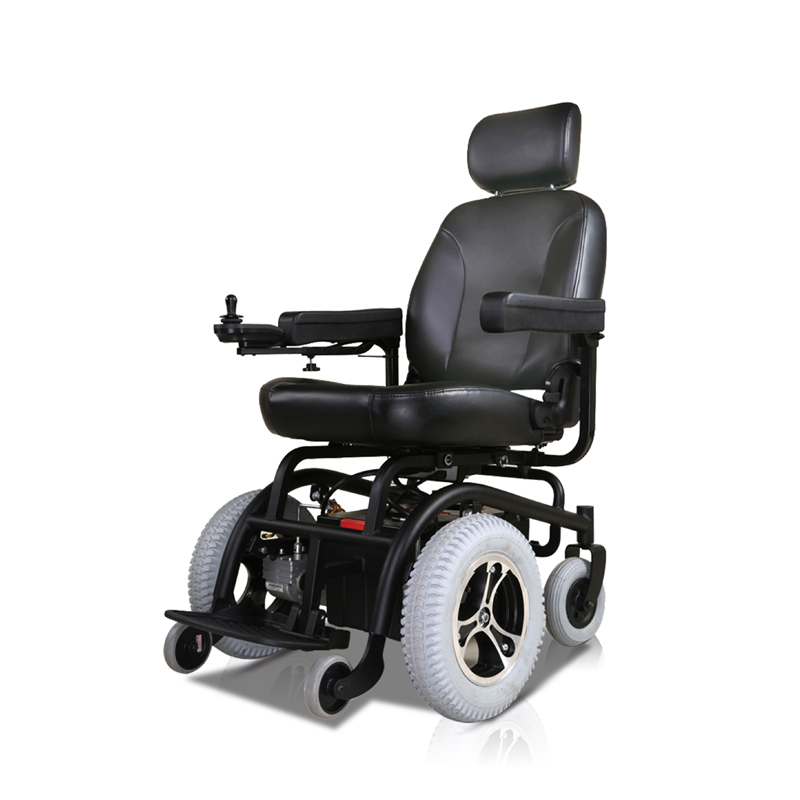
The iPower Sport is a heavy-duty four-wheel power wheelchair designed for users who value stability, outdoor capability, and straightforward operation. Its design combines large pneumatic tires, rear suspension, anti-tip wheels, a leather-like cushioned seat, adjustable seat-back support, electromagnetic braking, and a dual-motor drive system. These features position the model as a robust option for travel on a variety of reasonably maintained surfaces.
With a maximum forward speed of 8 km/h, a stated driving range of 30–40 km, and a maximum user weight capacity of 120 kg, the wheelchair is intended to provide more than short-distance indoor mobility. Its four-wheel configuration and suspension system help create a stable platform, while the 24V motor system supplies the power needed for everyday travel. The product is also designed around practical serviceability, using lead-acid batteries, a conventional charger, and a motor controller supplied by PG from the United Kingdom.
This article examines the product’s construction, user benefits, operating characteristics, manufacturing background, and potential advantages over less capable mobility products. It also explains the factors that buyers and mobility-equipment distributors should review before selecting a heavy-duty electric wheelchair.
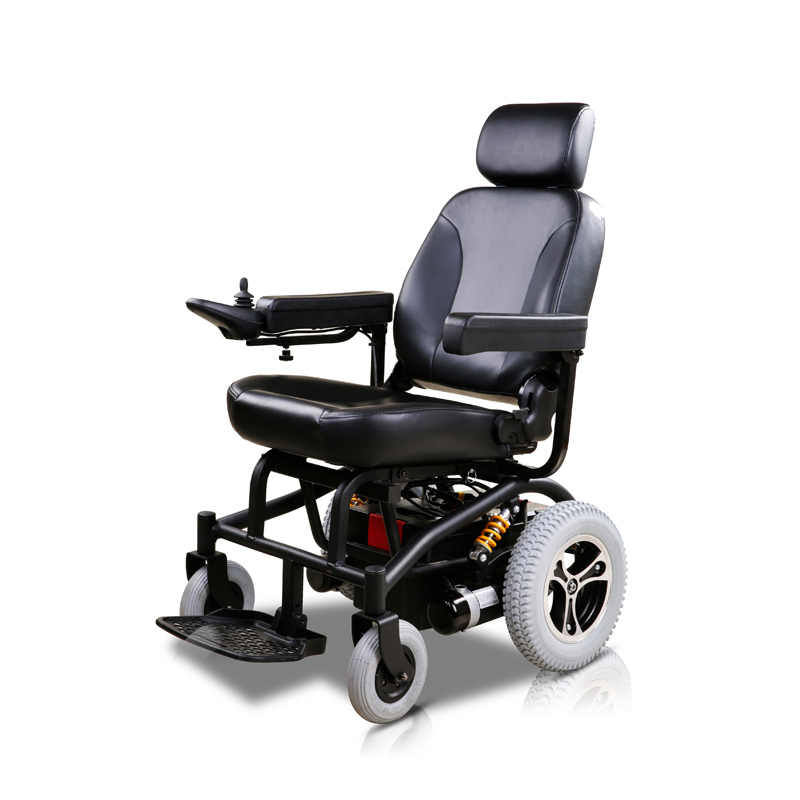
iPower Sport Hot popular four wheels power remote electronic wheelchair in dubai
1. Understanding the Product Concept
The iPower Sport belongs to the heavy-duty wheelchair category, but its design also shares several characteristics with outdoor mobility scooters. It uses four wheels, pneumatic tires, suspension, a powered drive system, and a supportive seat. Unlike a basic manual wheelchair, it is designed to reduce the physical effort required from the user. Unlike a small indoor power chair, it offers a larger outdoor-oriented structure, higher ground-contact capability, and a more substantial seating platform.
The main concept is simple: provide powered mobility in a stable, comfortable, and comparatively durable package. The design is especially relevant for users who may travel over indoor flooring, paved paths, residential streets, shopping areas, access ramps, and other surfaces where a compact indoor chair may feel too limited. The product is not described as a medical device for the United States market, so buyers should evaluate local classification, intended use, and regulatory requirements before purchase or resale.
The four-wheel arrangement gives the wheelchair a broad and balanced footprint. Four points of contact can help distribute the load and may provide a reassuring feeling when the product is moving forward or negotiating ordinary surface variations. The front and rear tire sizes are different: the front tires measure 8 by 2.5 inches, while the rear tires measure 14 by 3 inches. The larger rear tires support the drive section and contribute to the product’s outdoor-oriented appearance and function.
The iPower Sport is powered by two 24V/320W motors. A dual-motor configuration can provide consistent drive on both sides of the chair and supports controlled movement when the user is traveling in a straight line or making a turn. The system is paired with a 24V/50A PG motor controller. Together, the motors and controller form the core of the wheelchair’s power and handling system.
2. Key Specifications at a Glance
Technical specifications help buyers compare a powered wheelchair with other products in the same category. The following table summarizes the available product information.
| Specification | Product Information |
|---|---|
| Product category | Heavy-duty electric wheelchair |
| Overall dimensions | 980 × 600 × 1180 mm, length × width × height |
| Maximum forward speed | 8 km/h, approximately 5 miles per hour |
| Maximum driving gradient | 10 degrees |
| Maximum driving range | 30–40 km, approximately 19–25 miles |
| Weight capacity | 120 kg, approximately 265 lb |
| Suspension | Rear suspension |
| Front tire size | 8 × 2.5 inches |
| Rear tire size | 14 × 3 inches |
| Brake system | Electromagnetic brake |
| Battery type | Two lead-acid batteries, 12V 40Ah each |
| Charger | DC24V 5A; AC115–230V input |
| Charging time | Approximately 6–8 hours |
| Motor system | Two 24V/320W motors |
| Motor controller | 24V/50A PG controller |
| Heaviest part | 56 kg, approximately 123 lb |
These specifications show that the wheelchair is designed as a substantial travel product rather than a lightweight transport chair. Its 600 mm width may provide a stable seating and wheelbase arrangement, but buyers should compare this measurement with doorways, elevators, vehicle ramps, and storage areas. The stated heaviest-part weight of 56 kg is also important when planning transportation or loading. Although the wheelchair may be suitable for a range of travel situations, it should not be assumed to be easy to lift without suitable equipment or assistance.
3. Stability and Four-Wheel Performance
Stability is one of the most important qualities in a powered wheelchair. Users often feel more confident when the chair has a solid wheelbase, predictable steering, and features that help limit unwanted movement. The iPower Sport uses four wheels, rear suspension, and anti-tip wheels to support a stable riding experience.
The four-wheel layout is especially useful for users who prioritize a planted feel over the compact turning characteristics of a smaller three-wheel mobility product. Four wheels create a stable base under the frame and can make the wheelchair feel more balanced during ordinary forward movement. The anti-tip wheels add another layer of support by helping reduce the possibility of excessive rearward tipping during certain operating conditions.
However, stability depends on correct operation. A maximum gradient of 10 degrees is a stated product limit, not an invitation to attempt every slope of that angle. Actual performance can be influenced by the user’s weight, battery condition, tire pressure, surface texture, moisture, load distribution, and the length of the slope. Users should approach ramps and inclines carefully, follow local safety guidance, and avoid uneven or hazardous terrain that exceeds the product’s intended operating conditions.
The rear suspension is another useful design feature. Suspension can help reduce the impact transferred from the ground to the frame and seat when the wheelchair travels over small surface irregularities. It can also improve comfort on paved outdoor paths and other firm surfaces that are not perfectly smooth. Suspension does not eliminate the need for careful driving, but it can make everyday travel feel less harsh than it would on a fully rigid frame.
Compared with a basic powered wheelchair that lacks suspension and anti-tip equipment, the iPower Sport offers a more complete outdoor-oriented chassis. Compared with a narrow indoor chair, its larger rear tires and substantial frame may provide a more reassuring feel over common outdoor surfaces. The trade-off is that a heavier, wider product requires more planning for storage and transportation.
4. Comfort-Oriented Seating Features
Comfort has a direct effect on how often a user can enjoy powered mobility. A wheelchair that performs well but provides poor seating support may become tiring during longer trips. The iPower Sport includes a leather-like cushion seat and an adjustable seat back, two features that address basic comfort and positioning needs.
The cushioned seat is intended to provide a softer contact surface than a simple flat, rigid seat. The leather-like covering can also be practical for routine cleaning because smooth upholstery is generally easier to wipe than textured fabric. Users and caregivers should still follow appropriate cleaning practices and protect the seat from prolonged exposure to moisture, extreme heat, and abrasive materials.
The adjustable seat back allows users to alter the angle of the back support to suit personal comfort. An adjustable back can be useful during longer periods of sitting because different users have different posture preferences. Some may prefer a more upright position for visibility and conversation, while others may prefer additional reclining support when resting. The correct position should preserve control access, visibility, and safe weight distribution.
Seat comfort also depends on factors that are not fully represented in a specification sheet. Users should consider seat width, seat depth, foot placement, arm support, control position, cushion firmness, and ease of transfer. A distributor or professional adviser may need to help match the wheelchair to the user’s body shape, physical ability, and daily environment.
The iPower Sport’s seating design is a practical advantage over entry-level powered chairs that offer little adjustment. It does not mean that the product is suitable for every user or every clinical seating requirement. Because the product information identifies it as non-medical for the United States market, users who need specialized postural support should obtain appropriate professional guidance before purchase.

5. Pneumatic Tires and Outdoor Travel
Tires are a major contributor to the way a wheelchair feels and performs. The iPower Sport uses pneumatic tires, which contain air and can provide a degree of natural cushioning between the ground and the vehicle. The 8-inch front tires and larger 14-inch rear tires are intended to support movement across firm outdoor surfaces and common variations in pavement.
Pneumatic tires can offer a softer ride than solid tires when they are correctly inflated. They may also provide useful traction on suitable surfaces. The larger rear tires help the drive wheels maintain contact with the ground and can make it easier to roll over small transitions than very small wheels would. Nevertheless, tire pressure must be checked regularly. Underinflated tires can reduce efficiency, affect steering, increase rolling resistance, and create additional stress on the tire sidewalls. Overinflated tires may reduce comfort and traction.
Because pneumatic tires can be punctured, users should inspect them for cuts, embedded objects, and unusual wear. A distributor should explain how to inflate and maintain the tires and should identify suitable replacement components. Regular inspection is particularly important for users who travel outdoors or over surfaces where sharp debris may be present.
The tire design represents an advantage over some basic indoor wheelchairs fitted with smaller, harder wheels. Such products may be easier to store but can feel less capable on uneven pavement, thresholds, or outdoor paths. The iPower Sport is better aligned with users who want a balance between indoor usability and outdoor travel capability.
It is important to define outdoor capability realistically. The wheelchair is not intended to function as an off-road vehicle. Loose sand, deep mud, standing water, steep cross-slopes, ice, and heavily damaged terrain may create serious handling risks. The best performance should be expected on firm, reasonably maintained surfaces within the stated operating limits.
6. Motor Power and Control
The drive system uses two 24V/320W motors. Dual motors can provide balanced propulsion and allow the wheelchair to respond smoothly to control inputs. The motors are supplied as a matched system for the product, while the 24V/50A PG controller manages the electrical commands sent to the drive units.
A motor controller is central to the driving experience. It translates input from the control interface into acceleration, deceleration, and direction commands. A well-matched controller can help make movement more predictable, which is especially valuable for users who need confidence when maneuvering around furniture, doorways, pedestrians, and outdoor pathways.
The maximum forward speed is 8 km/h, or approximately 5 miles per hour. This speed is suitable for practical travel while allowing the user to maintain a manageable pace in many environments. Speed should always be adjusted to the conditions. Indoor areas, crowded sidewalks, ramps, corners, and wet surfaces require slower operation than open, clear paths.
The title supplied for the product describes it as a power remote electronic wheelchair. Buyers should confirm the exact control and remote functions included in the configuration they intend to purchase, because product packages and regional specifications may differ. They should also confirm whether the control system is designed for the user, an attendant, or both, and whether any remote function has specific range or operating limitations.
Compared with a low-power single-motor product, the dual-motor system may offer stronger and more balanced propulsion. The 320W rating for each motor provides a substantial drive foundation for a chair with a 120 kg stated weight capacity. Actual hill-climbing and range performance will vary with load, terrain, tire pressure, battery condition, temperature, and driving style.
7. Electromagnetic Braking
The iPower Sport uses an electromagnetic brake system. Electromagnetic braking is commonly valued in powered mobility because it can engage when the drive control is released or power is interrupted, helping the wheelchair slow and remain stationary under appropriate conditions.
A braking system is only one part of safe mobility. Users should not depend on the brake to compensate for excessive speed, an unsuitable slope, poor tire condition, or an unstable surface. Before each journey, the user or caregiver should check that the chair starts, stops, and holds as expected. Any unusual noise, delayed stopping, loss of braking, or control error should be treated as a reason to stop using the product until it has been inspected.
The electromagnetic brake is a valuable advantage over very basic mobility products that may rely on less sophisticated stopping arrangements. When integrated correctly with the controller and motors, it can support controlled deceleration and stationary holding. A retailer should provide clear operating instructions and explain how the braking system behaves when the chair is switched off or encounters a low-battery condition.
Users should also understand that parking on a slope presents additional risk. Whenever possible, the wheelchair should be parked on a level surface, with the power switched off according to the operating instructions. The chair should not be left unattended near stairs, roadways, water, or other hazards.
8. Battery System, Range, and Charging
The wheelchair uses two 12V 40Ah lead-acid batteries. Together, these batteries provide the 24V electrical supply required by the motor and controller system. Lead-acid batteries remain widely used in mobility equipment because they are familiar, comparatively accessible, and available through many service channels.
The stated maximum driving range is 30–40 km, or approximately 19–25 miles. This figure is useful for planning but should not be interpreted as a guaranteed distance under every condition. Range is affected by user weight, gradient, speed, stop-and-start operation, tire pressure, temperature, battery age, surface quality, and the use of accessories or lighting if fitted.
For example, a user traveling on level, firm pavement at moderate speed may achieve a result closer to the upper end of the stated range than a user frequently climbing slopes or driving over rough ground. Batteries also lose capacity gradually as they age. Proper charging habits and routine inspection can help preserve useful performance.
The charger is specified as DC24V 5A with AC115–230V input. This broad input range can support use across many electrical markets, although the correct plug, local electrical requirements, and approved charging procedure must be confirmed before use. The stated charging time is approximately 6–8 hours. Users should charge the batteries in a suitable, dry, ventilated location and should use only the charger intended for the wheelchair.
Lead-acid batteries are heavier than some newer battery technologies. This contributes to the product’s overall weight and affects transportation. Their advantage is that they are a familiar and established solution with straightforward replacement pathways in many markets. Buyers who prioritize the lowest possible weight may wish to compare battery options, but any alternative must be electrically compatible and approved for the wheelchair.
The battery compartment and electrical connections should be kept clean and dry. Users should avoid modifying wiring, bypassing protective components, or installing a charger with an unsuitable voltage or current. Battery maintenance and replacement should be performed according to the supplier’s instructions.
9. Dimensions, Storage, and Transportation
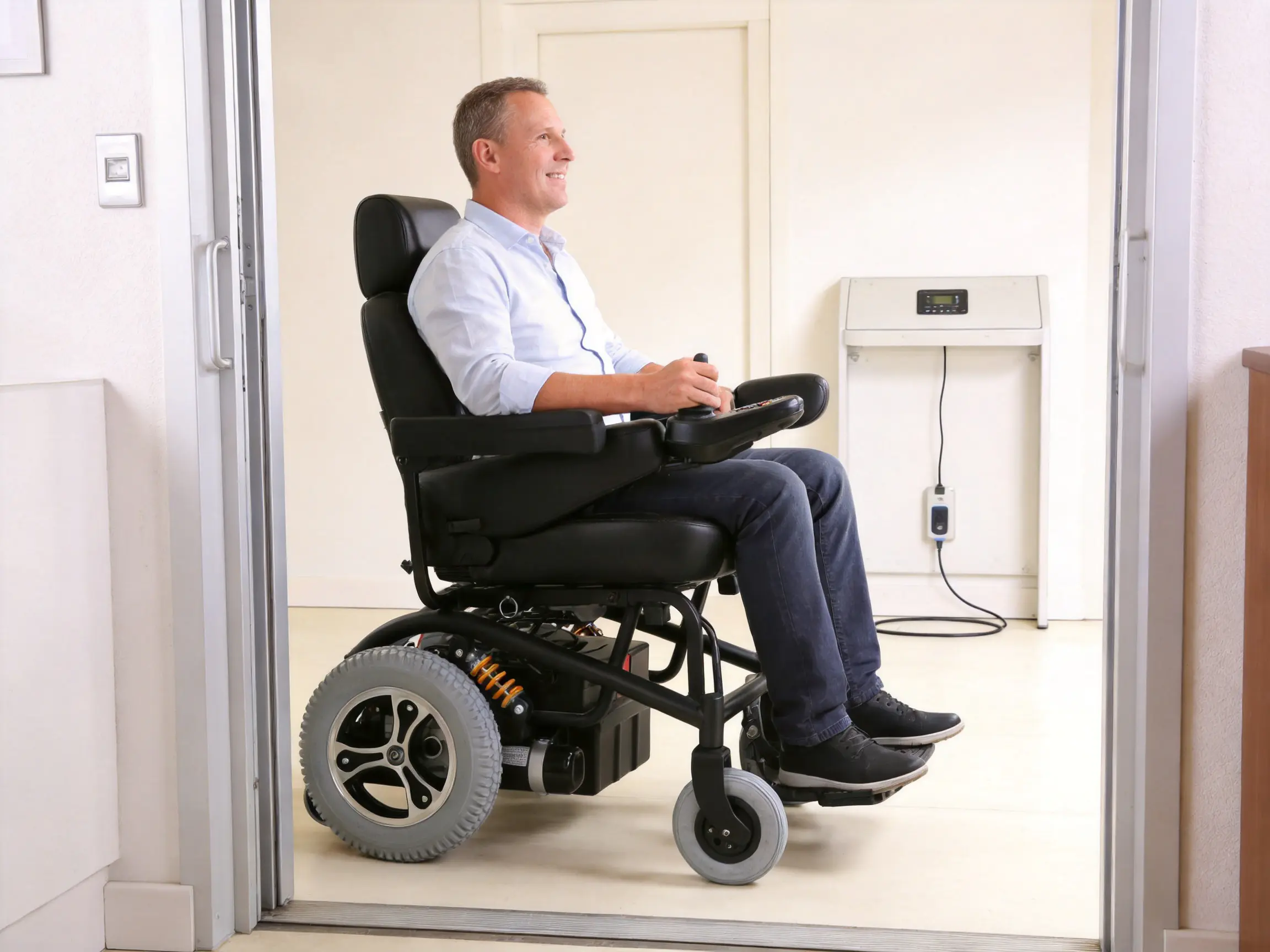
The overall dimensions are 980 mm in length, 600 mm in width, and 1180 mm in height. The 600 mm width may allow the wheelchair to pass through many standard access points, but each user’s environment should be measured carefully. Door frames, elevator entrances, bathroom layouts, vehicle ramps, and hallway corners can differ considerably.
The height of 1180 mm provides a substantial seating and control position, but it should be considered when entering low-clearance areas or storing the wheelchair beneath shelves and vehicle interiors. The chair’s length and four-wheel base should also be compared with the turning space available in the home or workplace.
The heaviest part weighs 56 kg, or approximately 123 lb. This is a significant weight for one person to lift. Transportation planning is therefore essential. A suitable vehicle lift, loading ramp, transport platform, or accessible van may be necessary. Caregivers should not attempt unsafe lifting techniques, particularly when handling the wheelchair together with its batteries.
The product may be a strong choice for users who prioritize performance and stability over portability. In comparison, a lightweight folding wheelchair may be easier to carry but may provide less suspension, a smaller seating structure, a lower weight capacity, or reduced outdoor capability. The best choice depends on whether the main requirement is vehicle transport, daily outdoor travel, indoor maneuverability, or a combination of these priorities.
Retailers should communicate the transportation requirements honestly. Clear information about dimensions and weight helps reduce installation problems and prevents customers from purchasing a product that cannot be safely stored or transported.
10. Comparing the Product with Less Capable Alternatives
Consumers often compare electric wheelchairs based only on price. A more useful comparison considers the entire ownership experience, including stability, range, seating, control, serviceability, and intended environment. The iPower Sport has several characteristics that may distinguish it from basic or smaller alternatives.
Four wheels versus compact three-wheel designs
A three-wheel mobility product may offer a tighter turning radius and can be convenient in confined indoor areas. However, some users prefer the balanced footprint of four wheels, especially for outdoor travel and general stability. The iPower Sport is oriented toward users who value a more planted chassis and additional anti-tip support.
Suspension versus a rigid frame
A rigid wheelchair can be mechanically simple and relatively efficient on smooth floors, but impacts from uneven surfaces may be transferred more directly to the seat and frame. The iPower Sport’s rear suspension can help moderate those impacts during appropriate outdoor use.
Larger pneumatic tires versus small solid wheels
Small solid wheels can be convenient for indoor operation and may resist punctures, but larger pneumatic tires can provide a softer ride and improved ability to handle ordinary surface transitions. The iPower Sport’s tire arrangement reflects a preference for broader travel capability.
Dual motors versus a basic single-motor system
Two motors can provide balanced propulsion and support a substantial chair structure. The iPower Sport’s two 320W motors are paired with a dedicated controller, giving the product a more robust drive configuration than many entry-level chairs.
Adjustable seating versus fixed seating
An adjustable seat back can improve comfort and allow the user to select a more suitable posture. Fixed seating may reduce complexity, but it cannot accommodate as broad a range of personal preferences.
Electromagnetic braking versus simpler stopping systems
The electromagnetic brake adds an important powered stopping function. When correctly maintained and operated, it can support controlled stopping and stationary holding, contributing to user confidence.
These comparisons do not mean that the iPower Sport is ideal for every application. A lightweight folding model may be better for frequent air travel or stair-free vehicle loading. A highly specialized clinical power chair may provide more advanced seating adjustments. The iPower Sport is best understood as a substantial, outdoor-capable powered wheelchair for users who need a balance of comfort, stability, range, and practical drive performance.
11. Manufacturing Strengths of the Supplier
Suzhou Sweetrich Vehicle Industry Technology Co., Ltd. is identified as the company behind the product. The company was established in 2011 and is located in Suzhou Industrial Zone, Jiangsu, China. According to the supplied company information, it operates on a 60-acre site with a 30,000-square-meter factory.
The company focuses on the research, development, and production of mobility scooters and power wheelchairs. This specialization is relevant because mobility equipment requires the integration of mechanical structures, electrical systems, batteries, control technology, seating, wheels, braking, and user-oriented design. A manufacturer working across these product categories can develop experience in matching components into complete mobility systems rather than treating each component in isolation.
The company also states that it owns intellectual property rights related to its electric scooters and power wheelchairs. Intellectual property ownership can support product development and provide a foundation for creating designs tailored to specific user requirements and market conditions. Buyers should request product-specific documentation when intellectual property, design ownership, or technical originality is important to a purchasing decision.
The supplied company profile describes strict production management and scientific product design as part of the organization’s manufacturing approach. In practical terms, a structured manufacturing process should include consistent incoming-material inspection, controlled assembly procedures, electrical testing, mechanical checks, and final product inspection. Specific inspection records, quality standards, and certificates should be confirmed with the manufacturer or authorized distributor for the relevant market.
Experience accumulated over more than ten years can be valuable in a product category where reliability depends on many interacting elements. Manufacturing mobility products is not limited to assembling a motor and battery. The manufacturer must consider weight distribution, frame strength, steering response, braking behavior, charging, seating comfort, tire selection, packaging, and after-sales support. Long-term experience can help identify recurring service issues and improve product design over successive production cycles.
12. Research, Development, and Product Design
Research and development are especially important in powered mobility because users depend on the product for routine independence. The company states that its products are designed to improve comfort and use advanced control technology and driving systems. The iPower Sport reflects this objective through its combination of dual motors, controller integration, electromagnetic braking, suspension, and adjustable seating.
Good product design begins with understanding the user’s daily environment. A wheelchair must be easy enough to control, stable enough for ordinary travel, comfortable enough for extended sitting, and durable enough for repeated use. It should also be serviceable, because batteries, tires, chargers, and electrical components eventually require inspection or replacement.
The iPower Sport’s design is notable for combining features that address different areas of performance. The pneumatic tires relate to ride quality and surface contact. The rear suspension relates to comfort and impact management. The anti-tip wheels relate to stability. The electromagnetic brake relates to stopping and stationary control. The adjustable seat back relates to posture and comfort. The dual-motor system relates to propulsion. Together, these features create a more complete mobility platform than a product designed around only one performance characteristic.
Manufacturers serving international markets must also consider differences in user expectations, climate, electrical systems, road surfaces, transportation practices, and local regulations. The company reports that its products are exported to America, Europe, Japan, Australia, the Middle East, Russia, and other markets. International experience may help a supplier understand the importance of varied power inputs, packaging, documentation, replacement parts, and distributor support.
Even so, market suitability should be confirmed for each destination. Export history does not automatically establish compliance with every country’s current regulations. Importers and distributors should request relevant technical files, testing documents, labeling information, manuals, and declarations required by their local authorities.
13. Quality Management and Production Consistency
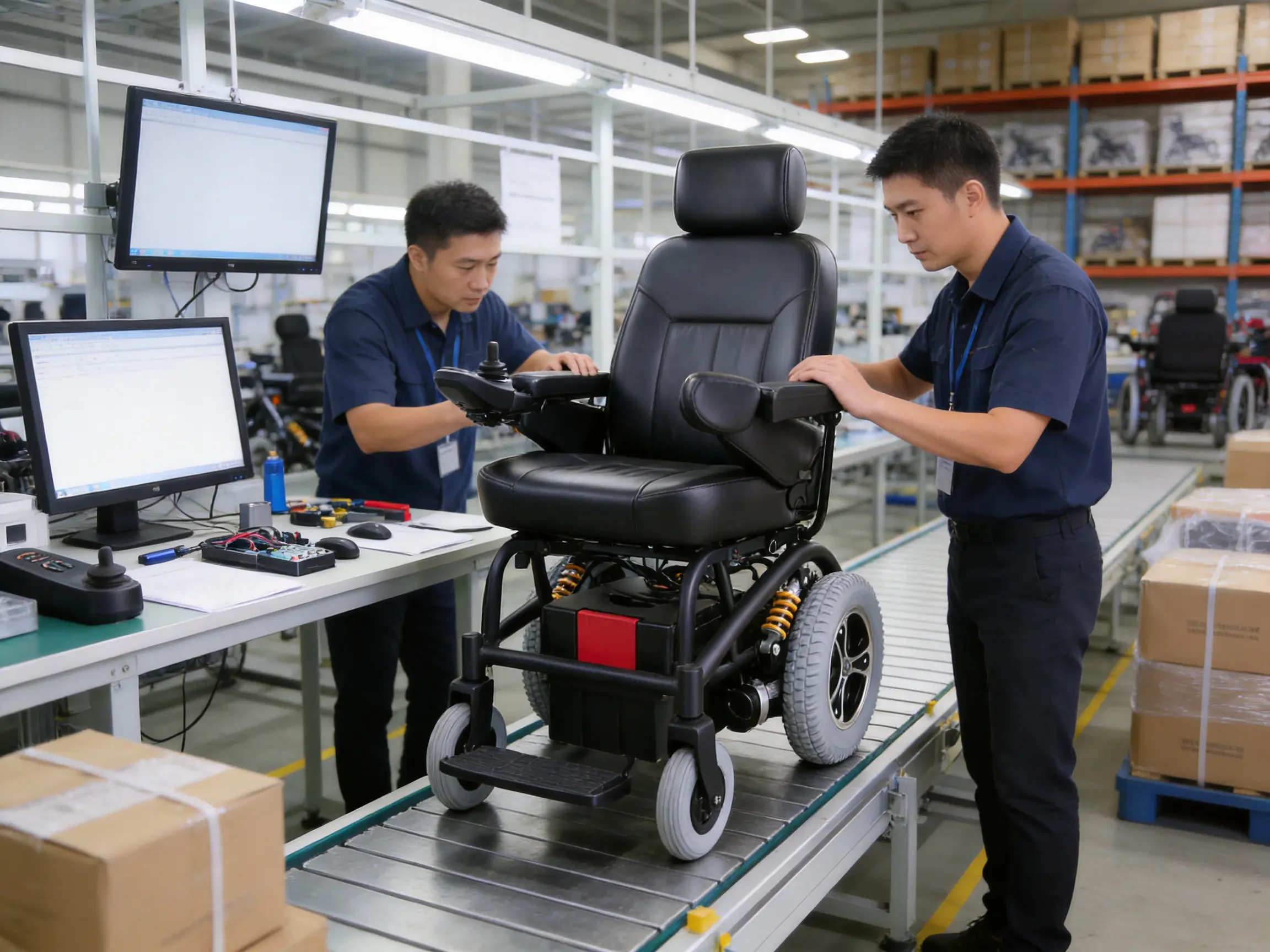
For a powered wheelchair, production consistency is as important as the design itself. Two products with the same model name should perform within predictable limits. Consistent assembly helps ensure that the motors, brakes, controller, batteries, tires, seat, and frame work together as intended.
Quality management may involve several stages. Incoming materials can be checked for dimensions, electrical ratings, appearance, and compatibility. Frames and structural parts can be inspected for correct alignment and secure fastening. Wiring can be checked for routing, insulation, connector engagement, and protection against abrasion. The drive system can be tested for forward and reverse operation, steering response, braking, and unusual noise.
Battery and charger checks are also important. A product should be evaluated for correct charging behavior, connector fit, polarity, and electrical safety. Final inspection should verify dimensions, controls, tire condition, seat adjustment, brake operation, and overall appearance. Packaging inspection is equally valuable because a carefully manufactured chair can still be damaged during transport if it is not properly protected.
The company’s stated commitment to strict production management supports confidence in its manufacturing direction. However, commercial buyers should establish measurable acceptance criteria. These may include sample inspections, pre-shipment testing, warranty terms, spare-parts availability, packaging standards, labeling requirements, and procedures for handling defects.
For distributors, a reliable manufacturing relationship offers advantages beyond the initial shipment. Consistent production can reduce returns, simplify staff training, make replacement parts easier to identify, and improve customer satisfaction. It can also help distributors build a more credible product range in the competitive mobility market.
14. Practical Benefits for Users and Caregivers
The primary benefit of the iPower Sport is powered independence. A user who cannot comfortably propel a manual wheelchair may be able to travel farther and participate in more daily activities with an electric model. The stated range of 30–40 km can support planned day trips, although users should always reserve sufficient battery capacity for the return journey and unexpected delays.
The seating features may benefit users who spend extended periods in the chair. A cushioned seat and adjustable back support can make shopping, visiting friends, attending community activities, or traveling around a residential area more comfortable. Caregivers may also appreciate a powered system that reduces the physical effort involved in pushing a heavy chair.
The four-wheel structure, suspension, and larger rear tires may be useful for outdoor routes. Users can potentially travel over firm sidewalks, paved courtyards, access paths, and other suitable surfaces with greater confidence than they might have in a small indoor-only chair. The anti-tip wheels provide additional support, although they do not replace safe driving techniques.
The product can also serve commercial and institutional mobility needs where a durable, full-size powered wheelchair is appropriate. Hotels, residential communities, shopping facilities, and mobility-equipment rental providers may consider the model for users who need stable powered transportation. Any commercial deployment should include staff training, routine inspections, charging procedures, and a clear maintenance schedule.
Because the product has a 120 kg weight capacity, it can support a broad range of adult users, but the stated limit should never be exceeded. The total load may include clothing, bags, accessories, and other items. Overloading can affect braking, range, handling, structural stress, and tire performance.
15. Safe and Responsible Use
Powered mobility products should be used responsibly and in accordance with the supplied manual. Before the first journey, the user should become familiar with the control system in an open, level area. Practice should include starting, stopping, reversing, turning, approaching a doorway, and managing speed.
Users should inspect the tires, battery charge, seat position, control connection, and visible wiring before operation. The electromagnetic brake should be tested in a safe area. If the chair behaves unexpectedly, it should be switched off and examined by an appropriately qualified service provider.
The wheelchair should be operated within its specified limits. The maximum gradient is 10 degrees, but the user should avoid slopes that are wet, loose, uneven, or difficult to descend. Cross-slopes can be particularly challenging because they may affect steering and stability. The wheelchair should not be used near open water, stairs, railway tracks, deep potholes, or unstable ground.
Speed should be reduced around pedestrians, corners, narrow passages, ramps, and obstacles. The user should keep both hands and feet positioned safely and should avoid carrying loads that obstruct visibility or interfere with the controls. Seat adjustments should be made while the chair is stationary.
Charging should take place in a dry, ventilated area away from flames and ignition sources. The charger should be disconnected according to the manufacturer’s instructions after charging is complete. Batteries should not be modified, opened, or replaced with incompatible units.
Local laws may regulate where powered wheelchairs can travel, whether lights or reflectors are required, and how the product should be transported in a vehicle. Users and importers are responsible for checking the rules applicable to their location.
16. Maintenance and Ownership Considerations
Routine maintenance helps preserve performance and safety. Tire pressure should be checked regularly, and the tires should be examined for punctures or excessive wear. Nuts, bolts, wheel assemblies, and seat adjustments should be inspected according to the maintenance schedule. Unusual looseness, vibration, or noise should be investigated promptly.
The battery system requires particular attention. The user should monitor charging time, range, and any change in battery behavior. A sudden reduction in range may indicate battery aging, a charging problem, tire underinflation, excessive load, or a mechanical issue. Batteries are consumable components and will eventually need replacement.
The frame and seat should be kept clean and dry. Spilled liquids should be removed promptly, and the product should not be exposed unnecessarily to heavy rain or flooding. Electrical connectors should be protected from water and contamination. High-pressure washing is generally unsuitable for powered mobility equipment unless specifically approved by the manufacturer.
Maintenance support is an important part of product selection. Buyers should ask about warranty coverage, service intervals, replacement batteries, tires, chargers, controllers, motors, upholstery parts, and technical support. A product with strong specifications but poor parts availability may create difficulties over time. Sweetrich’s focus on mobility scooters and power wheelchairs gives distributors a relevant manufacturing partner, but local service arrangements should still be established before purchase.
17. Suitability for Different Markets
The product is presented as suitable for international distribution, and the company reports exports to multiple regions. Its AC115–230V charger input is useful for markets with different mains-voltage systems, subject to the correct plug and local approval requirements. The product’s speed, range, weight capacity, and four-wheel structure may appeal to buyers in urban, suburban, residential, and hospitality environments.
In hot climates, battery performance, tire condition, and storage temperature deserve additional attention. In cold climates, range may decrease and charging conditions may need closer monitoring. In regions with rough sidewalks or uneven paving, suspension and pneumatic tires may be especially valuable, although the wheelchair should remain on suitable surfaces.
Distributors should adapt product education to local users. This includes translating manuals where required, explaining battery charging, providing safety training, describing local access rules, and offering replacement parts. Product presentation should also make clear that the wheelchair is not automatically classified as a medical device in every jurisdiction.
For the United States market, the supplied material specifically identifies the equipment as non-medical. Buyers should therefore avoid making medical, therapeutic, or clinical claims unless supported by appropriate evidence and authorization. The product can be described in terms of powered mobility, comfort, stability, and travel assistance without presenting it as a treatment device.
18. Questions Buyers Should Ask Before Ordering
Before placing an order, a private buyer should confirm the exact model configuration, included accessories, seat dimensions, control arrangement, battery condition if purchasing from inventory, charger compatibility, warranty terms, and expected delivery condition. The buyer should also measure the intended storage area and transportation route.
A commercial buyer should ask for production lead times, minimum order quantities, packaging dimensions, spare-parts lists, user manuals, technical drawings, inspection procedures, warranty handling, and after-sales support. It is also useful to confirm whether the model can be customized with different colors, controls, seating options, or regional labels.
Importers should review customs classification, battery transportation requirements, electrical documentation, product labeling, and local accessibility or mobility regulations. These details can affect the total cost and delivery schedule.
19. Frequently Asked Questions
Is this wheelchair intended mainly for indoor or outdoor use?
The iPower Sport is designed as a substantial powered wheelchair with outdoor-oriented features, including four wheels, pneumatic tires, rear suspension, anti-tip wheels, and a stated range of 30–40 km. It may also be used indoors where the dimensions and turning space are suitable. Buyers should measure doorways and indoor routes before purchase.
What is the maximum user weight?
The stated weight capacity is 120 kg, or approximately 265 lb. Users should include clothing, bags, and any carried items when evaluating the total load. The capacity should not be exceeded.
How fast can it travel?
The maximum forward speed is 8 km/h, approximately 5 miles per hour. The appropriate operating speed will depend on the environment, surface, visibility, traffic, and user experience.
What range can be expected from one charge?
The stated maximum driving range is 30–40 km, or approximately 19–25 miles. Actual range varies according to user weight, terrain, gradient, tire pressure, speed, temperature, battery age, and driving style.
How long does charging take?
The listed charging time is approximately 6–8 hours. Charging should be completed with the supplied or approved charger in a dry and ventilated location.
What type of batteries does the wheelchair use?
It uses two 12V 40Ah lead-acid batteries. Together they provide the 24V system voltage used by the drive and control system.
Does the product have suspension?
Yes. The specifications identify rear suspension. The suspension is intended to improve comfort and help manage minor impacts on suitable surfaces.
Are the tires pneumatic?
Yes. The product uses pneumatic tires. The front tires measure 8 by 2.5 inches, and the rear tires measure 14 by 3 inches. Tire pressure and condition should be checked regularly.
What braking system is used?
The product uses an electromagnetic brake system. Users should test braking regularly and stop using the wheelchair if braking performance changes unexpectedly.
How heavy is the wheelchair?
The supplied specifications identify the heaviest part as 56 kg, or approximately 123 lb. Buyers should plan for appropriate loading, storage, and transport equipment.
Is the product a medical device?
The supplied material describes it as a non-medical device for the United States market. Classification can differ by country, so buyers should confirm local requirements and avoid unsupported medical claims.
Is a remote control included?
The product title refers to a remote electronic wheelchair, but the available technical specifications do not fully explain the remote-control configuration. Buyers should confirm the exact remote or attendant-control functions included in their order.
Who manufactures the product?
The product is associated with Suzhou Sweetrich Vehicle Industry Technology Co., Ltd., a Suzhou-based company established in 2011 that focuses on mobility scooters and power wheelchairs.
What should distributors confirm before importing it?
Distributors should confirm regional compliance, labeling, battery and charger documentation, packaging, warranty terms, spare-parts availability, technical manuals, service procedures, and the exact product configuration.
20. Overall Evaluation
The iPower Sport is a practical heavy-duty electric wheelchair for users who need stable powered travel, supportive seating, and useful outdoor capability. Its four-wheel structure, anti-tip wheels, rear suspension, pneumatic tires, adjustable seat back, electromagnetic brake, and dual 320W motors create a balanced package for everyday mobility.
Its stated range of 30–40 km and maximum speed of 8 km/h support longer and more flexible travel than many basic indoor chairs. The 120 kg capacity makes the product suitable for a broad adult user group, while the 24V electrical system and PG controller provide a clear, established foundation for operation. Lead-acid batteries are heavier than some modern alternatives, but they remain familiar and serviceable in many markets.
The product’s main trade-offs are its substantial weight, the need to maintain pneumatic tires, the charging time, and the requirement for suitable storage and transportation. It should not be selected solely on the basis of speed or range. Buyers should consider the user’s body size, posture, home layout, vehicle access, local terrain, service availability, and regulatory environment.
The supplier’s experience in mobility product research, development, and manufacturing strengthens the product’s commercial potential. Its factory capacity, international market experience, stated focus on quality management, and concentration on electric scooters and power wheelchairs provide a suitable foundation for distributor relationships. Nevertheless, buyers should confirm product-specific documentation and establish clear service arrangements.
For users seeking a comfortable and stable powered wheelchair for appropriate indoor and outdoor surfaces, the iPower Sport offers a well-rounded combination of performance features. For distributors seeking a full-size mobility product with broad market appeal, it provides a practical platform that can be supported through professional product education, responsible marketing, and dependable after-sales service.
References
1. Product specification sheet for the iPower Sport heavy-duty four-wheel electric wheelchair, supplied product information.
2. Manufacturer information for Suzhou Sweetrich Vehicle Industry Technology Co., Ltd., including company history, factory details, product focus, and export markets.
3. General principles of powered wheelchair operation, battery charging, tire inspection, braking, and mobility-equipment maintenance.
4. General guidance concerning safe use of electric mobility equipment on slopes, ramps, paved surfaces, and pedestrian routes.
5. General considerations for international mobility-equipment distribution, product labeling, battery transportation, and market-specific compliance.