
 +86-(0)512-82283871
Content
- 1 Product Overview: Built for Stability, Comfort, and Daily Independence
- 2 Key Specifications
- 3 Four-Wheel Stability as a Core Advantage
- 4 Comfort-Focused Seating and Ride Quality
- 5 Power System and Driving Performance
- 6 Battery System and Charging Convenience
- 7 Safety-Oriented Features for Real-World Use
- 8 Advantages Over Common Competing Products
- 9 Advanced Manufacturing Strengths Behind the Product
- 10 Engineering Choices That Support Real User Needs
- 11 Value for Distributors, Dealers, and Mobility Retailers
- 12 Practical User Experience in Daily Scenarios
- 13 Responsible Use and Maintenance
- 14 Company Strengths and Long-Term Reliability
- 15 Why This Product Fits the Modern Mobility Market
- 16 Q&A Section
- 16.1 What type of user is this four-wheel power wheelchair designed for?
- 16.2 How fast can the wheelchair travel?
- 16.3 What is the expected driving range?
- 16.4 Does the wheelchair have suspension?
- 16.5 What kind of tires does it use?
- 16.6 What is the weight capacity?
- 16.7 What type of brake system is included?
- 16.8 How long does charging take?
- 16.9 What batteries are used?
- 16.10 How does this product compare with basic electric wheelchairs?
- 16.11 Is the chair easy to lift?
- 16.12 What manufacturing strengths support the product?
- 17 Conclusion: A Balanced Heavy-Duty Mobility Solution
- 18 References
- 19 Product: iPower Sport Hot popular four wheels power remote electronic wheelchair in dubai
Modern personal mobility is no longer defined only by movement from one point to another. For many users, it is about confidence, stability, comfort, independence, and the reassurance that the equipment beneath them has been engineered with care. A heavy-duty four-wheel power wheelchair designed for everyday travel must combine a strong frame, reliable drive technology, supportive seating, dependable braking, and enough range to handle daily routines without constant interruption. The product discussed in this article is a four-wheel electric power wheelchair built with these priorities in mind, offering a practical combination of strength, comfort, and user-friendly performance for seniors, disabled users, caregivers, distributors, and mobility product buyers.
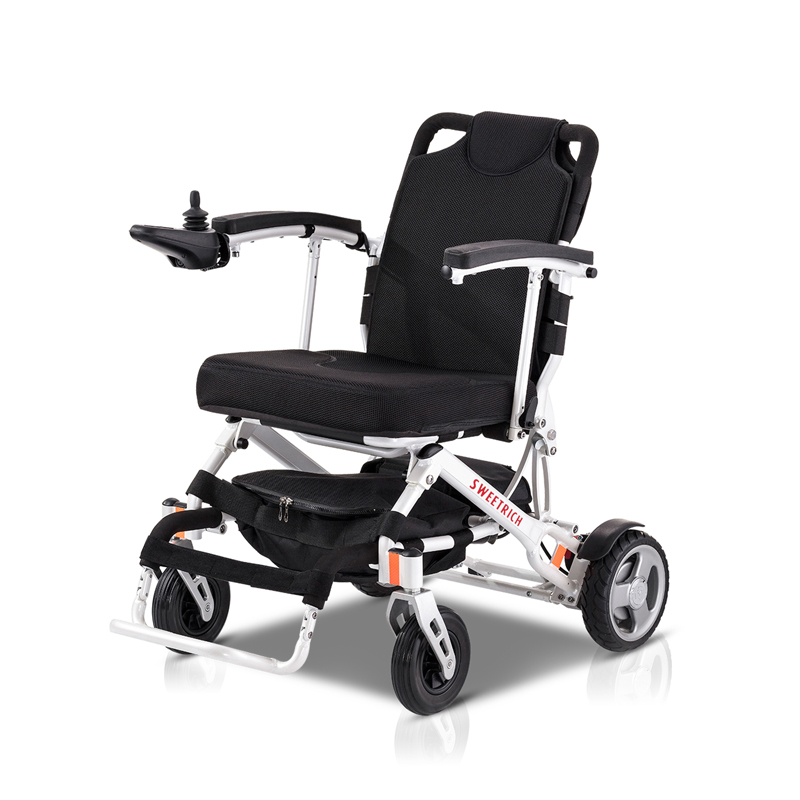
This power wheelchair belongs to the heavy-duty wheelchair category and is designed as a non-medical device for the U.S. market. It is suitable for users who need enhanced mobility assistance in daily life, especially those who value stable four-wheel driving performance, a comfortable seat, large pneumatic tires, rear suspension, and reliable electromagnetic braking. Its structure, specification package, and component choices show a focus on usability rather than unnecessary complexity. The result is a robust mobility solution that balances everyday convenience with durable construction.
Unlike lightweight indoor-only mobility products that may struggle with uneven surfaces, this model uses big pneumatic tires, suspension, anti-tip wheels, dual motors, and a strong battery configuration to support smoother travel and greater confidence. With a maximum forward speed of 8 km/h, a driving range of 30 to 40 km, and a weight capacity of 120 kg, it is positioned as a capable daily-use power wheelchair for users who need a stronger and more comfortable alternative to basic electric wheelchairs.
The manufacturer, Sweetrich Mobility, brings more than a decade of experience in research, development, and production of mobility scooters and power wheelchairs. Located in Suzhou Industrial Park, China, the company operates from a large manufacturing base with a 30,000-square-meter factory and focuses on producing mobility products that improve the well-being, independence, and dignity of elderly and disabled people. Its product development philosophy combines user comfort, driving safety, production quality, and practical design for global markets.
This article explores the product’s key advantages, technical features, user-oriented design, manufacturing background, quality strengths, market value, and competitive positioning. It also includes a specification table, practical selection guidance, and a Q&A section to help buyers better understand how this heavy-duty four-wheel power wheelchair can serve modern mobility needs.
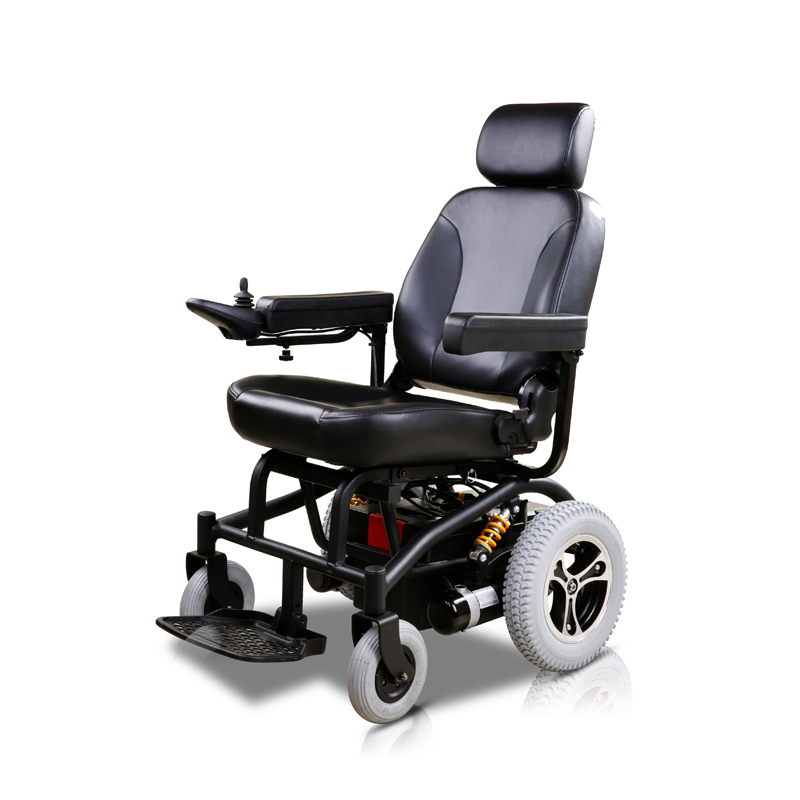
iPower Sport Hot popular four wheels power remote electronic wheelchair in dubai
Product Overview: Built for Stability, Comfort, and Daily Independence
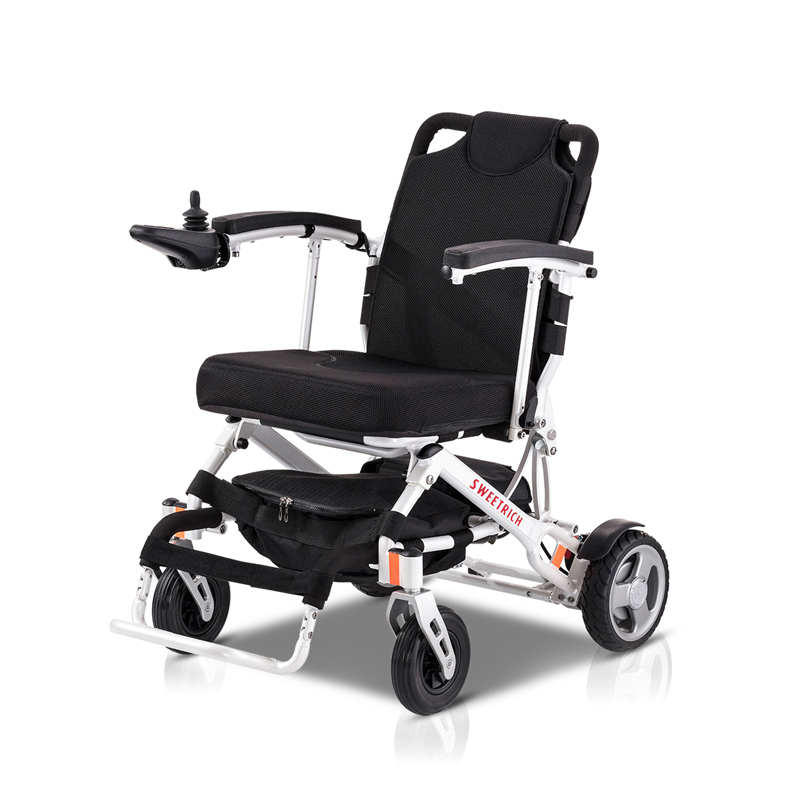
A heavy-duty power wheelchair should deliver more than motorized movement. It should support the user with a secure seating position, stable wheelbase, predictable control, and components that can withstand repeated use. This four-wheel power wheelchair is designed around those principles. Its dimensions of 980 mm in length, 600 mm in width, and 1180 mm in height give it a substantial and stable profile while remaining practical for daily environments. The chair is compact enough for many mobility scenarios while offering a strong structural presence that users can feel when seated.
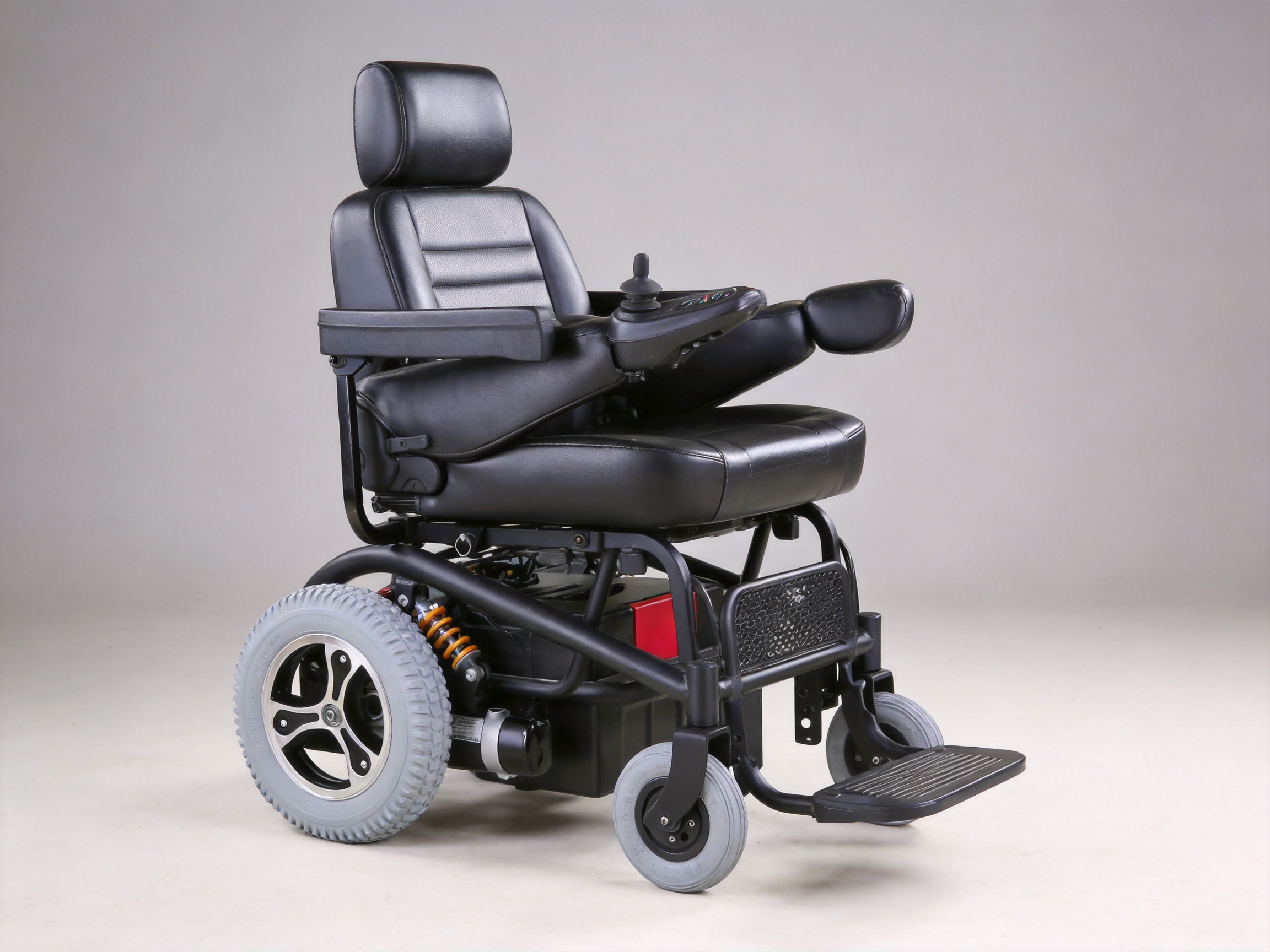
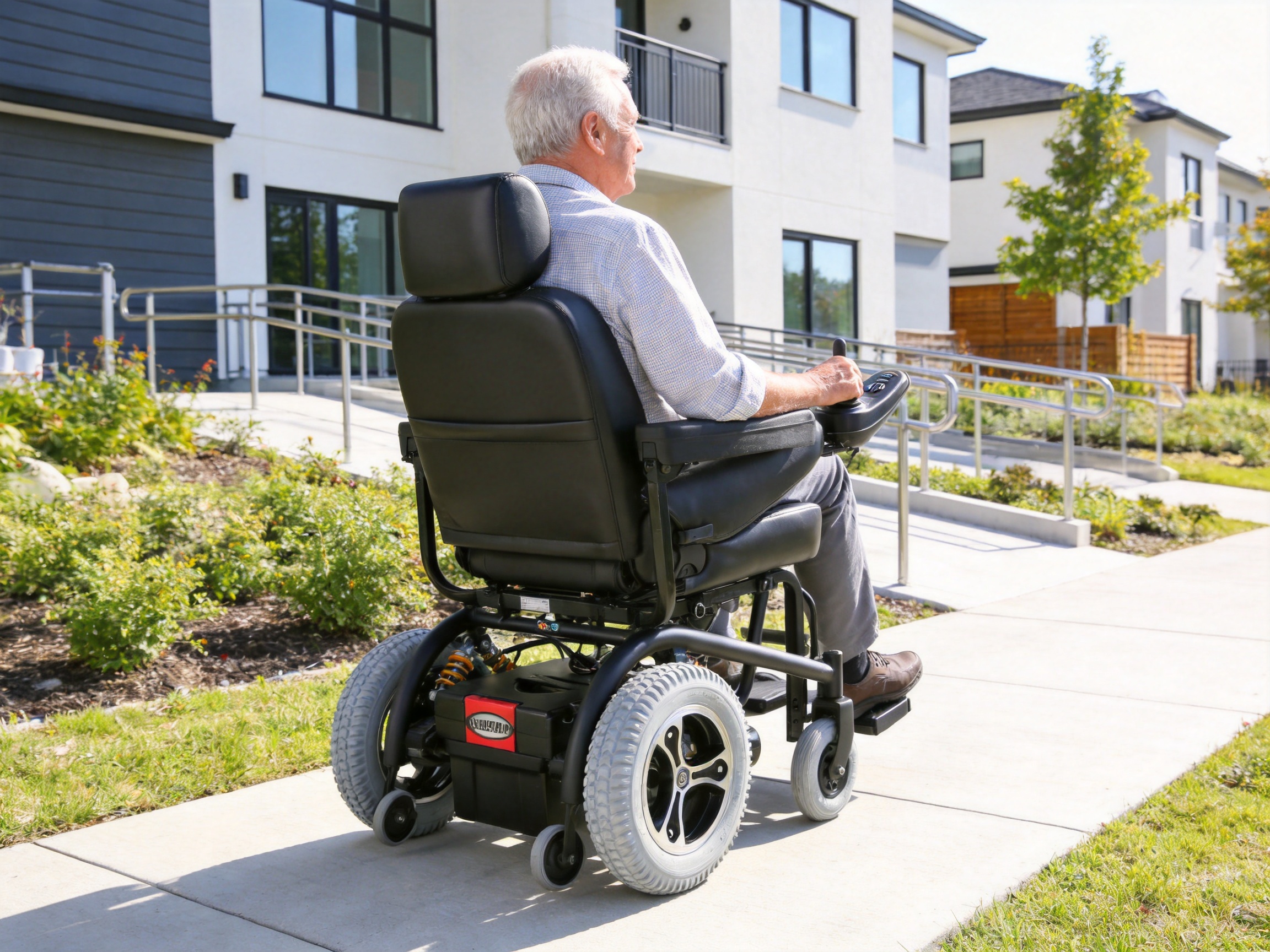
The product is equipped with four wheels, including 8-inch by 2.5-inch front tires and larger 14-inch by 3-inch rear tires. This tire configuration is important because rear wheels play a major role in traction, drive power, and obstacle handling. The larger rear pneumatic tires help absorb surface vibration and improve the feel of travel over outdoor paths, sidewalks, ramps, and other common daily surfaces. Pneumatic tires are often preferred in comfort-focused mobility equipment because they provide a softer ride compared with solid tires, especially when combined with suspension.
Rear suspension further improves ride comfort by reducing jolts and vibration. For users who spend extended periods seated, suspension is not just a luxury feature; it can contribute significantly to overall comfort and confidence. The rear suspension system supports smoother travel and helps make the chair more forgiving on imperfect surfaces. In combination with anti-tip wheels, the design helps promote a safer and more balanced riding experience.
The seat uses a leather-like cushion, giving the product a more premium and comfortable appearance. A mobility product is often used repeatedly throughout the day, so seating quality matters. The adjustable seat back allows users or caregivers to adapt the seating angle to improve support and comfort. This adjustability is especially valuable because users have different posture preferences and physical requirements. A fixed seat back can limit comfort, while an adjustable design adds flexibility.
The power system includes two 24V/320W motors, offering dual-motor performance for reliable movement. A dual-motor layout provides drive strength and responsiveness, particularly useful for a heavier-duty power wheelchair. The motor controller is a 24V/50A unit from PG in the United Kingdom, a component selection that supports dependable control performance. The braking system uses electromagnetic braking, which is widely valued in mobility equipment because it can provide controlled stopping and holding performance when the chair is not actively moving.
The battery system uses two 12V 40Ah lead-acid batteries. Lead-acid batteries remain common in mobility products because they are stable, widely serviceable, and cost-effective. With a charging time of 6 to 8 hours and a driving range of 30 to 40 km, the chair is designed to cover daily travel needs for many users. The included charger supports DC24V5A output and AC115-230V input, providing adaptability for different electrical environments.
Key Specifications
Item |
Specification |
Product Type |
Heavy-duty four-wheel power wheelchair |
Dimensions |
980(L) × 600(W) × 1180(H) mm |
Maximum Forward Speed |
8 km/h, approximately 5 mi/h |
Maximum Driving Gradient |
10 degrees |
Maximum Driving Range |
30 to 40 km, approximately 19 to 25 miles |
Weight Capacity |
120 kg, approximately 265 lbs |
Suspension |
Rear suspension |
Tire Sizes |
8 inches × 2.5 inches front; 14 inches × 3 inches rear |
Brake System |
Electromagnetic brake |
Batteries |
Lead-acid 12V 40Ah × 2 pieces |
Charger |
DC24V5A, AC115-230V |
Charging Time |
6 to 8 hours |
Motor |
24V/320W × 2 pieces |
Motor Controller |
24V/50A controller from PG, United Kingdom |
Heaviest Part |
56 kg, approximately 123 lbs |
Four-Wheel Stability as a Core Advantage
One of the most important advantages of this power wheelchair is its stable four-wheel layout. Four-wheel mobility products generally provide users with a greater sense of balance than compact three-wheel alternatives, particularly when moving across varied surfaces or turning at controlled speeds. For a heavy-duty wheelchair, stability is essential because the user may rely on the chair throughout the day, indoors and outdoors, on flat floors, sidewalks, ramps, and transitional surfaces.
The wheel configuration contributes to the chair’s dependable ride character. The larger rear tires help support traction and rolling performance, while the front tires provide guidance and balance. This design can be particularly beneficial when navigating moderate outdoor conditions where smaller indoor wheels might feel harsh or less secure. The product is not presented as an off-road vehicle, but its pneumatic tires and suspension make it better suited to real-world daily use than many simple power chairs intended primarily for smooth indoor floors.
Competitor products in the same general market often make compromises to reduce weight or cost. Some may use smaller solid tires, limited suspension, lower motor output, or simpler controllers. Those designs may be adequate for short indoor trips, but they can feel less comfortable over distance. This model’s larger rear pneumatic tires, rear suspension, dual motors, and electromagnetic braking create a more complete mobility package. For users who value comfort and confidence, these differences are meaningful.
Anti-tip wheels add another layer of reassurance. Anti-tip devices are especially useful when the wheelchair is used on gradients, during acceleration, or when traveling over small surface transitions. Although users should always follow safe operating practices, a product designed with anti-tip support shows attention to everyday safety. When combined with a maximum driving gradient of 10 degrees, the anti-tip and suspension configuration helps the chair handle common ramps and slopes with controlled performance.
Stability also affects user confidence. Many people who use power wheelchairs are not only evaluating technical specifications; they are assessing whether the product feels trustworthy. A chair that shakes excessively, stops roughly, or feels unstable during turns can discourage regular use. A more stable chair encourages independence because users are more willing to travel, participate in daily activities, and move without constant assistance. The product’s four-wheel design is therefore not just a mechanical feature; it is a foundation for better quality of life.
Comfort-Focused Seating and Ride Quality
Comfort is one of the clearest selling points of this power wheelchair. The leather-like cushion seat provides a smooth, supportive surface with a more refined appearance than basic fabric seating. For daily mobility equipment, seat comfort can influence how long a user is willing to remain active. A hard or poorly shaped seat can limit use, while a well-cushioned seat encourages longer outings and more independent movement.
The adjustable seat back is another major advantage. Users vary in height, posture, flexibility, and personal preference. Some need a more upright position for control and visibility, while others prefer a slightly reclined posture for comfort. An adjustable backrest allows the product to serve a broader range of users and makes it easier for caregivers or distributors to match the chair to individual needs. This feature also reflects a user-centered design philosophy rather than a one-size-fits-all approach.
Ride comfort depends not only on the seat but also on the undercarriage. Rear suspension plays a vital role by helping absorb bumps and unevenness from the ground. When a wheelchair lacks suspension, vibration travels through the frame into the seat and user. Over time, this can become tiring. The rear suspension in this model helps reduce that harshness, making the ride smoother and more controlled.
Pneumatic tires further improve comfort. Air-filled tires can deform slightly as they roll over irregular surfaces, reducing shock transmission. Compared with rigid solid tires, pneumatic tires are often appreciated for their smoother ride and better surface contact. In this chair, the combination of pneumatic tires and rear suspension helps create a mobility experience that feels more refined than many basic electric wheelchairs.
Competitor products that emphasize low price may reduce comfort features to cut manufacturing costs. They may use thin cushions, non-adjustable seating, small wheels, and no suspension. While those products may initially appear economical, users may quickly notice the limitations during daily operation. A power wheelchair is not simply a purchase; it is a daily companion. Comfort should be treated as a core performance attribute, and this model addresses that requirement with practical, visible features.
Power System and Driving Performance
The power system is central to any electric wheelchair. This model uses two 24V/320W motors, giving it the strength needed for regular daily movement. Dual motors are valuable because they allow effective control of left and right drive functions, helping the chair turn, accelerate, and maneuver with precision. A balanced dual-motor system can make the chair feel responsive without being difficult to control.
The maximum forward speed is 8 km/h, approximately 5 miles per hour. This speed is appropriate for many daily mobility situations. It is fast enough to make outdoor travel efficient, yet controlled enough for a power wheelchair used by seniors and mobility-limited users. Excessive speed is not always desirable in personal mobility equipment; what matters more is predictable acceleration, reliable braking, and stable handling. The specified speed reflects a practical balance.
The maximum driving gradient is 10 degrees. This indicates the chair’s ability to handle moderate slopes under suitable conditions. Gradients are common in real environments, including access ramps, driveway transitions, building entrances, and sidewalk inclines. Users should always operate within recommended limits and consider surface condition, user weight, battery charge, and safety practices, but a 10-degree gradient capability makes the product more versatile than chairs designed only for level indoor floors.
The product’s range of 30 to 40 km is another competitive advantage. Many users want a chair that can support full daily activity without constant recharging. A long range reduces anxiety and allows users to participate in errands, social visits, community activities, and outdoor movement. Range can vary based on user weight, terrain, speed, battery condition, and temperature, but the stated capacity provides a strong basis for everyday use.
The motor controller is a 24V/50A controller from PG in the United Kingdom. Controller quality is often overlooked by casual buyers, but it has a major influence on the driving experience. A good controller helps regulate acceleration, turning, braking response, and motor coordination. Smooth control is particularly important for seniors and users with limited strength or coordination, because sudden or jerky movement can reduce confidence. By selecting a recognized controller source, the manufacturer supports better reliability and more refined operation.
Electromagnetic braking adds another critical performance feature. When a user releases the control input, the braking system helps stop and hold the chair. This is especially important on slight slopes, during transfers, or when stopping at crossings and entrances. Electromagnetic brakes are widely used in powered mobility equipment because they combine convenience with safety-oriented function. Compared with simple mechanical braking arrangements, electromagnetic braking is better suited to modern powered wheelchairs that require automatic stopping behavior.
Battery System and Charging Convenience
The wheelchair uses two 12V 40Ah lead-acid batteries, creating a 24V power system. Lead-acid batteries are a familiar and widely used choice in mobility equipment. While lithium batteries are popular in lightweight travel products, lead-acid batteries continue to provide advantages in cost, stability, availability, and service familiarity. For a heavy-duty wheelchair, lead-acid batteries can be an appropriate choice because they provide dependable energy storage and are commonly understood by service providers.
The charging time is 6 to 8 hours, making overnight charging a practical routine. Many users can recharge the wheelchair while sleeping and begin the next day with a full battery. The charger supports AC115-230V input, which helps accommodate different electrical standards in international markets. This is especially useful for distributors serving multiple regions or users who may move between environments with different power supply conditions.
Battery range of 30 to 40 km is one of the product’s most practical strengths. For users who do not want to recharge after every short trip, this range supports greater flexibility. It can cover many daily routines such as moving around the home, visiting nearby shops, attending appointments, traveling within a community, and enjoying outdoor time. A longer range also reduces dependence on caregivers, because users are less likely to worry about losing power during normal activities.
Compared with some competing power wheelchairs that use smaller battery packs to reduce cost or weight, this model’s battery configuration supports a stronger everyday-use profile. A wheelchair with insufficient range may be frustrating even if it has attractive styling. Buyers should consider not only the initial price but also how the chair performs over a full day. A dependable battery system is central to that evaluation.
Proper battery maintenance remains important. Users should follow charging instructions, avoid deep discharge when possible, store the wheelchair in suitable conditions, and have batteries inspected when performance declines. Distributors and service providers can add value by educating users about battery care, because correct maintenance helps preserve range and reliability over time.
Safety-Oriented Features for Real-World Use
Safety in a power wheelchair depends on several connected systems: frame stability, braking, tires, suspension, controller behavior, seating support, and user training. This model incorporates multiple features that contribute to safer everyday operation. The four-wheel structure provides a stable base. The anti-tip wheels help reduce tipping risk in appropriate use conditions. The electromagnetic brake helps control stopping. The rear suspension and pneumatic tires improve surface contact and reduce harsh shocks.
Anti-tip wheels deserve special attention. Users often encounter ramps, small thresholds, or transitions between indoor and outdoor surfaces. While no anti-tip system removes the need for careful operation, it can provide an added safety margin. This feature is especially important in a heavy-duty product because users may depend on the wheelchair in varied settings.
The brake system is also fundamental. Electromagnetic braking helps ensure that the wheelchair stops when the control is released and remains controlled when stationary. This is valuable during transfers, when waiting on a slight incline, or when stopping in busy environments. A reliable brake system reduces the likelihood of unwanted rolling and supports user confidence.
The maximum speed of 8 km/h is practical and safety-conscious. Some buyers mistakenly believe that faster is always better, but for many power wheelchair users, control and stability matter more than high speed. A moderate top speed helps the chair remain manageable while still allowing efficient travel. This balance is especially important for seniors who may prefer smooth, predictable movement.
Seating safety is also improved by the adjustable seat back and supportive cushion. A comfortable, well-supported posture allows users to operate controls more effectively and maintain better awareness of surroundings. Poor posture can lead to fatigue and reduced control. By supporting comfort, the chair indirectly supports safer operation.
Manufacturing quality plays a major role in safety as well. A power wheelchair must be assembled consistently, with attention to wiring, brake function, motor mounting, tire installation, controller calibration, and structural integrity. Sweetrich Mobility’s production experience and factory scale support this requirement. The company’s focus on strict production management and scientific design helps create products that are not only attractive in specification sheets but also dependable in use.
Advantages Over Common Competing Products
The mobility market includes many types of powered wheelchairs, from ultra-light folding travel models to basic indoor chairs and heavy-duty outdoor-oriented designs. This product’s competitive strength lies in its balanced combination of durability, comfort, drive performance, and everyday practicality. It does not rely on a single feature; instead, it integrates several important features into one coherent product.
One advantage is the tire configuration. Competitors in lower price segments may use small solid tires that are durable but uncomfortable on uneven surfaces. This model’s big pneumatic rear tires and supportive front tires help improve comfort and rolling performance. For users who travel outdoors or over mixed surfaces, this can be a decisive benefit.
Another advantage is the rear suspension. Many basic electric wheelchairs omit suspension entirely. Without suspension, every bump is transmitted more directly to the user. By including rear suspension, this chair offers a smoother ride, particularly useful for daily travel beyond perfectly flat indoor floors. The difference may be especially noticeable on sidewalks, paved community paths, and entrance ramps.
The dual 24V/320W motors provide stronger drive capability than many low-power alternatives. Motor performance affects acceleration, slope handling, and general responsiveness. A chair that feels underpowered can be frustrating and may struggle under heavier loads or on gradients. This model’s motor system supports its heavy-duty positioning and weight capacity.
The controller selection is another point of differentiation. A quality controller influences how refined the chair feels during movement. Smooth starts, controlled turns, and predictable stops are important for comfort and safety. Some competing products use lower-cost controllers that may not deliver the same control experience. A PG controller from the United Kingdom gives the product a more professional component profile.
The driving range also stands out. A range of 30 to 40 km is generous for many daily-use power wheelchairs. Competing products with smaller batteries may require more frequent charging, limiting independence. A longer range allows users to plan their day with more confidence.
Comfort features provide another competitive edge. The leather-like cushion and adjustable seat back improve user experience compared with basic seating designs. For distributors, these features make the product easier to present as a higher-value option. For users, they improve the daily relationship with the chair.
Finally, the product benefits from a manufacturer with established production capacity and international market experience. Buyers are not only purchasing a wheelchair; they are relying on the manufacturer’s ability to maintain quality, support supply, and continue product development. Sweetrich Mobility’s background in mobility scooters and power wheelchairs strengthens the product’s credibility in competitive markets.
Advanced Manufacturing Strengths Behind the Product
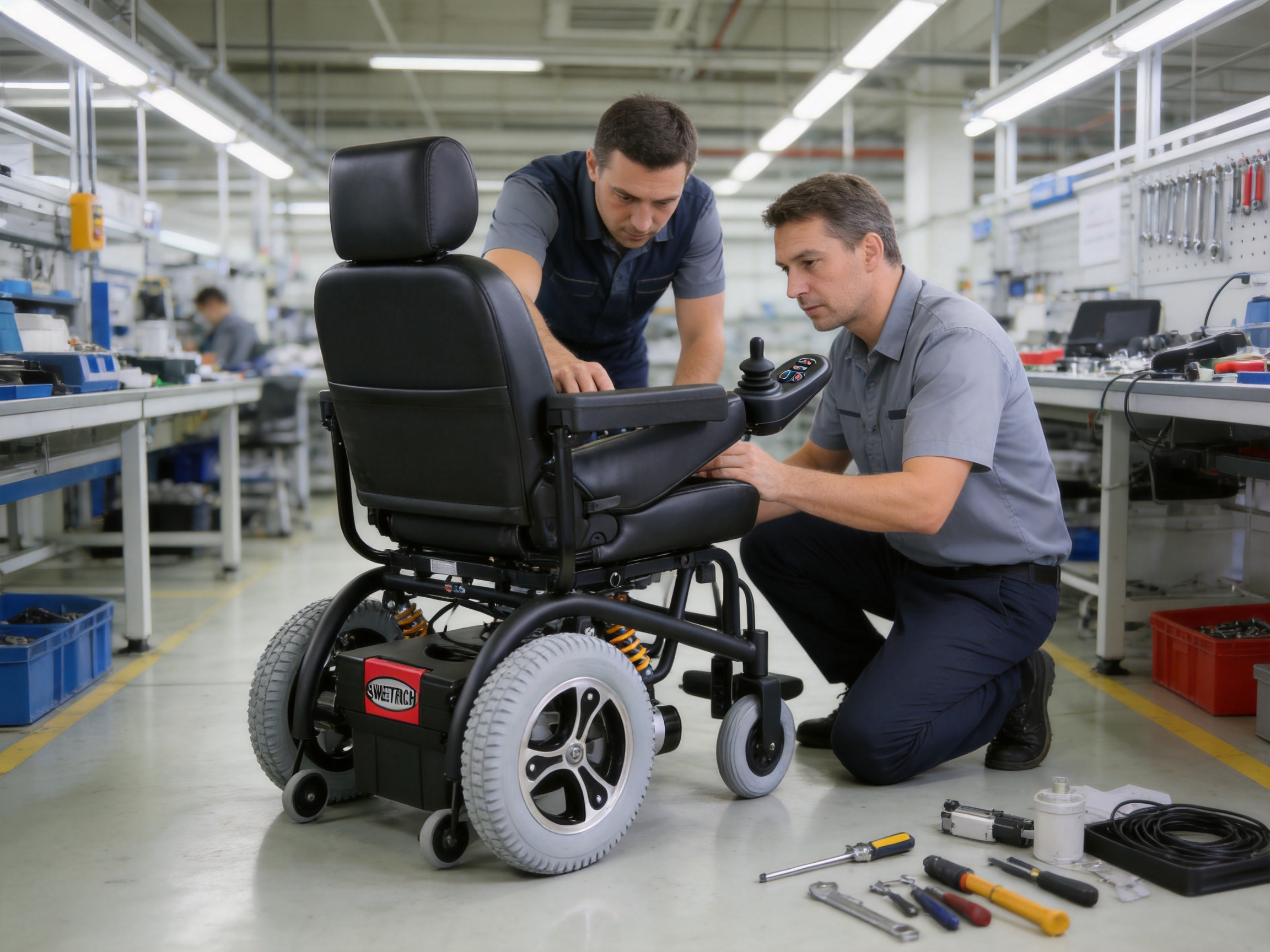
A well-designed power wheelchair depends on advanced manufacturing processes as much as product concept. Strong specifications are only meaningful when they are supported by consistent production, quality control, and engineering discipline. Sweetrich Mobility has developed its manufacturing capabilities over more than ten years, focusing on mobility scooters and power wheelchairs for international users.
The company is located in Suzhou Industrial Park, Jiangsu, China, and operates a large facility covering a significant production area, including a 30,000-square-meter factory. This scale supports organized production lines, component storage, assembly operations, inspection stations, and product testing processes. A large manufacturing base also helps maintain stable output for distributors and wholesale customers who require reliable supply.
Advanced manufacturing in mobility equipment begins with design and engineering. The company owns intellectual property rights for electric scooters and power wheelchairs, indicating an investment in product development rather than simple assembly. Product design must consider frame geometry, center of gravity, seating ergonomics, wheel positioning, motor placement, wiring routes, controller compatibility, battery access, and serviceability. Each design choice affects safety, comfort, and durability.
Scientific product design is especially important for heavy-duty wheelchairs. The frame must support the user and the mechanical components while maintaining stability. The motors must be matched to the controller and battery system. The braking system must coordinate with the drive system. The tires and suspension must be selected for the expected usage environment. A manufacturer with experience in these relationships is better positioned to produce a reliable chair.
Production management is another strength. Mobility products contain electrical, mechanical, and structural elements. Consistency requires controlled assembly procedures, trained workers, inspection standards, and traceability of key components. Strict production management helps reduce variation between units. This is important for dealers and users because a product should perform consistently from one shipment to another.
Quality control may include incoming inspection of components, frame checks, wiring verification, controller function tests, brake testing, battery and charger checks, drive testing, and final appearance inspection. While specific internal procedures may vary, a responsible manufacturer must confirm that each chair meets expected standards before shipment. For a power wheelchair, small assembly errors can affect performance, so inspection discipline is essential.
The company’s export experience further supports product reliability. Products are sold to markets including America, Europe, Japan, Australia, the Middle East, Russia, and other regions. Serving diverse markets requires attention to customer expectations, documentation, packaging, product consistency, and after-sales communication. International experience also exposes the manufacturer to different usage habits and regulatory expectations, encouraging continuous improvement.
Manufacturing strength is not only about machines and factory size. It is also about culture. Sweetrich Mobility states a principle of quality first, credit above, and customer supreme. In practical terms, this means that product reliability, business trust, and customer service are treated as long-term priorities. For buyers selecting a supplier, this philosophy matters because mobility products require ongoing confidence after the purchase.
Engineering Choices That Support Real User Needs
The design of this power wheelchair reflects several practical engineering choices. First, the dimensions are balanced. At 980 mm long and 600 mm wide, the chair provides a stable footprint without becoming excessively large. Width is particularly important because users may need to pass through doorways, corridors, elevators, and indoor spaces. A heavy-duty chair must be strong, but it should also remain practical for everyday environments.
Second, the seat height and total height of 1180 mm contribute to visibility and posture. Users need to see their surroundings, interact with others comfortably, and operate controls without strain. The adjustable seat back enhances this ergonomic adaptability.
Third, the tire selection indicates a focus on ride quality. Larger rear pneumatic tires are more forgiving over irregular surfaces. The rear tire size of 14 inches by 3 inches helps the chair feel more capable outdoors than compact chairs with smaller wheels. The 8-inch front tires support steering and balance while keeping the overall design manageable.
Fourth, the motor and controller pairing supports controlled power. The dual motors provide drive strength, while the controller manages power delivery. Without proper control, powerful motors can feel abrupt. With a quality controller, the chair can deliver strength in a more usable way.
Fifth, the battery capacity supports independence. A 30 to 40 km range allows users to think less about charging and more about daily life. This is a key psychological advantage. Mobility users often value freedom from constant planning, and range contributes directly to that freedom.
Sixth, the electromagnetic brake improves usability. Many users may not have the strength or reflexes to manage manual braking systems. Automatic braking behavior is therefore highly valuable. It simplifies operation and supports peace of mind.
These engineering choices show that the product is not designed for appearance alone. It is built around the realities of daily mobility: comfort, distance, control, slopes, stopping, and confidence.
Value for Distributors, Dealers, and Mobility Retailers
For distributors and mobility retailers, a product must offer more than attractive specifications. It must be sellable, serviceable, reliable, and suitable for a clear customer group. This heavy-duty four-wheel power wheelchair provides a strong value proposition because it addresses common user concerns: stability, comfort, range, and dependable control.
Retailers can position the chair as a practical solution for users who need more capability than a basic indoor power chair but do not necessarily need an oversized specialty mobility vehicle. Its four-wheel base, large rear tires, suspension, and comfortable seat make it suitable for customers who expect daily use across varied environments. The 120 kg weight capacity covers a broad user group, while the 30 to 40 km range supports active daily routines.
The chair’s component profile also helps with sales confidence. Dual motors, electromagnetic braking, lead-acid batteries, and a recognized controller source are concrete features that dealers can explain to customers. Rather than relying on vague claims, retailers can point to specific design choices that affect performance.
Service considerations are also important. Lead-acid batteries are familiar to many mobility service providers, and the overall configuration is practical for maintenance. The heaviest part is 56 kg, indicating that the chair is a substantial product rather than an ultra-light travel model. Dealers should communicate this clearly so users understand the product’s heavy-duty nature. It is best suited for users who prioritize stability, range, and comfort over frequent lifting.
The manufacturer’s export experience supports business relationships. Dealers need confidence that products can be supplied consistently and that the supplier understands international market expectations. Sweetrich Mobility’s long-term partnerships with customers worldwide and its established production base provide reassurance.
In competitive retail environments, differentiation matters. Many mobility products appear similar at first glance, but users quickly notice differences in comfort, control, and stability. This model’s combination of pneumatic tires, suspension, anti-tip wheels, adjustable backrest, and dual motors gives sales teams a clear story: it is a comfort-focused, stability-focused, heavy-duty power wheelchair for users who want dependable everyday movement.
Practical User Experience in Daily Scenarios
In home environments, the chair’s 600 mm width can support movement through many common indoor spaces, depending on doorway and room layout. Users can move from bedroom to living area, approach tables, and navigate corridors with appropriate care. The stable four-wheel structure helps create a secure feeling during indoor movement.
In community settings, the chair’s range and speed become more important. A maximum speed of 8 km/h allows users to travel efficiently on suitable paths without feeling excessively slow. The range of 30 to 40 km supports errands, visits, and longer outings. Users should always observe local rules and operate in safe environments, but the specifications support a more active lifestyle.
On sidewalks and paved outdoor paths, the pneumatic tires and rear suspension can improve comfort compared with basic solid-wheel chairs. Small surface imperfections are common outdoors, and comfort features make a significant difference during longer trips. The larger rear tires support better rolling behavior, while the suspension reduces vibration.
On ramps or moderate inclines, the 10-degree gradient capability, dual motors, anti-tip wheels, and electromagnetic brake contribute to controlled movement. Users should avoid unsafe slopes, wet surfaces, loose gravel, and conditions beyond the product’s intended use, but the chair is designed to handle common gradient situations better than limited indoor-only products.
During stopping and waiting, electromagnetic braking helps hold the chair. This is useful at building entrances, pedestrian areas, elevators, and social settings. The user can focus more on surroundings and less on manually controlling the chair after stopping.
For longer sitting periods, the leather-like cushion and adjustable seat back support comfort. Whether the user is attending a family gathering, waiting for transportation, visiting a park, or moving through a shopping area, seating comfort remains important. A product that is comfortable encourages participation in daily life.
Responsible Use and Maintenance
To obtain the best performance from any power wheelchair, users should follow responsible operating and maintenance practices. The chair should be charged according to instructions, and users should avoid allowing the batteries to remain deeply discharged for long periods. Regular charging helps preserve battery performance and ensures the chair is ready for daily use.
Tire condition should be checked regularly. Pneumatic tires provide comfort, but they require proper inflation and inspection. Underinflated tires may reduce range, affect handling, and increase wear. Users or caregivers should monitor tire pressure and look for damage or punctures.
The braking system should be kept in proper working condition. If stopping behavior changes, service should be requested promptly. Because electromagnetic brakes are critical to safety, users should not ignore unusual sounds, delayed braking, or inconsistent holding performance.
The seating system should be inspected for wear, loose parts, or adjustment issues. A secure seat and backrest help maintain posture and control. If the adjustable backrest becomes difficult to position or lock, it should be checked.
The frame and suspension should be examined periodically, especially if the chair is used frequently outdoors. Loose fasteners, unusual vibration, or changes in ride quality may indicate a need for maintenance. Preventive care can extend product life and reduce unexpected downtime.
Users should also learn safe driving habits. Speed should be reduced in crowded areas, near doorways, on slopes, and when turning. The chair should not be used on unsafe surfaces or gradients beyond the recommended capability. A heavy-duty wheelchair provides stability, but safe operation remains essential.
Company Strengths and Long-Term Reliability
The strength of a mobility product is closely connected to the strength of its manufacturer. Sweetrich Mobility was established in 2011 and has accumulated more than ten years of experience in the research, development, and production of mobility scooters and power wheelchairs. This experience matters because mobility products require a combination of mechanical engineering, electrical integration, user ergonomics, and quality control.
The company’s location in Suzhou Industrial Park provides access to a strong industrial environment, skilled labor, supply chains, and manufacturing infrastructure. Its facility covers a large area, including a 30,000-square-meter factory, supporting organized production and scalable output. For international buyers, factory capability is a key factor because it affects delivery stability, product consistency, and long-term cooperation.
The company focuses on improving convenience and well-being for elderly and disabled users. This mission is important because mobility equipment must be designed with empathy as well as engineering skill. A product that looks strong but ignores user comfort will not fully meet market needs. Sweetrich Mobility emphasizes comfort, advanced control technology, and driving systems intended to support smooth and safe operation.
Intellectual property ownership also reflects a deeper commitment to development. Instead of merely copying market designs, the company invests in its own electric scooters and power wheelchairs. This can lead to better product refinement, more consistent design logic, and stronger technical understanding.
Strict production management contributes to reliability. In a mobility product, every detail matters: weld quality, wiring routing, connector security, battery installation, controller programming, brake adjustment, tire fitting, seat mounting, and packaging. A company with disciplined production processes is better able to deliver consistent quality.
The company’s principle of quality first, credit above, and customer supreme supports long-term partnerships. Mobility distributors and end users need suppliers that value trust and service. Products are exported to America, Europe, Japan, Australia, the Middle East, Russia, and other markets, indicating broad international acceptance and experience.
Reasonable pricing is another strength. High-quality mobility equipment must remain accessible to buyers. By combining manufacturing scale, product experience, and practical design, the company aims to provide qualified products with considerate service and competitive value. This is especially important in the senior and disability mobility sector, where users and families often need dependable solutions at fair prices.
Why This Product Fits the Modern Mobility Market
The global mobility market is growing as populations age and as more people seek solutions that support independent living. Seniors and disabled users increasingly expect mobility products that are comfortable, attractive, reliable, and suited to real environments. A chair that only functions indoors may not meet the needs of users who want to remain socially active. At the same time, users do not always need overly complex or expensive specialty equipment. This heavy-duty four-wheel power wheelchair fits the middle ground: robust, comfortable, and practical.
Its strongest market fit is for users who want dependable daily mobility with enhanced comfort. The chair’s large pneumatic tires, rear suspension, and adjustable seat back make it appealing to users who value ride quality. Its dual motors, electromagnetic brake, and 10-degree gradient capability support controlled performance. Its 30 to 40 km range supports independence. These features align closely with modern expectations.
The product is also suitable for distributors seeking a clear offering in the heavy-duty electric wheelchair segment. It can serve customers who are not satisfied with basic models but who also do not require highly specialized clinical seating systems. Because it is described as a non-medical device for the U.S. market, it should be positioned appropriately as a personal mobility product rather than a medical treatment device.
In terms of design language, the leather-like seat and substantial wheel structure communicate comfort and strength. Customers often make first judgments visually, and this chair presents itself as stable and capable. However, its value is not merely visual; the specification package supports the appearance with real functional features.
As mobility users become more informed, they compare range, motor power, brakes, suspension, and seating. This product performs well across those comparison points. It may not be the lightest product available, but that is not its purpose. Its strength lies in durability, comfort, and confidence.
Q&A Section
What type of user is this four-wheel power wheelchair designed for?
It is designed for users who need stable, powered mobility for daily activities and who value comfort, range, and stronger construction. It may be suitable for seniors, disabled users, and mobility-limited individuals who want a heavy-duty personal mobility product. It is identified as a non-medical device for the U.S. market, so it should be used and marketed accordingly.
How fast can the wheelchair travel?
The maximum forward speed is 8 km/h, approximately 5 miles per hour. This speed is practical for daily mobility, offering efficient travel while remaining suitable for controlled use.
What is the expected driving range?
The stated maximum driving range is 30 to 40 km, approximately 19 to 25 miles. Actual range can vary depending on user weight, terrain, battery condition, tire inflation, speed, temperature, and driving habits.
Does the wheelchair have suspension?
Yes. The product includes rear suspension, which helps reduce vibration and improve ride comfort on uneven surfaces.
What kind of tires does it use?
It uses pneumatic tires, with 8-inch by 2.5-inch front tires and 14-inch by 3-inch rear tires. Pneumatic tires can provide a smoother ride than many solid tire alternatives.
What is the weight capacity?
The weight capacity is 120 kg, approximately 265 lbs. Users should remain within the specified capacity for safe and reliable operation.
What type of brake system is included?
The chair uses an electromagnetic brake system. This type of braking supports controlled stopping and holding when the user releases the control input.
How long does charging take?
Charging time is approximately 6 to 8 hours. Overnight charging is a practical routine for many users.
What batteries are used?
The product uses two 12V 40Ah lead-acid batteries. This configuration supports reliable energy storage and a practical daily-use range.
How does this product compare with basic electric wheelchairs?
Compared with many basic models, it offers larger pneumatic tires, rear suspension, anti-tip wheels, dual motors, electromagnetic braking, an adjustable seat back, and a longer driving range. These features make it more comfortable and capable for daily use across varied environments.
Is the chair easy to lift?
The heaviest part is 56 kg, approximately 123 lbs. This is a heavy-duty product, so it is not primarily designed for frequent manual lifting like ultra-light travel chairs. Buyers should choose it for stability, comfort, and capability rather than portability.
What manufacturing strengths support the product?
The product is supported by a manufacturer with more than ten years of experience, a large factory, research and development capability, intellectual property ownership, strict production management, and international export experience. These strengths contribute to product consistency and long-term reliability.
Conclusion: A Balanced Heavy-Duty Mobility Solution
This heavy-duty four-wheel power wheelchair offers a strong combination of stability, comfort, range, and practical engineering. Its four-wheel layout, big pneumatic tires, rear suspension, anti-tip wheels, leather-like cushion seat, adjustable backrest, dual motors, electromagnetic brake, and 30 to 40 km range make it a compelling option in the daily mobility market. It is designed for users who want more confidence and comfort than basic power chairs typically provide.
The product’s advantages over competitors are clear. It improves ride quality through pneumatic tires and suspension. It supports controlled performance through dual motors and a quality controller. It enhances safety with electromagnetic braking and anti-tip wheels. It improves comfort with supportive seating and an adjustable backrest. It supports independence with a generous battery range. These strengths work together rather than standing alone.
Behind the product is a manufacturer with established mobility industry experience, a large production base, research and development focus, strict production management, and global market reach. This manufacturing foundation is important because buyers need confidence not only in the chair’s design but also in its production consistency and long-term supply.
For users, caregivers, retailers, and distributors seeking a heavy-duty four-wheel electric wheelchair that balances comfort, practicality, and dependable performance, this model represents a thoughtful and competitive choice. It is not merely a mobility product; it is a tool for greater independence, smoother daily travel, and improved confidence in everyday movement.
References
World Health Organization. World Report on Disability. Geneva: World Health Organization.
International Organization for Standardization. ISO 7176 Wheelchairs Standards Series.
Cooper, Rory A. Wheelchair Selection and Configuration. Demos Medical Publishing.
Cook, Albert M., and Polgar, Janice Miller. Assistive Technologies: Principles and Practice. Elsevier.
U.S. Access Board. Accessibility Guidelines for Buildings and Facilities.
Braddom, Randall L. Physical Medicine and Rehabilitation. Elsevier.