
 +86-(0)512-82283871
Content
- 1 Product Overview
- 2 Key Technical Specifications
- 3 Outdoor Mobility Designed Around Real Conditions
- 4 Comfort as a Core Product Advantage
- 5 Power System and Driving Performance
- 6 Safety-Oriented Features
- 7 Foldability and Transport Convenience
- 8 Advantages Over Common Competitors
- 9 Manufacturing Strength Behind the Product
- 10 Research and Development Focus
- 11 Production Quality and Process Control
- 12 User-Centered Design for Seniors and Mobility-Limited Users
- 13 Applications and Suitable Use Scenarios
- 14 Maintenance and Practical Ownership
- 15 Why This Model Is a Strong Choice for Dealers and Buyers
- 16 Company Strength and Global Cooperation
- 17 Q&A Section
- 17.1 What type of user is this electric wheelchair designed for?
- 17.2 Is this product intended as a medical device?
- 17.3 What makes the front-wheel-drive design useful?
- 17.4 How far can the wheelchair travel on one charge?
- 17.5 How fast can it travel?
- 17.6 What is the maximum user weight capacity?
- 17.7 Why are pneumatic tires an advantage?
- 17.8 What braking system does the chair use?
- 17.9 How long does charging take?
- 17.10 What type of batteries does it use?
- 17.11 How does this model compare with lightweight travel power chairs?
- 17.12 How does it compare with mobility scooters?
- 17.13 Why is the manufacturer’s experience important?
- 18 Conclusion
- 19 References
- 20 Product: iPower Sport FWD Certificated power suppier used battery electric wheelchair foldable for out door use
Modern mobility equipment must do more than move a user from one place to another. It must support independence, comfort, safety, confidence, and day-to-day practicality across real living environments. The heavy-duty foldable front-wheel-drive electric wheelchair described in this article is designed for people who need dependable powered mobility for outdoor travel, neighborhood use, daily errands, and flexible transport. With large pneumatic tires, suspension, anti-tip support, a comfortable leather-like cushion seat, electromagnetic braking, dual motors, and a long driving range, this model brings together the strength of an outdoor power chair and the convenience expected from a foldable mobility solution.
The product is positioned in the heavy-duty wheelchair category and is built for non-medical use in the United States market. Its purpose is to provide stable, comfortable, and efficient movement for elderly users, people with mobility limitations, and users who want a robust powered wheelchair for outdoor conditions. It combines a 24V electrical system, two 320W motors, a 50A controller, and two 12V 40Ah lead-acid batteries to deliver steady performance. A maximum speed of 8 km/h, a driving range of 30 to 40 km, and a maximum gradient of 10 degrees make it suitable for daily journeys where reliability matters.
Beyond the product itself, the value of this electric wheelchair is also closely connected to the manufacturing strength behind it. Produced by Sweetrich Mobility, a company with more than a decade of experience in electric scooters and power wheelchairs, the model benefits from structured production management, engineering experience, product design knowledge, and export familiarity. The company’s factory scale, research and development background, and focus on comfort and dependable control systems provide a strong foundation for consistent quality.
Product Overview
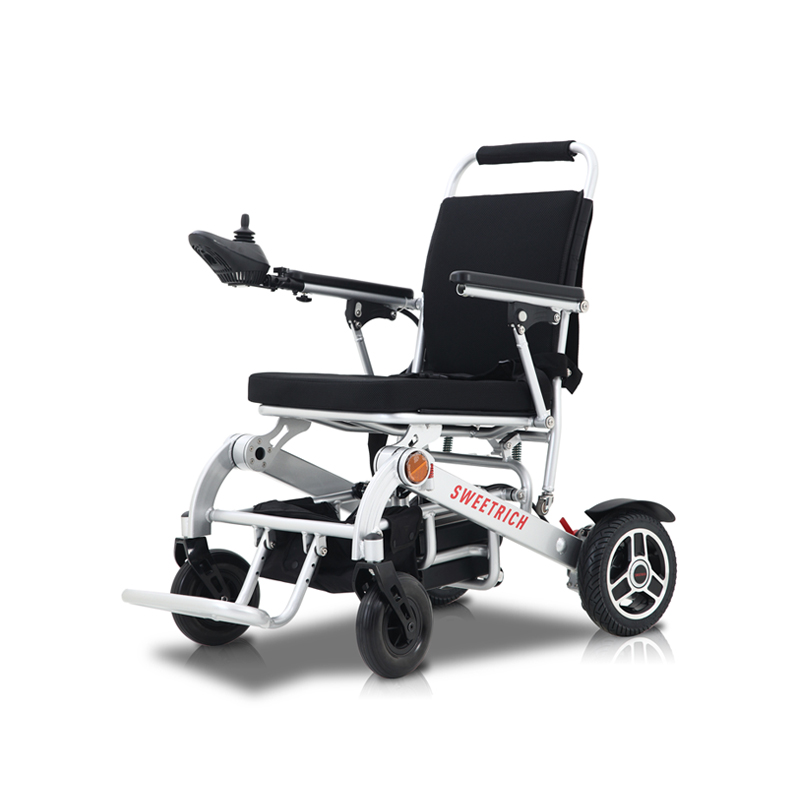
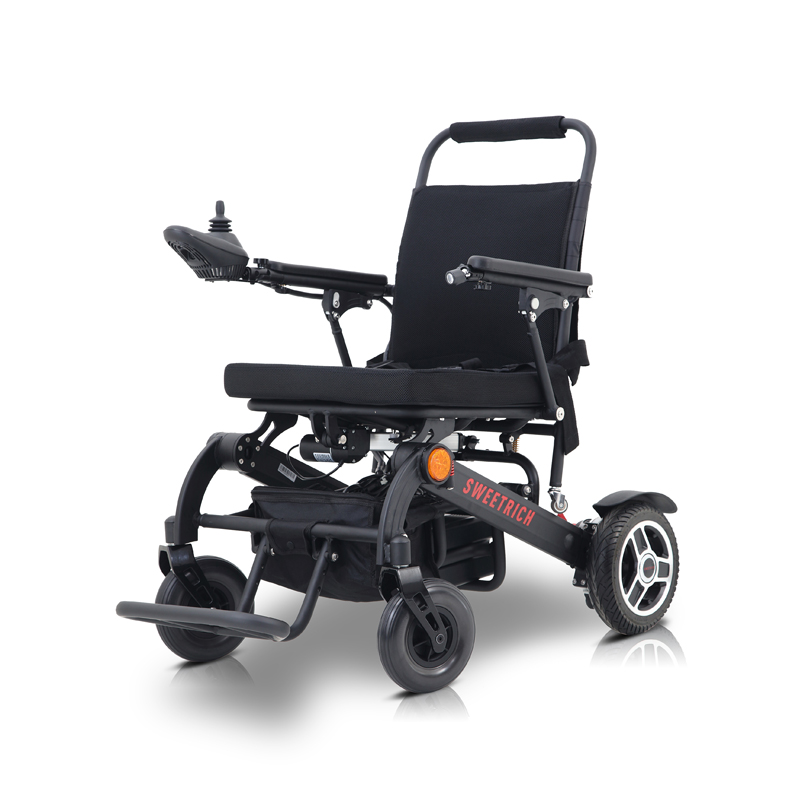
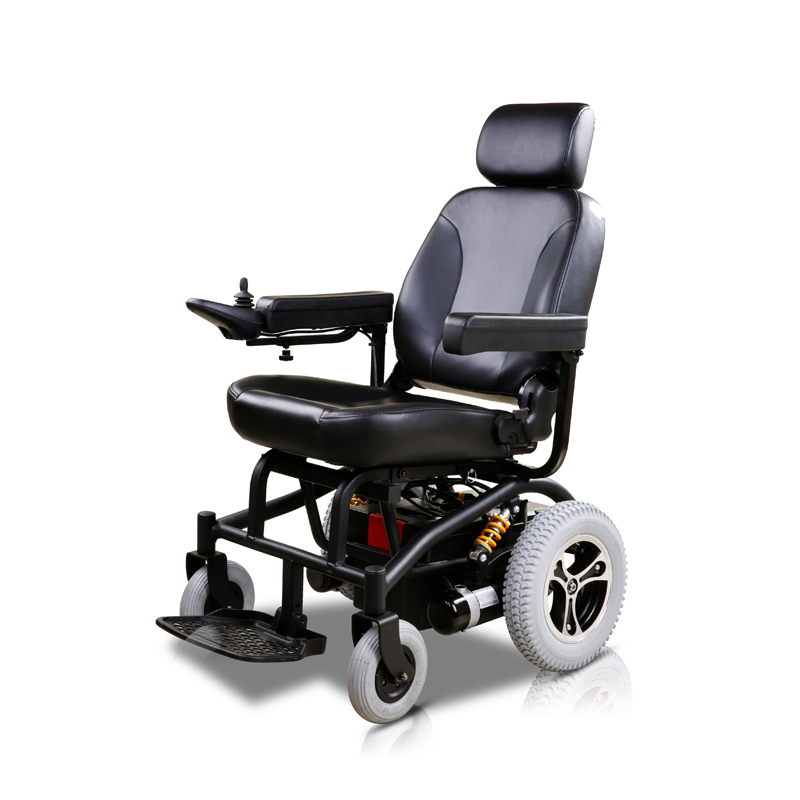
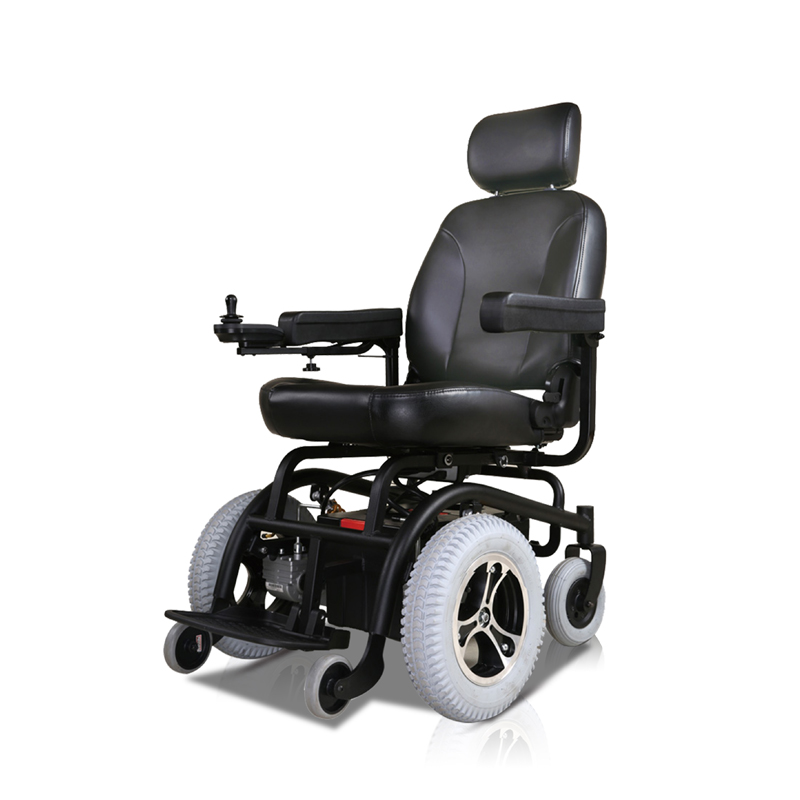
This heavy-duty foldable electric wheelchair is designed around the practical needs of users who require strong outdoor capability without giving up comfort or portability. Its overall dimensions are 980 mm in length, 600 mm in width, and 1180 mm in height. This size provides a stable footprint while remaining manageable for many residential and public environments. The width helps the chair maintain balance, while the height and seating arrangement support a comfortable riding posture.
A major feature is the front-wheel-drive configuration. Front-wheel drive is especially valuable in outdoor conditions because the powered wheels lead the movement, helping the chair pull itself forward over uneven surfaces. Combined with large 14-inch front pneumatic tires, this layout improves traction and helps the wheelchair handle surfaces that may be more challenging for small-wheel indoor chairs. The rear wheels measure 8 inches by 2.5 inches, contributing to stable tracking and balanced support.
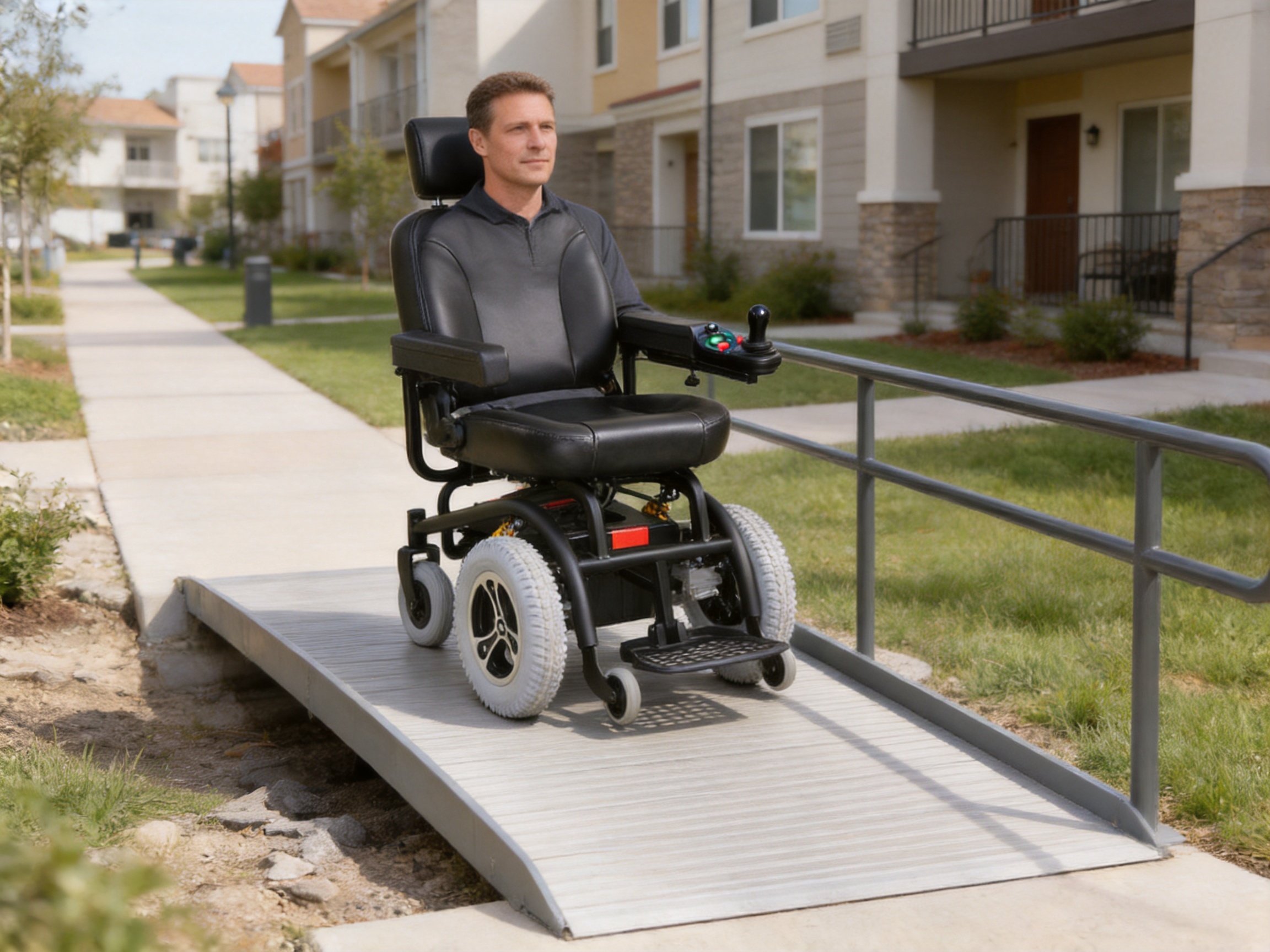
The chair is equipped with front suspension, rear suspension features, and anti-tip wheels. These elements are important for outdoor confidence. Pavement cracks, driveway transitions, ramps, small surface changes, and garden paths can produce vibration or instability in simpler models. Suspension helps absorb some of those shocks, while anti-tip wheels add a safety-oriented support system when the chair moves across uneven terrain or inclines.
Comfort is supported by a leather-like cushion seat and an adjustable seat back. A power wheelchair is often used for extended periods, so seating quality has a direct effect on user satisfaction. A supportive cushion, an adjustable back, and a stable frame can reduce fatigue during longer journeys. The user can travel for daily tasks or social activities with better posture and a more pleasant riding experience.
The power system uses two lead-acid 12V 40Ah batteries, forming a 24V battery configuration. The wheelchair is paired with a DC 24V 5A charger compatible with AC 115V to 230V input, making it suitable for multiple electrical environments. Charging time is approximately 6 to 8 hours, which is practical for overnight charging. With a driving range of 30 to 40 km, or approximately 19 to 25 miles, the model supports many daily mobility needs without constant recharging.
Key Technical Specifications
Item |
Specification |
User Benefit |
Dimensions |
980 mm × 600 mm × 1180 mm |
Stable size for outdoor use while remaining manageable for transport and storage. |
Maximum Forward Speed |
8 km/h, approximately 5 mph |
Supports practical daily travel at a controlled and comfortable pace. |
Maximum Driving Gradient |
10 degrees |
Helps users manage ramps and moderate slopes with confidence. |
Maximum Driving Range |
30 to 40 km, approximately 19 to 25 miles |
Provides strong range for errands, neighborhood travel, and daily outdoor movement. |
Weight Capacity |
120 kg, approximately 265 lb |
Supports a broad range of adult users. |
Suspension |
Front suspension with rear suspension features |
Improves ride comfort over uneven outdoor surfaces. |
Tire Sizes |
14 in × 3 in front, 8 in × 2.5 in rear |
Large front tires enhance traction, shock absorption, and outdoor stability. |
Brake System |
Electromagnetic brake |
Provides dependable stopping support and user control. |
Batteries |
Lead-acid 12V 40Ah × 2 |
Reliable energy storage for long daily driving range. |
Charger |
DC 24V 5A, AC 115V to 230V |
Convenient charging compatibility for different markets. |
Charging Time |
6 to 8 hours |
Suitable for overnight charging and daily use planning. |
Motor |
24V 320W × 2 |
Dual-motor power supports traction and consistent outdoor movement. |
Motor Controller |
24V 50A controller |
Helps deliver smooth speed response and controlled operation. |
Outdoor Mobility Designed Around Real Conditions
Outdoor wheelchair use is different from indoor movement. A chair used mainly inside a home or facility may only need to move across smooth floors, narrow corridors, and flat surfaces. Outdoor travel introduces more variables: pavement joints, mild slopes, gravelly patches, curbs near ramps, worn sidewalks, wet ground, and changes in surface texture. A heavy-duty outdoor-focused electric wheelchair must therefore emphasize stability, traction, shock absorption, braking control, and user comfort.
This model addresses those conditions through its front-wheel-drive system and tire selection. The 14-inch front pneumatic tires are one of its most important advantages over smaller-wheel competitors. Pneumatic tires provide cushioning because they contain air, allowing them to absorb some impact from the ground. This can make the ride feel smoother compared with solid tires on rough paths. The larger diameter also helps the front wheels roll over small obstacles more effectively, reducing the harshness of surface changes.
The front-wheel-drive layout gives the chair a pulling action. In many outdoor situations, powered front wheels can help the chair maintain direction and grip. This can be especially helpful when driving over uneven ground or beginning movement on a slight incline. While rear-wheel-drive and mid-wheel-drive chairs each have their strengths, front-wheel drive offers a strong combination of traction and obstacle approach for users who want outdoor dependability.
Suspension and anti-tip wheels also distinguish this model from basic powered wheelchairs. A low-cost power chair may have limited suspension or small wheels, causing more vibration to reach the user. Over time, vibration can create discomfort and reduce confidence. With suspension support, the user experiences less jarring movement. Anti-tip wheels provide an added layer of safety awareness, especially when the chair is used on ramps or uneven transitions.
The maximum gradient of 10 degrees is another practical advantage. Many daily environments include slopes, such as driveway entrances, accessible ramps, parking areas, and gentle hills. The ability to handle moderate gradients expands where the user can go. When combined with electromagnetic braking, the chair provides a stronger sense of control during starts, stops, and slope management.
Comfort as a Core Product Advantage
Comfort is not a luxury in mobility equipment. It is a central requirement because many users depend on their power wheelchair for long periods. The leather-like cushion seat gives this model a more supportive and pleasant seating experience than basic vinyl or thin-pad seats commonly found on entry-level chairs. A good cushion can help distribute pressure and support posture during longer rides.
The adjustable seat back is equally important. Users differ in height, posture, strength, and comfort preference. A fixed backrest may force some users into a position that is not ideal for them. An adjustable seat back allows more flexible support and helps improve the fit between the chair and the user. This adaptability is particularly valuable for seniors and users who may need to change their posture during the day.
The chair’s dimensions also contribute to comfort. With a width of 600 mm, it maintains a stable base while avoiding an overly bulky profile. Stability reduces the feeling of insecurity on outdoor surfaces. A chair that feels narrow or unstable can discourage users from traveling outside, even if the motor system is powerful. By providing a balanced structure, this model encourages users to move with greater confidence.
Ride comfort is further supported by the tire and suspension combination. Large pneumatic tires soften impact from small bumps, while suspension helps reduce vibration through the frame. Together, these features create a smoother riding feel, especially compared with chairs designed mainly for indoor floors. For users who enjoy neighborhood trips, outdoor markets, community centers, parks, or family visits, this difference can significantly improve daily quality of life.
Power System and Driving Performance
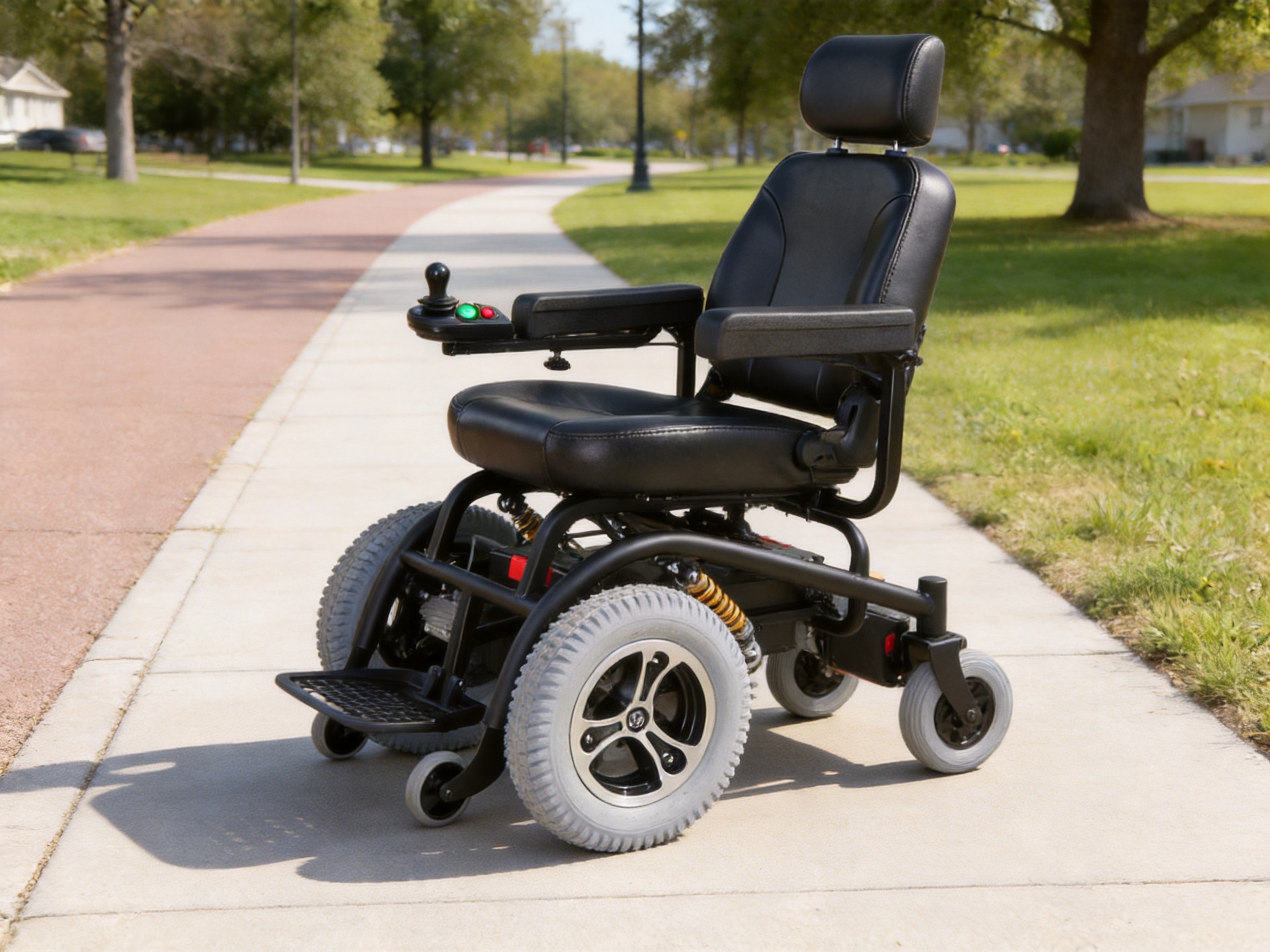
The performance of an electric wheelchair depends on the relationship between battery capacity, motor output, controller quality, tire traction, and frame design. This model uses two 24V 320W motors, providing dual-motor drive power. Dual motors are beneficial because each powered wheel can receive dedicated drive force, improving traction and response. For outdoor use, this helps the wheelchair maintain steady movement over varied surfaces.
The 24V 50A motor controller is an important part of the system. A controller manages how power is delivered from the batteries to the motors. Smooth controller behavior affects acceleration, turning response, deceleration, and overall drivability. A high-quality controller helps prevent sudden jerks and provides a more predictable driving experience. For elderly users or users with limited upper-body strength, smooth response can make the chair easier and safer to operate.
The maximum forward speed of 8 km/h is suitable for outdoor mobility. It is fast enough for practical travel yet controlled enough for safe operation in public spaces. Many users do not need excessive speed; they need dependable, predictable, comfortable movement. A speed around 5 mph can support neighborhood travel, shopping trips, and social visits while maintaining user control.
The driving range of 30 to 40 km is one of the model’s strongest advantages. Range anxiety is a real concern for power wheelchair users. A short-range chair can limit independence because users must constantly plan around battery life. With approximately 19 to 25 miles of range, this chair can handle many daily routines on a single charge, depending on user weight, terrain, temperature, battery condition, and driving style. This gives users greater freedom and reduces the need for frequent charging interruptions.
The lead-acid battery system is familiar, proven, and widely understood in mobility equipment. While lithium batteries are often lighter, lead-acid batteries can provide stable performance and are commonly used in heavier-duty applications. For users and distributors who prioritize established technology, predictable charging behavior, and service familiarity, lead-acid batteries remain a practical choice.
The charger supports AC 115V to 230V input, making it adaptable for different power supply environments. Charging time of 6 to 8 hours is convenient for overnight use. A user can complete daily travel, plug in the chair at night, and begin the next day with a full battery. This rhythm is important because mobility equipment should fit naturally into daily life rather than create complicated routines.
Safety-Oriented Features
Safety is central to the design of any powered mobility product. This wheelchair uses an electromagnetic brake system, which is widely valued in electric mobility equipment. Electromagnetic brakes are designed to engage when power is reduced or the chair stops, helping prevent unwanted movement. This is especially important on slopes, ramps, or during transfers.
The anti-tip wheels provide additional support against backward instability. Outdoor environments can include sudden changes in angle or traction. Anti-tip support does not replace careful driving, but it can reduce risk and improve confidence. Users and caregivers often look for this feature when choosing a chair for outdoor travel.
The frame size and wheel arrangement also support stability. Large front tires, rear support wheels, and a balanced base help the chair remain steady. A 120 kg weight capacity makes the chair suitable for many adult users while maintaining a defined performance range. Staying within the recommended capacity is important because it helps preserve braking effectiveness, range, tire performance, and motor life.
Controlled speed is another safety factor. Some competitors may promote higher top speeds, but higher speed is not always better for users who value control. An 8 km/h maximum forward speed offers a practical balance. It allows the user to travel efficiently while still operating at a pace appropriate for shared public spaces and outdoor pedestrian environments.
The adjustable seat back can also contribute to safety by improving posture and seated stability. A user who sits securely is better able to operate the joystick or control interface, respond to surface changes, and maintain balance. Comfort and safety often work together in mobility design.
Foldability and Transport Convenience
A heavy-duty electric wheelchair must be strong, but strength alone is not enough. Many users also need the chair to fit into transport routines, storage spaces, or home environments. Foldability gives this model an important advantage over rigid-frame outdoor power chairs. A foldable design can make storage easier and may support transport in suitable vehicles, depending on lifting equipment, available space, and user assistance.
For families and caregivers, foldability can reduce the practical barriers of using a power wheelchair outside the home. A non-folding chair may require specialized transport equipment or larger vehicles. A foldable model offers more flexibility. While users should always confirm weight, dimensions, and lifting requirements before transport, the folding function adds convenience for travel planning.
Foldability also helps in residential spaces. Some homes have limited storage areas. A foldable chair can be placed more conveniently when not in use. This is especially useful for users who alternate between different mobility devices or who need to store the chair in a garage, entryway, or vehicle-access area.
Compared with lighter travel chairs, this model offers more outdoor capability. Compared with large non-folding heavy-duty power chairs, it offers improved storage flexibility. This middle position is one of its competitive advantages: it provides robust outdoor performance while still addressing portability needs.
Advantages Over Common Competitors
The electric wheelchair market includes many product types, from compact indoor chairs to large complex rehabilitation power chairs and mobility scooters. This model stands out because it balances outdoor strength, comfort, range, and foldable practicality. Its advantages become clear when compared with common alternatives.
Compared with basic indoor power wheelchairs, this model offers larger pneumatic front tires, suspension, anti-tip wheels, and a stronger outdoor profile. Indoor chairs often use smaller wheels and minimal suspension, making them less comfortable on rough paths. Users who want to go beyond smooth indoor flooring benefit from the stronger tire and suspension system.
Compared with lightweight travel power chairs, this model provides a more substantial driving system and longer range. Many travel chairs are designed mainly for airports, shopping malls, and indoor surfaces. They may fold easily, but they can have smaller batteries, smaller tires, and reduced comfort. This heavy-duty model is better suited for users who prioritize outdoor stability and daily range over ultra-lightweight design.
Compared with mobility scooters, this electric wheelchair offers a seated wheelchair-style format and front-wheel-drive maneuvering. Scooters are useful for many users, but they require steering tillers and a different seating posture. Some users prefer a power wheelchair because it can feel more compact in turning behavior and may be easier to operate with a joystick-style control system. The wheelchair format can also be more suitable for users with limited arm reach or reduced ability to steer a scooter tiller.
Compared with rigid heavy outdoor power chairs, this model’s foldability is a major benefit. Large rigid chairs can be powerful but difficult to transport or store. The foldable feature adds a layer of convenience while keeping strong outdoor elements such as large tires, suspension, and dual motors.
The driving range of 30 to 40 km also gives it a competitive edge. In real use, range can determine whether a user feels confident leaving home. A chair with limited range may be technically functional but psychologically restrictive. This model allows broader daily planning and supports a more independent lifestyle.
Manufacturing Strength Behind the Product
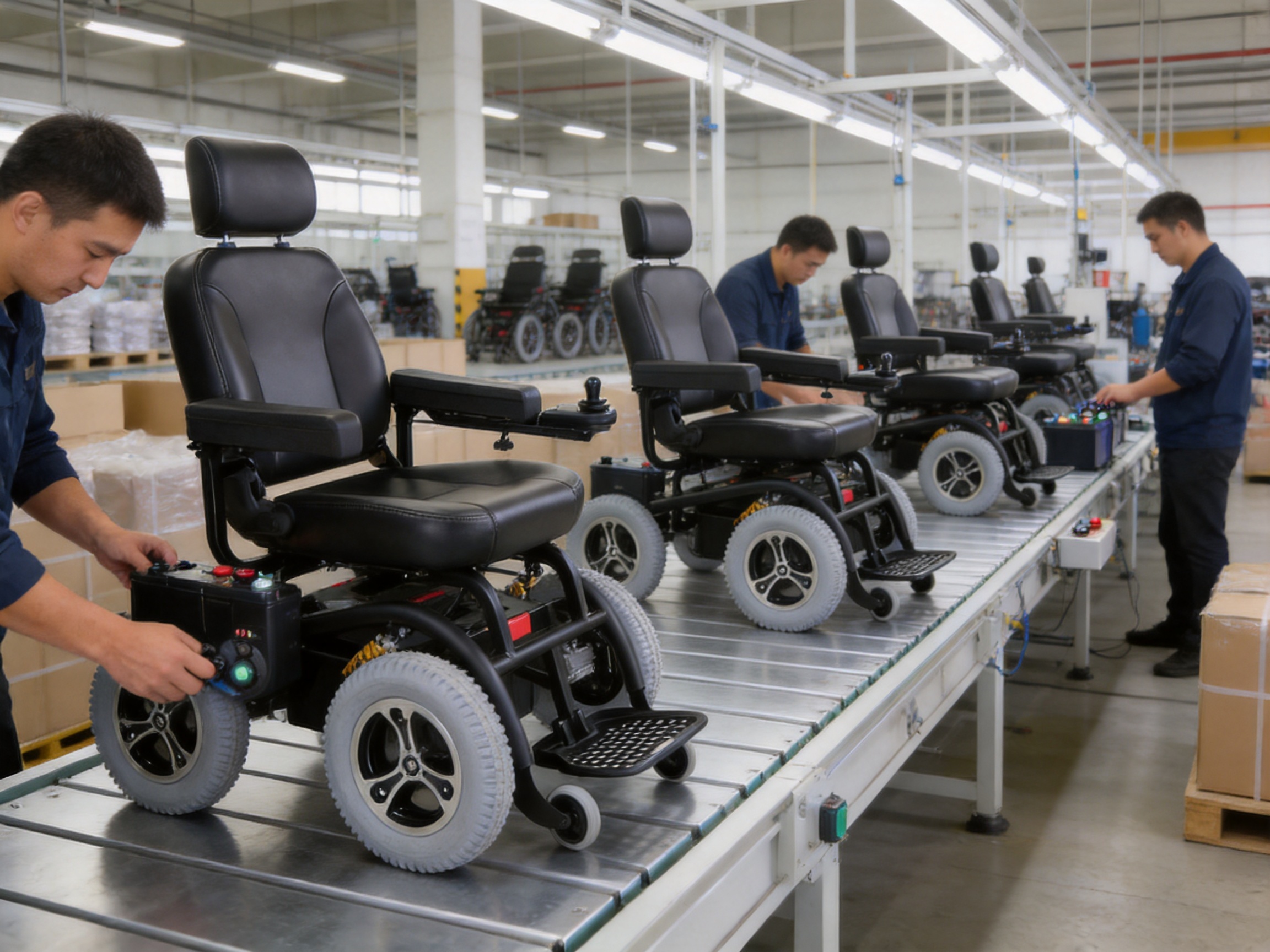
The quality of a power wheelchair is not determined only by its specification sheet. It depends on manufacturing discipline, component selection, assembly accuracy, testing, design experience, and after-sales awareness. Sweetrich Mobility has developed its capabilities through more than ten years of work in mobility scooters and power wheelchairs. Established in 2011 and located in Suzhou Industrial Zone, Jiangsu, China, the company operates from a factory area of approximately 30,000 square meters within a larger industrial site.
This manufacturing background matters because mobility products require consistent quality. A power wheelchair is used in daily life, often by users who depend on it for independence. The frame must be strong, the electrical system must be stable, the seating must be reliable, the brake must operate correctly, and the control system must respond predictably. These requirements demand organized production processes rather than simple assembly.
The company’s experience in research, development, and production allows it to integrate user needs with engineering decisions. Product design is not only about appearance. It includes frame geometry, motor placement, battery layout, suspension arrangement, tire selection, controller matching, wiring safety, service access, and packaging. A manufacturer with long-term focus in this field is better able to refine these details.
Advanced manufacturing strength also includes supplier management. The model uses motors identified as Taiwan-sourced and a controller identified as from the United Kingdom. Component sourcing of this kind reflects a focus on performance-critical parts. The motor and controller are central to driving quality, so selecting reliable components helps improve user experience and product consistency.
Production management is another strength. Strict production control helps ensure that each unit is assembled according to defined standards. For mobility equipment, small assembly differences can affect braking, wheel alignment, vibration, noise, or battery connection stability. A systematic factory process reduces these risks and supports repeatable quality across production batches.
The company’s export experience is also relevant. Products are supplied to markets including America, Europe, Japan, Australia, the Middle East, Russia, and other regions. Exporting mobility equipment requires attention to customer expectations, documentation, packaging, shipment durability, and market-specific product positioning. Experience across regions helps the manufacturer understand different user preferences, road conditions, and distributor requirements.
Research and Development Focus
A strong mobility manufacturer must continuously improve design. Users’ expectations are changing: they want safer movement, better range, better comfort, more attractive styling, simpler charging, and easier transport. Research and development work helps transform those needs into practical products. In this model, the combination of heavy-duty outdoor performance and foldable convenience shows the value of design integration.
The company owns intellectual property rights for its electric scooters and power wheelchairs. Intellectual property ownership suggests that product design is not merely copied or assembled from generic parts. It indicates ongoing engineering input and a commitment to developing proprietary solutions. For distributors and buyers, this can be important because original design capability often supports better customization, product updates, and technical support.
The manufacturer’s design philosophy focuses on improving well-being and convenience for elderly and disabled users. This mission is reflected in the product’s practical features. The chair is not overloaded with unnecessary complexity; instead, it emphasizes the elements that users feel every day: range, stability, traction, seating comfort, braking, and manageable charging.
R&D also influences how components work together. A powerful motor alone does not guarantee a good wheelchair. If the controller is poorly matched, acceleration can be rough. If the frame is not properly balanced, the chair may feel unstable. If the tire selection is wrong, outdoor comfort suffers. A well-developed product is a system in which every part supports the others.
The result is a chair that competes through balanced performance rather than a single feature. Its speed, range, tire size, suspension, braking, and comfort features align with the expectations of outdoor users. That systems-based approach is one reason it can stand out in a crowded mobility market.
Production Quality and Process Control
Manufacturing a dependable electric wheelchair involves multiple stages. These may include raw material inspection, frame fabrication, surface treatment, component preparation, wiring, motor installation, battery installation, controller matching, brake testing, seat assembly, wheel alignment, functional inspection, charging verification, final quality control, and packaging. Each stage influences the final user experience.
Frame strength is especially important in a heavy-duty wheelchair. The frame must support user weight, battery weight, motor torque, and repeated vibration from outdoor surfaces. Good welding, accurate alignment, and proper surface finishing help extend product life and maintain structural reliability. A factory with dedicated production space and mobility-product experience is better positioned to manage these processes.
Electrical assembly is another critical area. Wiring must be secure and protected from vibration. Battery connectors must be correctly installed. Controller connections must be stable. A loose or poorly protected electrical connection can create service issues, especially in equipment used outdoors. Process control reduces such risks.
Brake system testing is essential. The electromagnetic brake must engage and release correctly. It should provide dependable stopping behavior and support safe parking. Quality inspection helps confirm that braking performance meets the product’s intended use.
Drive testing is also important. The wheelchair should accelerate smoothly, turn predictably, and respond correctly to control inputs. Testing can identify issues in motor behavior, controller calibration, wheel alignment, or tire installation. For users, these details translate into confidence and comfort.
Packaging is another part of quality. Mobility products often travel long distances before reaching users or distributors. Proper packaging helps protect the frame, tires, seat, batteries, and controls during shipment. A manufacturer with export experience understands that delivery condition is part of product quality.
User-Centered Design for Seniors and Mobility-Limited Users
The core users for this type of wheelchair often include seniors, people with limited walking endurance, individuals recovering mobility confidence, and users who need powered assistance for outdoor movement. These users may have different physical abilities, but they share a need for dependable mobility that does not feel intimidating.
The chair’s controlled speed supports this need. It is fast enough for outdoor travel but not excessively aggressive. Smooth controller performance and electromagnetic braking support predictable operation. Large tires and suspension reduce the discomfort that can discourage outdoor activity.
The 120 kg capacity provides practical support for many users. Capacity should always be considered together with terrain and driving habits, but the specification places the chair in a useful range for adult mobility support. The wide and stable design helps users feel secure while seated.
Comfort details matter for seniors. The leather-like cushion seat is easier to appreciate during daily use than many technical specifications. A user may not think about motor wattage every day, but they will notice whether the seat feels supportive and whether the ride feels harsh. This model’s comfort-oriented features help make mobility more pleasant.
Independence is another user-centered benefit. A long driving range means users can plan more activities. They can visit neighbors, move through community spaces, go shopping, or enjoy outdoor time with less worry about battery depletion. Mobility is not only transportation; it is participation in daily life.
Applications and Suitable Use Scenarios
This heavy-duty foldable electric wheelchair is well suited for neighborhood travel. Users can move along sidewalks, visit local shops, reach community areas, or enjoy short recreational outings. The large front pneumatic tires and suspension make these trips more comfortable than they would be in a basic indoor chair.
It is also useful for family outings. Foldability can help when arranging transportation, and the long range supports extended use during the day. Families who want to include elderly or mobility-limited members in outdoor activities may find this type of chair especially practical.
The chair can support users in residential communities, retirement areas, parks with accessible paths, large campuses, and public facilities with ramps. Its 10-degree gradient capability provides support for moderate slopes, though users should always operate carefully and avoid unsafe terrain.
It is important to understand that this product is positioned as a non-medical device for the U.S. market. Users should select mobility equipment according to their own needs, local regulations, and professional guidance when necessary. The chair is designed for mobility support, comfort, and independence, but it should be used responsibly and within its stated specifications.
For distributors, this model can fill a valuable product category. It offers more outdoor capability than lightweight travel chairs while being more flexible than rigid heavy-duty power wheelchairs. It can appeal to customers who want durability, range, and comfort without moving into highly complex or specialized equipment.
Maintenance and Practical Ownership
Ownership experience is an important part of product value. A mobility product should not only perform well when new; it should also be manageable over time. The use of lead-acid batteries provides a familiar maintenance and replacement pathway in many markets. Users should charge the batteries regularly, avoid deep discharge when possible, and follow charging instructions to support battery life.
The 6 to 8 hour charging time supports daily routines. A common practice is to charge the wheelchair overnight after use. Users should keep the charger in a dry, safe area and ensure connections are secure. Because the charger supports a wide AC input range, it is practical for different electrical environments, but users should always use the supplied or approved charger.
Pneumatic tires improve ride comfort but require periodic air pressure checks. This is a normal trade-off. Solid tires may require less air maintenance, but pneumatic tires often provide a smoother ride. Users should inspect tires for wear, punctures, and proper inflation. Correct tire pressure can affect range, steering, comfort, and motor load.
Suspension and anti-tip wheels should also be inspected periodically. Outdoor use exposes the chair to vibration and dust, so routine checks help maintain performance. Caregivers or service providers should look for loose fasteners, unusual noises, or changes in ride feel.
Keeping the chair clean can extend its service life. The frame, wheels, seat, and control area should be wiped down as needed. The chair should not be exposed to deep water or harsh conditions beyond intended use. Electrical mobility products should be protected from unnecessary moisture, impact, and extreme storage conditions.
Good maintenance strengthens the product’s advantages. The motors, controller, tires, batteries, and brake system all perform best when the chair is used and cared for properly. Manufacturers and distributors can support customers by providing clear instructions and service guidance.
Why This Model Is a Strong Choice for Dealers and Buyers
For individual buyers, the strongest reasons to consider this electric wheelchair are outdoor comfort, dependable range, stable front-wheel-drive performance, safety-oriented braking, and foldable convenience. It is designed for people who want more freedom outside the home and who need a chair that can handle daily practical conditions.
For dealers, the product offers a clear market position. It is not simply another compact power chair. Its large pneumatic tires, suspension, dual motors, 30 to 40 km range, and heavy-duty structure allow it to be presented as an outdoor-capable foldable power wheelchair. This makes it easier to explain to customers who are comparing different mobility options.
The manufacturing background adds confidence for business buyers. A company with a 30,000-square-meter factory, more than a decade of industry experience, and exports to multiple regions has the operational foundation needed for long-term cooperation. Distributors often need more than a product; they need consistent supply, quality control, communication, and reasonable pricing. The manufacturer’s stated principles of quality first, credit, and customer focus align with those needs.
The model’s component choices also support dealer confidence. Dual 320W motors, a 50A controller, electromagnetic braking, and a proven lead-acid battery configuration make the product understandable for service teams and customers. Clear specifications help dealers match the chair to the right users and reduce incorrect expectations.
In a market where many products look similar online, real differentiation comes from practical features. Larger tires, suspension, range, braking, comfort, and foldability are easy for customers to understand. These are not abstract claims; they directly affect the daily riding experience.
Company Strength and Global Cooperation
Sweetrich Mobility has built its business around mobility scooters and power wheelchairs, with a focus on supporting elderly and disabled users. The company’s location in Suzhou Industrial Zone gives it access to industrial resources, skilled production networks, and export logistics. Its long-term presence in the mobility field supports both product development and customer service.
The company’s products are exported to America, Europe, Japan, Australia, the Middle East, Russia, and other markets. This global reach demonstrates adaptability. Different markets have different expectations for comfort, safety, documentation, packaging, and after-sales support. A manufacturer that serves many regions gains valuable feedback, which can be used to improve future products.
Another strength is the company’s integrated approach to product design and manufacturing. Because it focuses specifically on mobility products, it can refine designs based on practical user needs. This is different from general manufacturers that may produce unrelated products without deep category knowledge. Specialization helps improve product relevance.
The company’s mission emphasizes independence and dignity for users. In mobility equipment, this mission is meaningful. A well-designed electric wheelchair can help users leave home more often, reduce reliance on others, and participate more fully in family and community life. Manufacturing quality becomes a human-centered responsibility, not just an industrial target.
Reasonable prices and considerate service are also part of the company’s value proposition. Mobility products must be reliable, but they also need to be accessible. A manufacturer that balances quality and cost can support distributors and end users more effectively.
Q&A Section
What type of user is this electric wheelchair designed for?
It is designed for users who need a sturdy powered wheelchair for outdoor mobility, daily errands, neighborhood travel, and comfortable movement across varied surfaces. It is especially suitable for seniors and people with mobility limitations who want a stable, long-range, foldable electric wheelchair.
Is this product intended as a medical device?
The product is positioned as a non-medical device for the U.S. market. Users should choose mobility equipment according to personal needs, applicable regulations, and professional advice when appropriate.
What makes the front-wheel-drive design useful?
Front-wheel drive helps the chair pull forward with strong traction, especially on outdoor surfaces. Combined with large 14-inch pneumatic front tires, it improves confidence when traveling across pavement changes, mild uneven ground, and moderate slopes.
How far can the wheelchair travel on one charge?
The maximum driving range is approximately 30 to 40 km, or 19 to 25 miles. Actual range depends on user weight, terrain, tire pressure, battery condition, temperature, slope, and driving style.
How fast can it travel?
The maximum forward speed is 8 km/h, approximately 5 mph. This speed provides a practical balance between efficient travel and controlled operation.
What is the maximum user weight capacity?
The wheelchair supports up to 120 kg, approximately 265 lb. Users should remain within the specified capacity to maintain safe and reliable performance.
Why are pneumatic tires an advantage?
Pneumatic tires contain air, which helps absorb vibration and impact from uneven surfaces. They usually provide a smoother outdoor ride than small solid tires, though they require periodic air pressure checks.
What braking system does the chair use?
It uses an electromagnetic brake system. This type of brake supports dependable stopping and helps prevent unwanted movement when the chair is stopped or powered down.
How long does charging take?
Charging time is approximately 6 to 8 hours. This makes overnight charging practical for daily use.
What type of batteries does it use?
The wheelchair uses two 12V 40Ah lead-acid batteries, forming a 24V system. Lead-acid batteries are widely used in mobility equipment and are familiar to many service providers.
How does this model compare with lightweight travel power chairs?
Lightweight travel chairs may be easier to lift, but they often have smaller wheels, shorter range, and less outdoor comfort. This model provides stronger outdoor capability, longer range, suspension, and larger tires while still offering foldable convenience.
How does it compare with mobility scooters?
Mobility scooters use a tiller steering design and may require different upper-body movement. This electric wheelchair offers a wheelchair-style seating and driving format, which some users may find easier or more suitable.
Why is the manufacturer’s experience important?
Electric wheelchairs require reliable frames, electrical systems, brakes, motors, controllers, and seating. A manufacturer with more than ten years of experience, dedicated production facilities, and export knowledge is better able to maintain consistent quality and support long-term cooperation.
Conclusion
This heavy-duty foldable front-wheel-drive electric wheelchair is a strong mobility solution for users who value outdoor stability, long range, comfort, and practical transport flexibility. Its large pneumatic front tires, suspension, anti-tip wheels, electromagnetic brake system, dual motors, adjustable seat back, and leather-like cushion seat combine to create a product that is more capable than basic indoor power chairs and more comfortable for outdoor use than many lightweight travel models.
The technical configuration supports real daily independence. A maximum speed of 8 km/h, a range of 30 to 40 km, a 10-degree gradient capability, and a 120 kg capacity make the chair suitable for many common mobility scenarios. The 24V electrical system, two 320W motors, 50A controller, and lead-acid battery setup provide a practical and proven performance foundation.
Its competitive advantage is not based on one feature alone. Instead, it comes from the combination of traction, comfort, safety, range, and foldability. This balance makes the chair appealing to end users, caregivers, families, and distributors seeking a reliable outdoor-capable mobility product.
The manufacturing strength behind the chair further increases its value. Sweetrich Mobility’s experience in mobility scooters and power wheelchairs, its factory scale, research and development capability, production management, and global export experience support consistent product quality. For users, this means greater confidence. For dealers, it means a more dependable supply partner. For the mobility market, it represents a practical solution designed around independence, dignity, and everyday freedom.
References
1. Cooper, R. A. Rehabilitation Engineering Applied to Mobility and Manipulation. Institute of Physics Publishing.
2. International Organization for Standardization. Wheelchairs: Requirements and Test Methods for Electric Wheelchairs and Scooters.
3. Batavia, M. The Wheelchair Evaluation: A Practical Guide. Jones and Bartlett Publishers.
4. RESNA. Assistive Technology Standards and Mobility Device Guidance Materials.
5. Cook, A. M., and Polgar, J. M. Assistive Technologies: Principles and Practice. Elsevier.
6. U.S. Access Board. Accessibility Guidelines for Pedestrian Facilities and Mobility Access Planning.